Dalla Lana School of Public Health, University of Torontogrid.17063.33, Toronto, Ontario, Canada.
Centre for Immunization Readiness, Public Health Agency of Canada, Ottawa, Ontario, Canada.
Microbiol Spectr. 2022 Feb 23;10(1):e0256321. doi: 10.1128/spectrum.02563-21.
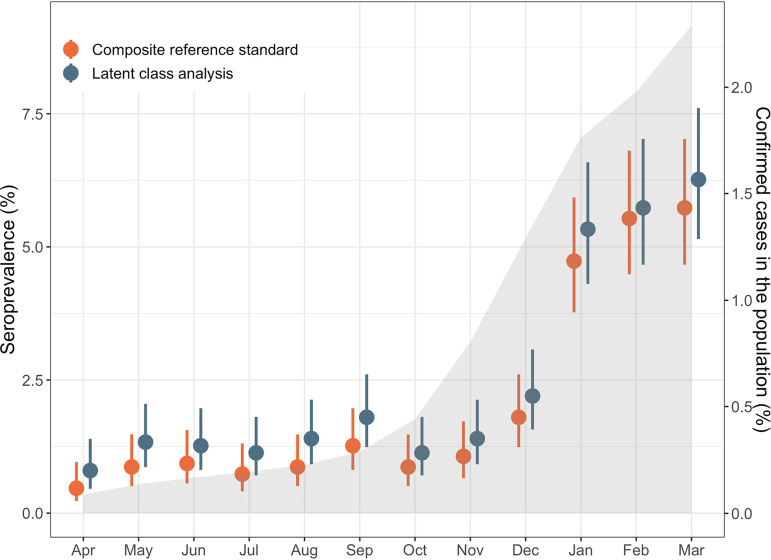
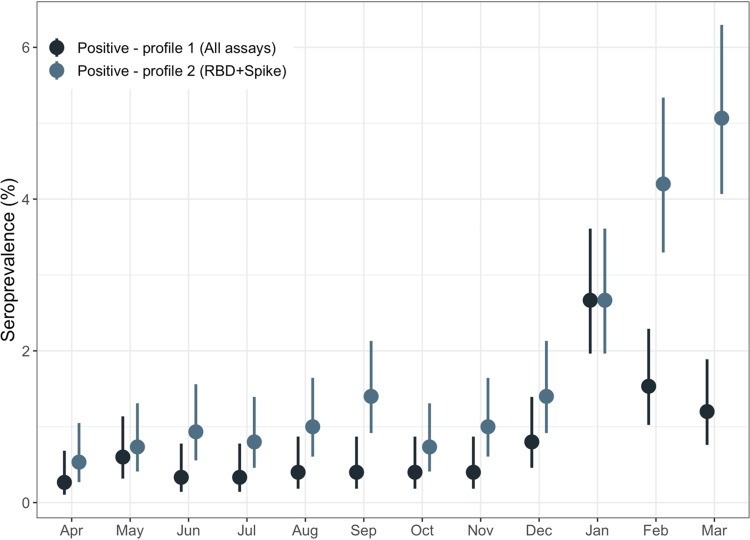
We have previously used composite reference standards and latent class analysis (LCA) to evaluate the performance of laboratory assays in the presence of tarnished gold standards. Here, we apply these techniques to repeated, cross-sectional study of Canadian blood donors, whose sera underwent parallel testing with four separate SARS-CoV-2 antibody assays. We designed a repeated cross-sectional design with random cross-sectional sampling of all available retention samples ( = 1500/month) for a 12 -month period from April 2020 until March 2021. Each sample was evaluated for SARS-CoV-2 IgG antibodies using four assays an Abbott Architect assay targeting the nucleocapsid antigen (Abbott-NP, Abbott, Chicago IL) and three in-house IgG ELISAs recognizing distinct recombinant viral antigens: full-length spike glycoprotein (Spike), spike glycoprotein receptor binding domain (RBD) and nucleocapsid (NP). We used two analytic approaches to estimate SAR-CoV-2 seroprevalence: a composite reference standard and LCA. Using LCA to estimate true seropositivity status based on the results of the four antibody tests, we estimated that seroprevalence increased from 0.8% (95% CI: 0.5-1.4%) in April 2020 to 6.3% (95% CI: 5.1-7.6%) in March 2021. Our study provides further support for the use of LCA in upcoming public health crises, epidemics, and pandemics when a gold standard assay may not be available or identifiable. Here, we describe an approach to estimating seroprevalence in a low prevalence setting when multiple assays are available and yet no known gold standard exists. Because serological studies identify cases through both diagnostic testing and surveillance, and otherwise silent, unrecognized infections, serological data can be used to estimate the true infection fatality ratio of a disease. However, seroprevalence studies rely on assays with imperfect sensitivity and specificity. Seroreversion (loss of antibody response) also occurs over time, and with the advent of vaccination, distinction of antibody response resulting from vaccination as opposed to antibody response due to infection has posed an additional challenge. Our approach indicates that seroprevalence on Canadian blood donors by the end of March 2021was less than 10%. Our study supports the use of latent class analysis in upcoming public health crises, epidemics, and pandemics when a gold standard assay may not be available or identifiable.
我们之前使用复合参考标准和潜在类别分析(LCA)来评估在有玷污的金标准存在的情况下实验室检测的性能。在这里,我们将这些技术应用于对加拿大献血者的重复、横断面研究,他们的血清使用四种单独的 SARS-CoV-2 抗体检测进行平行检测。我们设计了一种重复的横断面设计,对 2020 年 4 月至 2021 年 3 月期间的所有可用保留样本进行随机横断面抽样(每月 = 1500)。每个样本都使用四种检测方法评估 SARS-CoV-2 IgG 抗体,包括 Abbott 公司针对核衣壳抗原的 Architect 检测(Abbott-NP,Abbott,芝加哥 IL)和三种识别独特重组病毒抗原的内部 IgG ELISA:全长刺突糖蛋白(Spike)、刺突糖蛋白受体结合域(RBD)和核衣壳(NP)。我们使用两种分析方法来估计 SAR-CoV-2 血清阳性率:复合参考标准和 LCA。使用 LCA 根据四种抗体检测结果来估计真实的血清阳性状态,我们估计血清阳性率从 2020 年 4 月的 0.8%(95%CI:0.5-1.4%)增加到 2021 年 3 月的 6.3%(95%CI:5.1-7.6%)。我们的研究进一步支持在即将到来的公共卫生危机、流行病和大流行中使用 LCA,因为可能无法获得或识别金标准检测。在这里,我们描述了一种在存在多种检测方法且不存在已知金标准的低流行环境中估计血清阳性率的方法。由于血清学研究通过诊断检测和监测来识别病例,并且还识别出未被识别的无症状感染,因此血清学数据可用于估计疾病的真实感染致死率。然而,血清阳性率研究依赖于敏感性和特异性存在缺陷的检测。抗体反应也会随着时间的推移而逆转,随着疫苗接种的出现,区分疫苗接种引起的抗体反应与感染引起的抗体反应提出了额外的挑战。我们的方法表明,到 2021 年 3 月底,加拿大献血者的血清阳性率低于 10%。我们的研究支持在即将到来的公共卫生危机、流行病和大流行中使用潜在类别分析,因为可能无法获得或识别金标准检测。