University of California, Irvine School of Medicine, Medical Education, Irvine, CA, USA.
Department of Pediatrics, School of Medicine and School of Health Professions, Baylor College of Medicine, Houston, TX, USA .
J Educ Eval Health Prof. 2024;21:15. doi: 10.3352/jeehp.2024.21.15. Epub 2024 Jun 13.
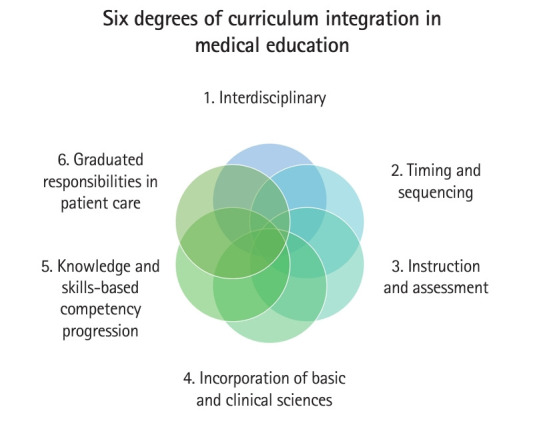
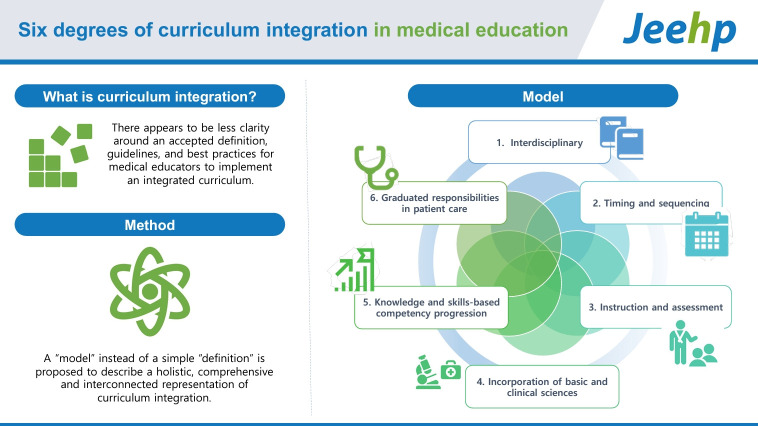
Despite explicit expectations and accreditation requirements for integrated curriculum, there needs to be more clarity around an accepted common definition, best practices for implementation, and criteria for successful curriculum integration. To address the lack of consensus surrounding integration, we reviewed the literature and herein propose a definition for curriculum integration for the medical education audience. We further believe that medical education is ready to move beyond “horizontal” (1-dimensional) and “vertical” (2-dimensional) integration and propose a model of “6 degrees of curriculum integration” to expand the 2-dimensional concept for future designs of medical education programs and best prepare learners to meet the needs of patients. These 6 degrees include: interdisciplinary, timing and sequencing, instruction and assessment, incorporation of basic and clinical sciences, knowledge and skills-based competency progression, and graduated responsibilities in patient care. We encourage medical educators to look beyond 2-dimensional integration to this holistic and interconnected representation of curriculum integration.
尽管对综合课程有明确的期望和认证要求,但在可接受的通用定义、实施的最佳实践以及课程整合成功的标准方面,仍需要更加清晰。为了解决整合缺乏共识的问题,我们回顾了文献,并在此为医学教育受众提出了课程整合的定义。我们进一步认为,医学教育已经准备好超越“横向”(一维)和“纵向”(二维)的整合,并提出了“6 度课程整合”模型,以扩展二维概念,为未来的医学教育项目设计做好准备,并使学习者更好地满足患者的需求。这 6 个维度包括:跨学科、时间和顺序、教学和评估、基础和临床科学的结合、知识和技能为基础的能力发展,以及在患者护理方面的逐步责任。我们鼓励医学教育者超越二维整合,关注课程整合的这种整体和相互关联的表现形式。