
对候选疫苗抗原的血清学反应表明,[原文此处缺失关键信息]是下肢蜂窝织炎的主要病因。
Serological Responses to Vaccine Candidate Antigens Suggests That Is the Predominant Cause of Lower Limb Cellulitis.
作者信息
Taggart Michael, Langworthy Kristyn, Hui Siong, Boyder Conchita, Fulurija Alma, Morici Michael, Raby Edward, Manning Laurens
机构信息
Department of Infectious Diseases, Fiona Stanley Fremantle Hospitals Group, Murdoch Western Australia, Australia.
Department of Microbiology, PathWest Laboratory Medicine, Fiona Stanley Hospital, Murdoch, Western Australia, Australia.
出版信息
Open Forum Infect Dis. 2024 Jun 11;11(6):ofae272. doi: 10.1093/ofid/ofae272. eCollection 2024 Jun.
BACKGROUND
A future (Strep A) vaccine will ideally prevent a significant burden of lower limb cellulitis; however, natural immune responses to proposed vaccine antigens following an episode of cellulitis remain uncharacterized.
METHODS
We enrolled 63 patients with cellulitis and 26 with invasive beta hemolytic streptococci infection, using a multiplexed assay to measure immunoglobulin G against Strep A vaccine candidate antigens, including: streptolysin O (SLO), deoxyribonuclease B (DNB), group A carbohydrate (GAC), C5a peptidase (ScpA), cell envelope proteinase (SpyCEP), and adhesion and division protein (SpyAD). Responses in the invasive cohort were used to predict the infecting etiology in the cellulitis cohort.
RESULTS
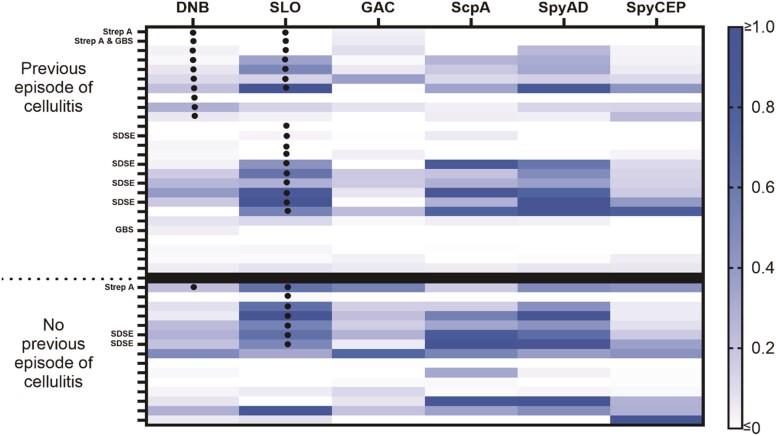
Of 41 patients with cellulitis and paired serological samples, 68.3% had evidence of beta hemolytic streptococci infection by conventional anti-SLO and/or anti-DNB criteria. A positive serological response to at least 1 of the tested antigens was seen in 78.0% of the cellulitis cohort. Individually, anti-SLO (58.5%), anti-SpyAD (46.3%), and anti-ScpA (39.0%) were the most common. Based on principal component analysis, increases in these 3 antibodies, without responses to DNB, GAC, and SpyCEP characterized (SDSE) infection.
CONCLUSIONS
SDSE appears to be the predominant cause of lower limb cellulitis. Effective Strep A vaccines incorporating antigens that provide additional cross protection against SDSE may prevent a significant burden of lower limb cellulitis.
背景
未来的A群链球菌疫苗理想情况下应能预防下肢蜂窝织炎的重大负担;然而,蜂窝织炎发作后对拟用疫苗抗原的天然免疫反应仍未得到充分描述。
方法
我们招募了63例蜂窝织炎患者和26例侵袭性β溶血性链球菌感染患者,采用多重检测法测量针对A群链球菌候选疫苗抗原的免疫球蛋白G,这些抗原包括:链球菌溶血素O(SLO)、脱氧核糖核酸酶B(DNB)、A群碳水化合物(GAC)、C5a肽酶(ScpA)、细胞包膜蛋白酶(SpyCEP)以及黏附与分裂蛋白(SpyAD)。侵袭性队列中的反应被用于预测蜂窝织炎队列中的感染病因。
结果
在41例有配对血清学样本的蜂窝织炎患者中,按照传统的抗SLO和/或抗DNB标准,68.3%有β溶血性链球菌感染的证据。在78.0%的蜂窝织炎队列中观察到对至少1种检测抗原呈阳性血清学反应。单独来看,抗SLO(58.5%)、抗SpyAD(46.3%)和抗ScpA(39.0%)是最常见的。基于主成分分析,这3种抗体增加且对DNB、GAC和SpyCEP无反应是猪链球菌(SDSE)感染的特征。
结论
SDSE似乎是下肢蜂窝织炎的主要病因。包含能提供针对SDSE额外交叉保护抗原的有效A群链球菌疫苗可能预防下肢蜂窝织炎的重大负担。


 Zotero 插件