Lei Meixian, Cao Yuan, Yuan Mingqing, Xiong Jie, He Huabin
Department of Cardiology, Jiujiang First People's Hospital, Jiujiang, China.
Front Med (Lausanne). 2024 May 30;11:1405494. doi: 10.3389/fmed.2024.1405494. eCollection 2024.
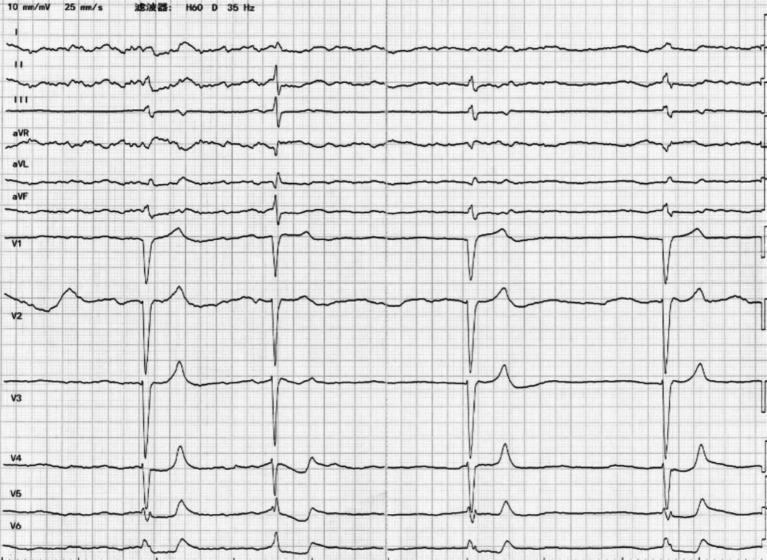
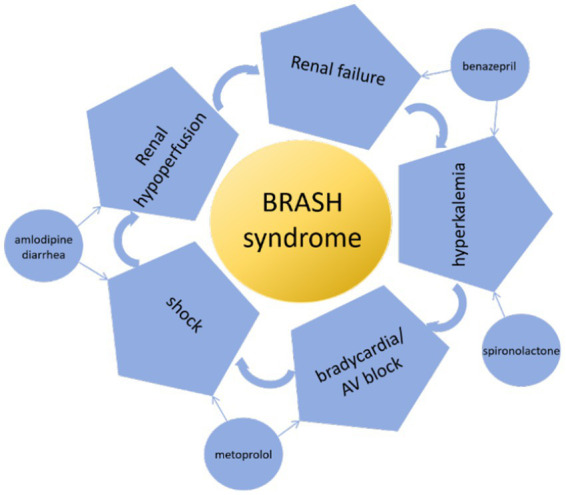
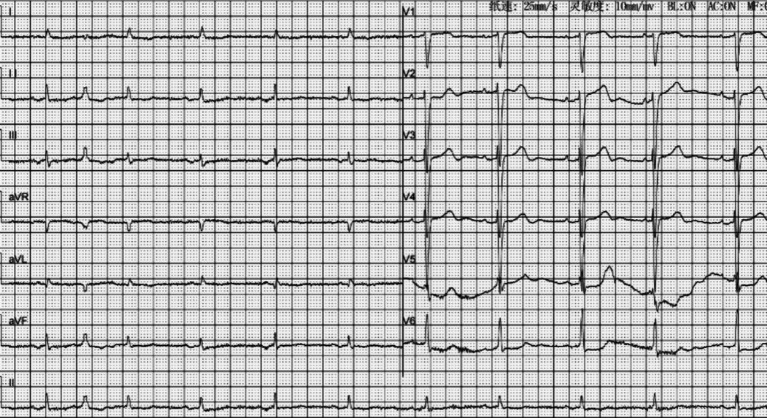
BRASH syndrome is a vicious cycle of hyperkalemia and bradycardia and is an under-recognized life-threatening clinical diagnosis. It is usually initiated by hypovolemia or hyperkalemia. We report here on the case of a 92-year-old man with hypertension and heart failure who presented to the emergency department with weakness following diarrhea. He was on amlodipine, benazepril, metoprolol, furosemide and spironolactone. The patient's blood pressure was 88/53 mmHg and the serum creatinine was 241 μmol/L. Within 2 h, the patient's heart rate decreased from 58 beats per minute to 26 beats per minute, and serum potassium levels gradually increased from 6.07 mmol/L to 7.3 mmol/L. The electrocardiogram showed a junctional escape rhythm with accidental sinus capture. The diagnosis of BRASH syndrome was made based on clinical symptoms, a biochemical profile and the results of an electrocardiogram. The patient was rapidly stabilized with the administration of intravenous calcium gluconate, dextrose and insulin, 5% sodium bicarbonate, 0.9% sodium chloride, furosemide, and oral zirconium cyclosilicate. Sinus rhythm at a heart rate of 75 bpm was detected 5 h later, along with normal serum potassium levels. After 2 weeks, kidney function returned to normal. Clinicians should be alert to patients with hyperkalemia and maintain a high index of suspicion for BRASH syndrome. Timely diagnosis and comprehensive intervention are critical for better outcomes in managing patients with BRASH.
BRASH综合征是高钾血症和心动过缓的恶性循环,是一种未得到充分认识的危及生命的临床诊断。它通常由血容量不足或高钾血症引发。我们在此报告一例92岁患有高血压和心力衰竭的男性病例,该患者因腹泻后出现乏力而就诊于急诊科。他正在服用氨氯地平、贝那普利、美托洛尔、呋塞米和螺内酯。患者血压为88/53 mmHg,血清肌酐为241 μmol/L。在2小时内,患者心率从每分钟58次降至每分钟26次,血清钾水平从6.07 mmol/L逐渐升至7.3 mmol/L。心电图显示交界性逸搏心律伴偶然窦性夺获。根据临床症状、生化指标和心电图结果做出BRASH综合征的诊断。通过静脉注射葡萄糖酸钙、葡萄糖和胰岛素、5%碳酸氢钠、0.9%氯化钠、呋塞米以及口服环硅酸锆钠,患者迅速病情稳定。5小时后检测到心率为75次/分钟的窦性心律,同时血清钾水平正常。2周后,肾功能恢复正常。临床医生应警惕高钾血症患者,并对BRASH综合征保持高度怀疑指数。及时诊断和综合干预对于管理BRASH患者获得更好的结果至关重要。