Diribe Nnaemeka, Le Jacqueline
Desert Regional Medical Center, Department of Emergency Medicine, Palm Springs, California.
Clin Pract Cases Emerg Med. 2019 Jul 22;3(3):282-285. doi: 10.5811/cpcem.2019.5.43118. eCollection 2019 Aug.
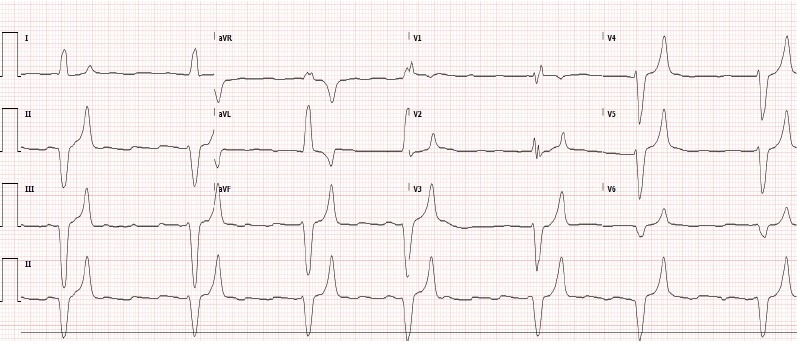
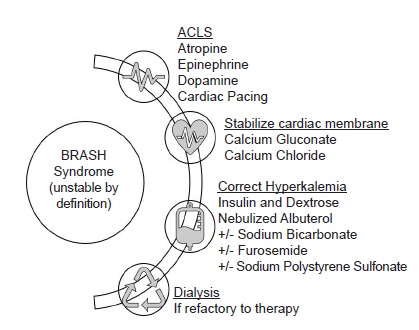
BRASH (bradycardia, renal failure, atrioventricular-node blockers, shock, and hyperkalemia) syndrome is a recently coined term for a condition that describes the severe bradycardia and shock associated with hyperkalemia in patients on atrioventricular (AV)-node blocking agents. The proposed pathophysiology involves a precipitating event that exacerbates renal dysfunction with resulting AV-node blocker and potassium accumulation that act synergistically to precipitate bradycardia and hypotension. This syndrome may be refractory to the usual management of bradycardia. This case describes BRASH syndrome precipitated by trimethoprim/sulfamethoxazole.
BRASH(心动过缓、肾衰竭、房室结阻滞剂、休克和高钾血症)综合征是一个最近新造的术语,用于描述使用房室(AV)结阻滞剂的患者中与高钾血症相关的严重心动过缓和休克。提出的病理生理学涉及一个促发事件,该事件会加剧肾功能不全,导致AV结阻滞剂和钾蓄积,二者协同作用引发心动过缓和低血压。这种综合征可能对心动过缓的常规治疗无效。本病例描述了由甲氧苄啶/磺胺甲恶唑引发的BRASH综合征。