Chamarthi Gajapathiraju, Orozco Tatiana, Hale-Gallardo Jennifer, Subhash Shobha, Shell Popy, Pearce Kailyn, Jia Huanguang, Shukla Ashutosh M
Division of Nephrology, Hypertension, and Transplantation, University of Florida, Gainesville, Florida.
Nephrology section, Medicine Service, North Florida South Georgia Veterans Healthcare System, Gainesville, Florida.
Kidney Med. 2024 Apr 26;6(6):100832. doi: 10.1016/j.xkme.2024.100832. eCollection 2024 Jun.
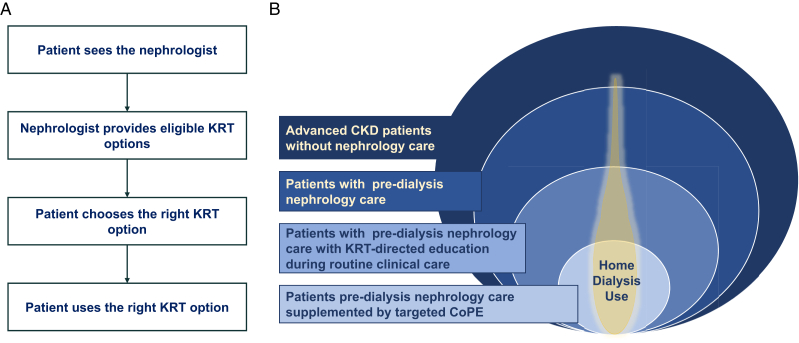
RATIONALE & OBJECTIVE: The Advancing Americans Kidney Health Executive order has directed substantial increases in home dialysis use for incident kidney replacement therapy (KRT). Clinical guidelines recommend patients' self-selection of KRT modality through a shared decision-making process, which, at the minimum, requires predialysis nephrology care and KRT-directed comprehensive prekidney failure patient education (CoPE). The current state of these essential services among Americans with advanced (stages 4 and 5) chronic kidney disease (CKD) and their informed preferences for home dialysis are unknown.
We conducted a community-based, cross-sectional, observational cohort study across a large regional Veteran Healthcare System from October 1, 2020, to September 30, 2021.
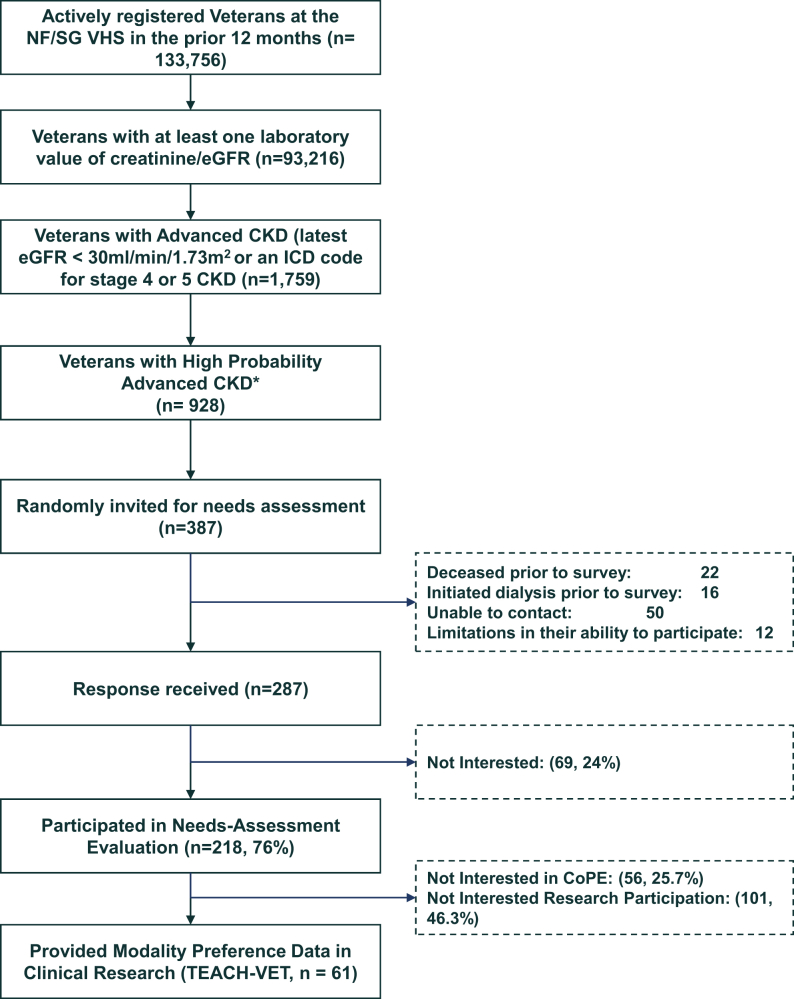
SETTING & PARTICIPANTS: Of the 928 Veterans with advanced CKD, 287 (30.9%) were invited for needs assessment evaluations. Of the 218 (76% of invited cohort) responding, 178 (81.6%) were receiving nephrology care, with approximately half of those (43.6%) receiving such care from non-Veterans Affairs providers.
The study was targeted to assess the prevalent state of ongoing nephrology care and KRT-directed pre-kidney failure education among Veterans with advanced CKD. The secondary outcome included evaluation of dialysis decision-making state among Veterans with advanced CKD.
Veterans with advanced CKD with 2 sustained estimated glomerular filtration rates <30 mL/min/1.73 m were identified through an electronic database query, and a randomly selected cohort was invited for their current state of and outstanding needs for predialysis nephrology care and CoPE, essential for informed KRT selection.
Basic awareness of kidney disease was high (92.2%) among Veterans with advanced CKD, although only 38.5% were aware of the severity of their CKD. KRT-directed education during clinical care was reported by 46.8% of Veterans, of which 21.1% reported having received targeted CoPE classes. Three-quarters (74.3%) of Veterans expressed interest in receiving CoPE services. Overall, awareness of CKD and its severity and receipt of KRT-directed education were significantly higher among Veterans with nephrology care than among those without. Of the 61 Veterans providing their KRT preferences, overall decision making was poor, with three-quarters (73.8%) of the cohort unable to choose any KRT modality, irrespective of ongoing nephrology care. Only 8 (13%) felt confident choosing home KRT modalities.
The study results are primarily applicable to the Veterans with advanced CKD. Furthermore, a limited numbers of respondents provided data on their KRT decision-making state, prohibiting broad generalizations.
In a first-of-its-kind community-based needs assessment evaluation among Veterans with advanced CKD, we found that awareness of kidney disease is positively associated with nephrology care; however, the informed KRT selection capabilities are universally poor, irrespective of nephrology care. Our results demonstrate a critical gap between the recommended and prevalent nephrology practices such as KRT-directed education and targeted CoPE classes required for informed patient-centered home dialysis selection in advanced CKD.
《推进美国肾脏健康行政命令》已指示大幅增加初发肾脏替代治疗(KRT)中家庭透析的使用。临床指南建议患者通过共同决策过程自行选择KRT方式,这至少需要透析前的肾脏病护理以及针对KRT的全面肾衰竭前患者教育(CoPE)。晚期(4期和5期)慢性肾脏病(CKD)美国患者中这些基本服务的现状以及他们对家庭透析的知情偏好尚不清楚。
2020年10月1日至2021年9月30日,我们在一个大型区域退伍军人医疗系统中开展了一项基于社区的横断面观察性队列研究。
在928名晚期CKD退伍军人中,287名(30.9%)被邀请进行需求评估。在218名(受邀队列的76%)做出回应者中,178名(81.6%)正在接受肾脏病护理,其中约一半(43.6%)从非退伍军人事务提供者处接受此类护理。
该研究旨在评估晚期CKD退伍军人中正在进行的肾脏病护理以及针对KRT的肾衰竭前教育的普遍状况。次要结果包括评估晚期CKD退伍军人的透析决策状态。
通过电子数据库查询识别出2次持续估计肾小球滤过率<30 mL/min/1.73 m²的晚期CKD退伍军人,并随机选择一个队列,邀请他们了解透析前肾脏病护理和CoPE的现状及未满足的需求,这对于明智地选择KRT至关重要。
晚期CKD退伍军人中对肾脏病的基本知晓率较高(92.2%),尽管只有38.5%的人知晓其CKD的严重程度。46.8%的退伍军人报告在临床护理期间接受了针对KRT的教育,其中21.1%报告接受了针对性的CoPE课程。四分之三(74.3%)的退伍军人表示有兴趣接受CoPE服务。总体而言,接受肾脏病护理的退伍军人对CKD及其严重程度的知晓率以及接受针对KRT的教育情况明显高于未接受护理的退伍军人。在61名表明其KRT偏好的退伍军人中,总体决策情况较差,四分之三(73.8%)的队列无法选择任何KRT方式,无论其是否正在接受肾脏病护理。只有8名(13%)觉得有信心选择家庭KRT方式。
研究结果主要适用于晚期CKD退伍军人。此外,只有少数受访者提供了关于其KRT决策状态的数据,因此无法进行广泛概括。
在首次针对晚期CKD退伍军人的基于社区的需求评估中,我们发现对肾脏病的知晓与肾脏病护理呈正相关;然而,无论是否接受肾脏病护理,明智地选择KRT的能力普遍较差。我们的结果表明,在晚期CKD中,推荐的肾脏病实践(如针对KRT的教育和针对性的CoPE课程)与普遍存在的实践之间存在关键差距,而这些对于以患者为中心的明智家庭透析选择是必需的。