Department of Human Physiology and Pathophysiology, University of Warmia and Mazury in Olsztyn, Olsztyn, Poland.
Faculty of Medicine and Dentistry, Medical University of Warsaw, Warsaw, Poland.
Front Public Health. 2024 May 30;12:1396558. doi: 10.3389/fpubh.2024.1396558. eCollection 2024.
Low back pain (LBP) is one of the most common problems of public health and creates a burden globally. The aim was to assess the Polish population's back pain prevention behaviors and beliefs and to examine how these health behaviors and beliefs vary across sociodemographic factors and physical activity.
A cross-sectional survey was carried out among 208 randomly selected patients of the public general practitioner clinic. The differences in LBP-related beliefs and attitudes were determined due to participants' status of requiring or non-requiring LBP treatment.
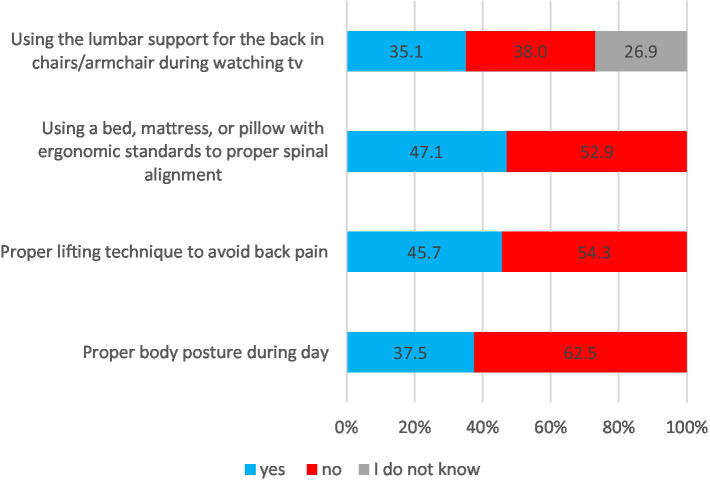
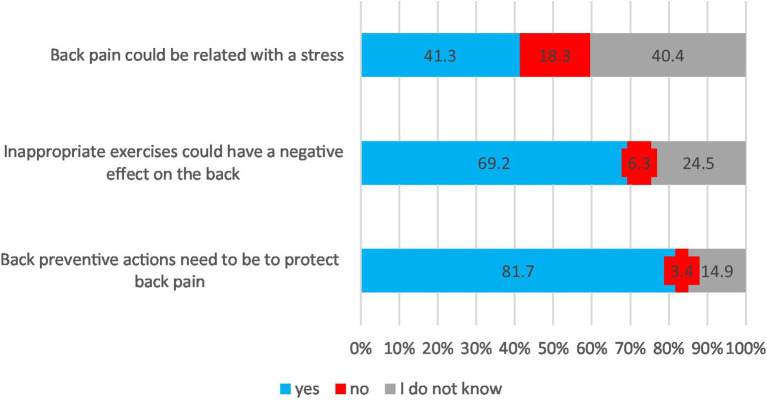
More than half of the respondents did not engage in behaviors that protect against back pain. Individuals with higher education levels and those who exercised at least once a week were significantly more likely to adopt behaviors to protect their backs. Less than half of the participants reported having a workplace that was adequately prepared to protect against back pain, and only 35.1% of the participants reported receiving instruction while taking up work on how to avoid back pain while working. According to respondents' opinions, preventive actions are necessary to protect against back pain. Inappropriate exercises and stress can be contributors to back pain, with these opinions reported more often by women and participants with higher education levels. Participants who received treatment for LBP showed a significantly higher expression of behaviors to protect against back pain compared to participants who did not require treatment. However, there were no significant differences in participants' beliefs about back pain prevention between the group requiring LBP treatment and the group not requiring LBP treatment.
The study provides valuable insights into the association between LBP treatment, back pain prevention behaviors, and beliefs, suggesting potential avenues for future research and intervention development. By addressing workplace ergonomics and promoting a culture of back health, it may be possible to reduce the burden of LBP in Poland.
下背痛(LBP)是公共卫生中最常见的问题之一,在全球范围内造成了负担。目的是评估波兰人口的腰痛预防行为和信念,并研究这些健康行为和信念如何因社会人口因素和体力活动而异。
对公共全科医生诊所的 208 名随机选择的患者进行了横断面调查。根据参与者是否需要腰痛治疗,确定了与腰痛相关的信念和态度的差异。
超过一半的受访者没有采取预防腰痛的行为。受教育程度较高的个体和每周至少运动一次的个体更有可能采取保护背部的行为。只有不到一半的参与者报告其工作场所为预防腰痛做好了充分准备,只有 35.1%的参与者报告在开始工作时接受了如何在工作中避免腰痛的指导。根据受访者的意见,预防措施是预防腰痛所必需的。不适当的运动和压力可能是腰痛的原因,这些意见更多地由女性和受教育程度较高的参与者报告。接受腰痛治疗的参与者比不需要治疗的参与者表现出更高的预防腰痛行为表达。然而,在需要治疗腰痛的组和不需要治疗腰痛的组之间,参与者对腰痛预防的信念没有显著差异。
该研究提供了有关腰痛治疗、腰痛预防行为和信念之间关联的有价值的见解,为未来的研究和干预措施的发展提供了潜在的途径。通过解决工作场所的人体工程学问题和促进背部健康文化,可能减少波兰的腰痛负担。