Department of Gerontology, Tongji Hospital, Tongji Medical College, Huazhong University of Science and Technology, Wuhan, China.
Front Public Health. 2024 May 30;12:1388424. doi: 10.3389/fpubh.2024.1388424. eCollection 2024.
Arterial stiffness, typically evaluated via estimated pulse wave velocity (ePWV), is believed to have a significant association with cardiovascular diseases. The objective of this study was to investigate the correlation between Life's Essential 8 (LE8), a newly revised metric of cardiovascular health, and ePWV among adult population in the United States.
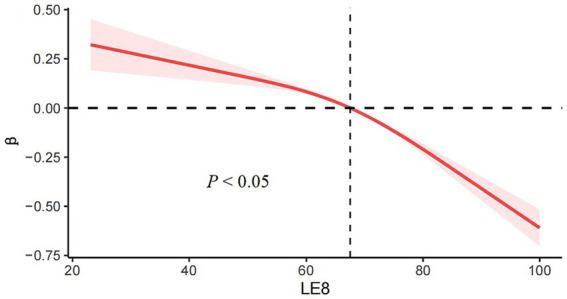
This research employed a cross-sectional methodology, drawing upon data from the National Health and Nutrition Examination Survey (NHANES) spanning from 2011 to 2018. To explore the relationship between LE8 and ePWV among adults in the US, both univariate and multivariate linear regression analyses were carried out. Additionally, the restricted cubic splines method was utilized to examine any non-linear correlation.
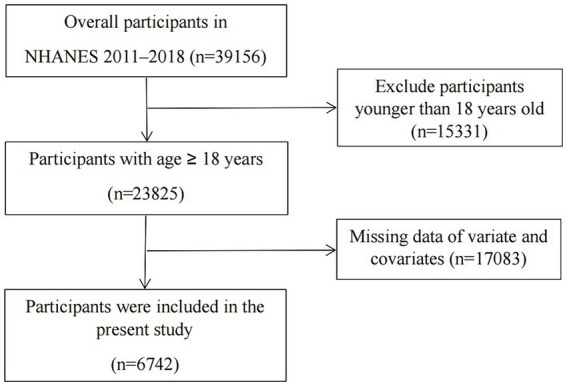
The study comprised 6,742 participants with an average age of 48.30 ± 0.35 years. Among these, 3,236 were males, representing a weighted percentage of 48%. The population's weighted average LE8 score was 68.68 ± 0.37, while the average ePWV was 8.18 ± 0.04. An entirely adjusted model revealed a negative correlation between ePWV and LE8 scores [in the moderate LE8 group, coefficient - 0.17, 95% CI -0.28 to -0.06, = 0.004; in the high LE8 group, coefficient - 0.44, 95% CI -0.56 to -0.32, < 0.0001]. This negative correlation was consistent with the findings in demographic subgroup analysis, with the effect size being more pronounced among adults under the age of 60, and individuals without hypertension, cardiovascular disease, or diabetes.
Our study reveals a negative correlation between LE8 and ePWV in the adult population of the US, suggesting that LE8 could potentially serve as an indicative marker for evaluating the risk of vascular stiffness. This inverse relationship is markedly stronger in adults below 60 years and those without diagnosed vascular diseases. This implies that lifestyle upgrades and risk factor management could be especially advantageous in curbing arterial stiffness within these groups. These conclusions underscore the importance of primary prevention in mitigating the risk of vascular aging in a relatively healthy group, emphasizing the significance of early intervention and risk factor management in cardiovascular disease.
动脉僵硬度通常通过估计脉搏波速度(ePWV)进行评估,据信与心血管疾病有显著关联。本研究旨在探究美国成年人中,新修订的心血管健康指标“生命的八项基本要素”(LE8)与 ePWV 之间的相关性。
本研究采用横断面研究方法,利用 2011 年至 2018 年国家健康和营养调查(NHANES)的数据。为了探讨美国成年人中 LE8 与 ePWV 之间的关系,我们进行了单变量和多变量线性回归分析。此外,还使用限制立方样条法检查了任何非线性相关性。
本研究共纳入 6742 名参与者,平均年龄为 48.30±0.35 岁。其中 3236 名为男性,占总人数的 48%。该人群的加权平均 LE8 评分为 68.68±0.37,平均 ePWV 为 8.18±0.04。完全调整模型显示,ePWV 与 LE8 评分之间存在负相关[在中度 LE8 组中,系数为-0.17,95%CI-0.28 至-0.06,P=0.004;在高 LE8 组中,系数为-0.44,95%CI-0.56 至-0.32,P<0.0001]。这种负相关在人口统计学亚组分析中是一致的,在 60 岁以下的成年人和没有高血压、心血管疾病或糖尿病的成年人中,这种效应大小更为明显。
我们的研究表明,在美国成年人中,LE8 与 ePWV 之间存在负相关,提示 LE8 可能成为评估血管僵硬度风险的指标。这种负相关在 60 岁以下和没有诊断出血管疾病的成年人中更为明显。这意味着在这些人群中,生活方式的改善和危险因素的管理可能特别有助于抑制动脉僵硬度。这些结论强调了初级预防在减轻相对健康人群中血管老化风险方面的重要性,强调了早期干预和危险因素管理在心血管疾病中的重要性。