RAND Corporation, Boston, Massachusetts.
Pardee RAND Graduate School, Santa Monica, California.
JAMA Health Forum. 2024 Jun 7;5(6):e241472. doi: 10.1001/jamahealthforum.2024.1472.
Millions of economically disadvantaged children depend on Medicaid for dental care, with states differing in whether they deliver these benefits using fee-for-service or capitated managed care payment models. However, there is limited research examining the association between managed care and the accessibility of dental services.
To estimate the association between the adoption of managed care for dental services in Florida's Medicaid program and nontraumatic dental emergency department visits and associated charges.
DESIGN, SETTING, AND PARTICIPANTS: This cohort study used an event-study difference-in-differences design, leveraging Florida Medicaid's staggered adoption of managed care to examine its association with pediatric nontraumatic dental emergency department visits and associated charges. This study included all Florida emergency department visits from 2010 to 2014 in which the patient was 17 years or younger, the patient was a Florida resident, Medicaid paid for the visit, and a primary or secondary International Classification of Diseases, Ninth Revision, code was used to classify a nontraumatic dental condition. Analyses were conducted between May 2023 and April 2024.
The county of residence transitioning Medicaid dental services from fee-for-service to a fully capitated managed care program managed by a dental plan.
The rate of nontraumatic dental emergency department visits per 100 000 pediatric Medicaid enrollees and the associated mean charges per visit. Nontraumatic dental emergency department visits are a well-documented proxy for access to dental care. Data on emergency department visit counts came from the Florida Agency for Health Care Administration. Medicaid population denominators were derived from the American Community Survey's 5-year estimates.
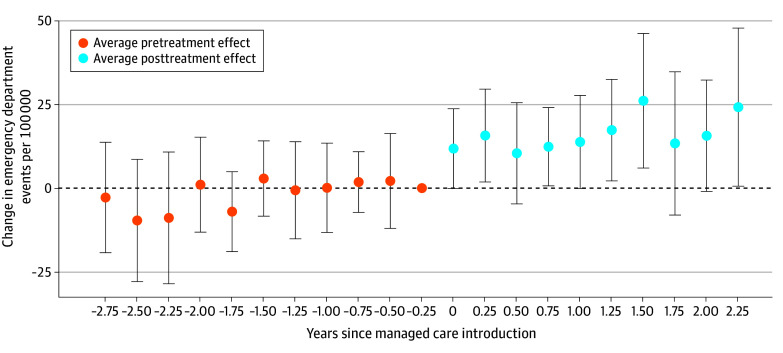
Among the 34 414 pediatric nontraumatic dental emergency department visits that met inclusion criteria across Florida's 67 counties, the mean (SD) age of patients was 8.11 (5.28) years, and 50.8% of patients were male. Of these, 10 087 visits occurred in control counties and 24 327 in treatment counties. Control counties generally had lower rates of NTDC ED visits per 100 000 enrollees compared with treatment counties (123.5 vs 132.7). Over the first 2.5 years of implementation, the adoption of managed care was associated with an 11.3% (95% CI, 4.0%-18.4%; P = .002) increase in nontraumatic dental emergency department visits compared with pre-implementation levels. There was no evidence that the average charge per visit changed.
In this cohort study, Florida Medicaid's adoption of managed care for pediatric dental services was associated with increased emergency department visits for children, which could be associated with decreased access to dental care.
数百万经济贫困的儿童依赖医疗补助计划来获得牙科护理,各州在是否使用按服务收费或人头支付的管理式医疗支付模式来提供这些福利方面存在差异。然而,关于管理式医疗与牙科服务可及性之间的关联,研究仍十分有限。
评估佛罗里达州医疗补助计划中牙科服务采用管理式医疗与非创伤性牙科急诊就诊次数和相关费用之间的关联。
设计、设置和参与者:本队列研究采用事件研究差分差异设计,利用佛罗里达州医疗补助计划中管理式医疗的逐步采用,来检验其与儿科非创伤性牙科急诊就诊次数和相关费用的关联。本研究纳入了 2010 年至 2014 年期间所有在佛罗里达州急诊就诊的患者,患者年龄在 17 岁及以下,为佛罗里达州居民,医疗补助支付就诊费用,使用国际疾病分类,第九版的主要或次要代码对非创伤性牙科疾病进行分类。分析于 2023 年 5 月至 2024 年 4 月进行。
居民所在县的医疗补助牙科服务从按服务收费转变为完全人头支付的管理式医疗计划,由牙科计划管理。
每 10 万儿科医疗补助参保者中非创伤性牙科急诊就诊率和每次就诊的平均相关费用。非创伤性牙科急诊就诊是牙科护理可及性的一个很好的记录指标。急诊就诊次数的数据来自佛罗里达州医疗保健管理局。医疗补助参保人数的基数来自美国社区调查的 5 年估计数。
在佛罗里达州 67 个县符合纳入标准的 34414 例儿科非创伤性牙科急诊就诊中,患者的平均(SD)年龄为 8.11(5.28)岁,50.8%为男性。其中,10087 例就诊发生在对照组县,24327 例发生在治疗组县。与治疗组县相比,对照组县的非创伤性牙科急诊就诊率通常较低(每 10 万参保者 123.5 次 vs 132.7 次)。在实施的头 2.5 年中,与实施前相比,管理式医疗的采用与非创伤性牙科急诊就诊率增加 11.3%(95%CI,4.0%-18.4%;P=0.002)相关。没有证据表明每次就诊的平均费用发生了变化。
在这项队列研究中,佛罗里达州医疗补助计划对儿科牙科服务采用管理式医疗与儿童急诊就诊次数增加有关,这可能与牙科护理可及性降低有关。
