Graduate School, Kunming Medical University, Kunming, 650500, China.
Department of Obstetric Ultrasound, The First Affiliated Hospital of Kunming Medical University, Kunming, 650032, China.
BMC Musculoskelet Disord. 2024 Jun 14;25(1):464. doi: 10.1186/s12891-024-07575-y.
To analyze the risk factors for the development of avascular necrosis (AVN) of the femoral head after reduction surgery in children with developmental hip dysplasia (DDH), and to establish a prediction nomogram.
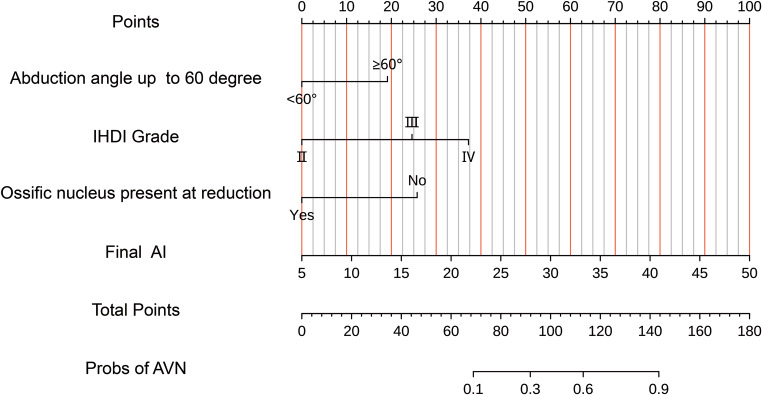
The clinical data of 134 children with DDH (169 hips) treated with closure reduction or open reduction from December 2016 to December 2019 were retrospectively analyzed. Independent risk factors for AVN after DDH reduction being combined with cast external immobilization were determined by univariate analysis and multivariate logistic regression and used to generate nomograms predicting the occurrence of AVN.
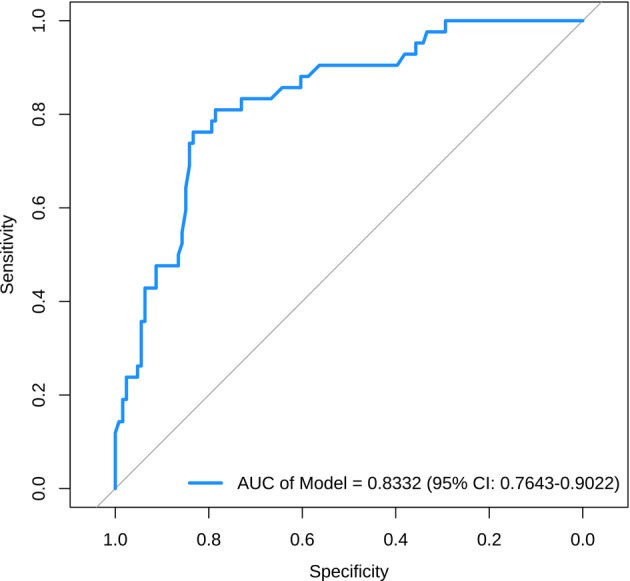
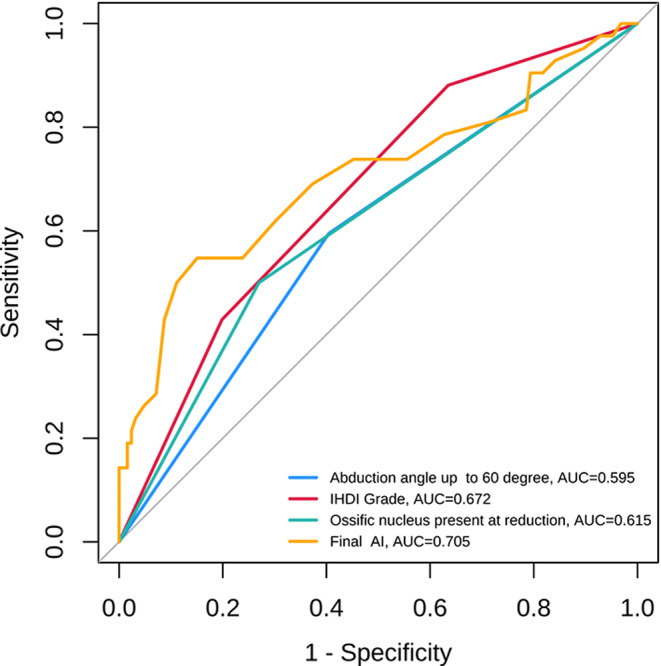
A total of 169 hip joints in 134 children met the inclusion criteria, with a mean age at surgery of 10.7 ± 4.56 months (range: 4-22 months) and a mean follow-up duration of 38.32 ± 27.00 months (range: 12-94 months). AVN developed in 42 hip joints (24.9%); univariate analysis showed that the International Hip Dysplasia Institute (IHDI) grade, preoperative development of the femoral head ossification nucleus, cartilage acetabular index, femoral head to acetabular Y-shaped cartilage distance, residual acetabular dysplasia, acetabular abduction angle exceeding 60°, and the final follow-up acetabular index (AI) were associated with the development of AVN (P < 0.05). Multivariate logistic regression analysis showed that the preoperative IHDI grade, development of the femoral head ossification nucleus, acetabular abduction angle exceeding 60°, and the final follow-up AI were independent risk factors for AVN development (P < 0.05). Internal validation of the Nomogram prediction model showed a consistency index of 0.833.
Preoperative IHDI grade, preoperative development of the femoral head ossification nucleus, final AI, and acetabular abduction angle exceeding 60° are risk factors for AVN development. This study successfully constructed a Nomogram prediction model for AVN after casting surgery for DDH that can predict the occurrence of AVN after casting surgery for DDH.
分析儿童发育性髋关节发育不良(DDH)患者接受复位手术后发生股骨头缺血性坏死(AVN)的危险因素,并建立预测列线图。
回顾性分析 2016 年 12 月至 2019 年 12 月收治的 134 例 DDH 患儿(169 髋)行闭合复位或切开复位治疗的临床资料。采用单因素分析和多因素 logistic 回归分析确定影响 DDH 复位后行石膏外固定发生 AVN 的独立危险因素,并据此生成预测 AVN 发生的列线图。
共 134 例患儿的 169 髋符合纳入标准,手术时平均年龄为 10.7±4.56 个月(422 个月),平均随访时间为 38.32±27.00 个月(1294 个月)。42 髋(24.9%)发生 AVN;单因素分析显示,国际髋关节发育不良研究所(IHDI)分级、术前股骨头骨骺核发育、髋臼软骨指数、股骨头髋臼 Y 型软骨距离、残余髋臼发育不良、髋臼外展角>60°及最终随访髋臼指数(AI)与 AVN 发生有关(P<0.05)。多因素 logistic 回归分析显示,术前 IHDI 分级、股骨头骨骺核发育、髋臼外展角>60°及最终随访 AI 是 AVN 发生的独立危险因素(P<0.05)。列线图预测模型的内部验证一致性指数为 0.833。
术前 IHDI 分级、术前股骨头骨骺核发育、最终 AI 及髋臼外展角>60°是 AVN 发生的危险因素。本研究成功构建了 DDH 患儿石膏固定术后发生 AVN 的列线图预测模型,可预测 DDH 患儿石膏固定术后发生 AVN 的概率。