MOE Joint International Research Laboratory of Animal Health and Food Safety, Nanjing Agricultural University, Nanjing, 210095, China.
Ningxia Hui Autonomous Region Food Testing and Research Institute, Yinchuan, 750002, China.
BMC Vet Res. 2024 Jun 14;20(1):258. doi: 10.1186/s12917-024-04116-6.
Senecavirus A (SVA), identified in 2002, is known to cause porcine idiopathic vesicular disease (PIVD), which presents with symptoms resembling other vesicular diseases. This similarity complicates field diagnosis. Conventional molecular diagnostic techniques are limited by their cost, sensitivity, and requirement for complicated instrumentation. Therefore, developing an effective and accurate diagnostic method is crucial for timely identification and isolation of affected pigs, thereby preventing further disease spread.
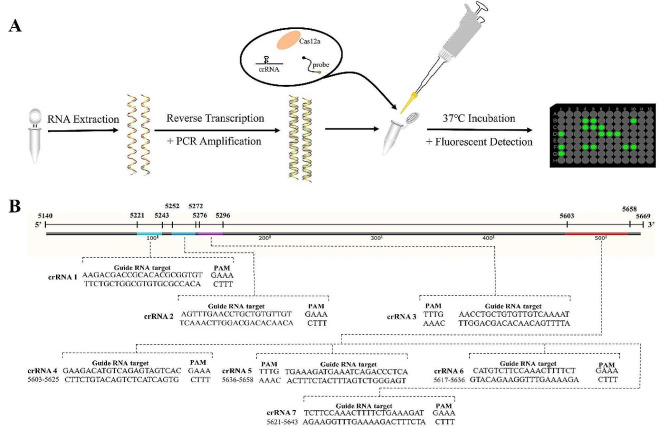
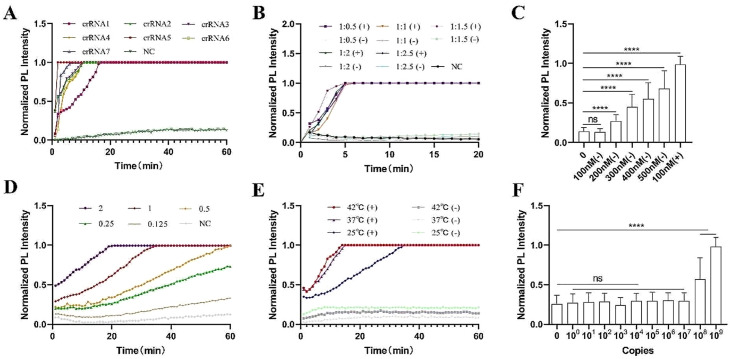
In this study, we developed a highly-specific and ultra-sensitive SVA detection method powered by CRISPR/Cas12a. To enhance the availability in laboratories with varied equipment conditions, microplate reader and ultraviolet light transilluminator were introduced. Moreover, PCR amplification has also been incorporated into this method to improve sensitivity. The specificity and sensitivity of this method were determined following the preparation of the recombinant Cas12a protein and optimization of the CRISPR/Cas12a-based trans-cleavage system.
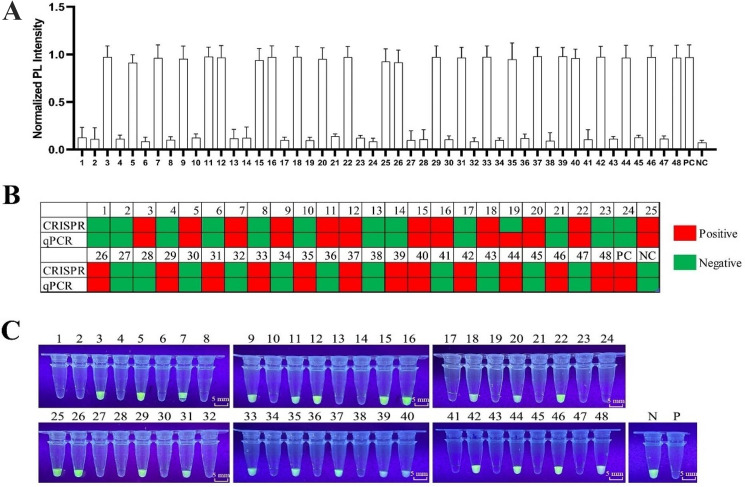
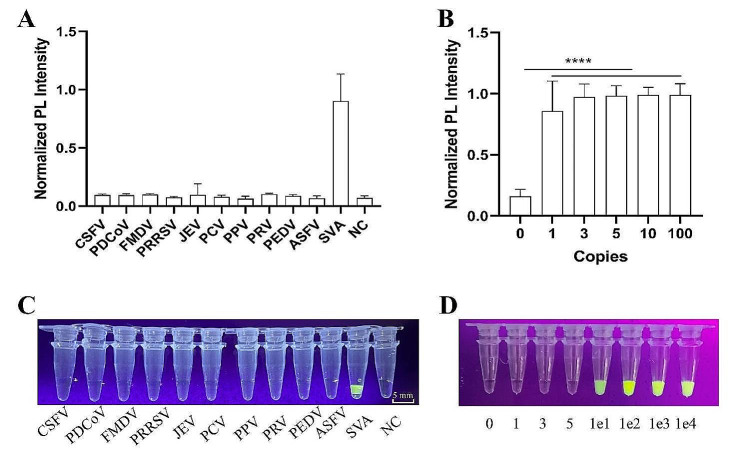
The method demonstrated no cross-reactivity with ten kinds of viruses of swine. The minimum template concentration required to activate substantial trans-cleavage activity was determined to be 10 copies/µL of SVA templates. However, when PCR amplification was incorporated, the method achieved a detection limit of one copy of SVA templates per reaction. It also exhibited 100% accuracy in simulated sample testing. The complete testing process does not exceed three hours.
Importantly, this method utilizes standard laboratory equipment, making it accessible for use in resource-limited settings and facilitating widespread and ultra-sensitive screening during epidemics. Overall, the development of this method not only broadens the array of tools available for detecting SVA but also holds significant promise for controlling the spread of PIVD.
塞尼卡病毒 A(SVA)于 2002 年被发现,已知会引起猪特发性水疱病(PIVD),其症状与其他水疱病相似。这种相似性使得现场诊断变得复杂。传统的分子诊断技术受到成本、灵敏度和对复杂仪器要求的限制。因此,开发一种有效和准确的诊断方法对于及时识别和隔离受感染的猪至关重要,从而防止疾病进一步传播。
在这项研究中,我们开发了一种基于 CRISPR/Cas12a 的高度特异性和超灵敏的 SVA 检测方法。为了增强在设备条件各异的实验室中的可用性,引入了微孔板读数仪和紫外线透射仪。此外,还将 PCR 扩增纳入了该方法以提高灵敏度。在制备重组 Cas12a 蛋白并优化基于 CRISPR/Cas12a 的转录切割系统后,确定了该方法的特异性和灵敏度。
该方法与十种猪病毒无交叉反应性。确定激活大量转录切割活性所需的最小模板浓度为 10 拷贝/µL 的 SVA 模板。然而,当纳入 PCR 扩增时,该方法的检测限达到每个反应 1 拷贝的 SVA 模板。在模拟样本测试中也达到了 100%的准确性。整个测试过程不超过三个小时。
重要的是,该方法利用标准实验室设备,使其可用于资源有限的环境,并在疫情期间方便进行广泛和超灵敏的筛查。总的来说,该方法的开发不仅拓宽了用于检测 SVA 的工具种类,而且对控制 PIVD 的传播具有重要意义。