Children's Hospital, School of Medicine, Technical University of Munich, Munich, Germany.
Institute of Virology, School of Medicine, Technical University of Munich and Helmholtz Munich, Schneckenburgerstr. 8, 81675, Munich, Germany.
Virol J. 2024 Jun 14;21(1):139. doi: 10.1186/s12985-024-02411-0.
Infection with the Epstein-Barr virus (EBV) elicits a complex T-cell response against a broad range of viral proteins. Hence, identifying potential differences in the cellular immune response of patients with different EBV-associated diseases or different courses of the same disorder requires interrogation of a maximum number of EBV antigens. Here, we tested three novel EBV-derived antigen formulations for their ability to reactivate virus-specific T cells ex vivo in patients with EBV-associated infectious mononucleosis (IM).
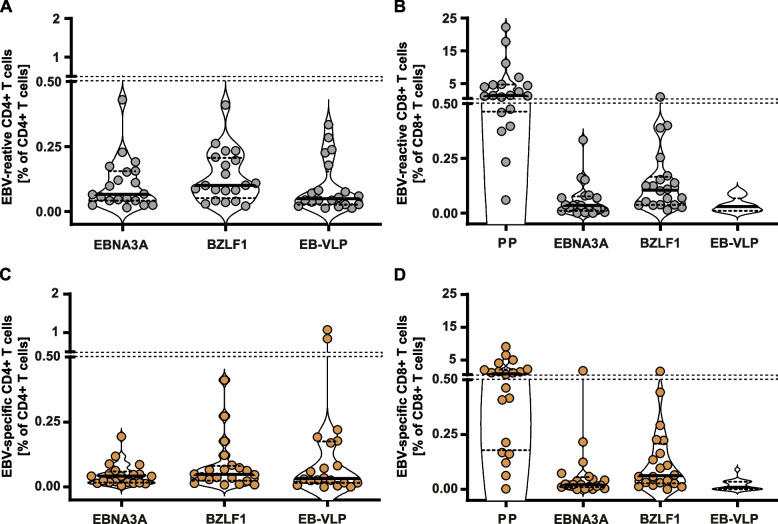
We comparatively analyzed EBV-specific CD4+ and CD8+ T-cell responses to three EBV-derived antigen formulations in 20 pediatric patients during the early phase of IM: T-activated EBV proteins (BZLF1, EBNA3A) and EBV-like particles (EB-VLP), both able to induce CD4+ and CD8+ T-cell responses ex vivo, as well as an EBV-derived peptide pool (PP) covering 94 well-characterized CD8+ T-cell epitopes. We assessed the specificity, magnitude, kinetics, and functional characteristics of EBV-specific immune responses at two sequential time points (v1 and v2) within the first six weeks after IM symptom onset (T).
All three tested EBV-derived antigen formulations enabled the detection of EBV-reactive T cells during the early phase of IM without prior T-cell expansion in vitro. EBV-reactive CD4+ and CD8+ T cells were mainly mono-functional (CD4+: mean 64.92%, range 56.15-71.71%; CD8+: mean 58.55%, range 11.79-85.22%) within the first two weeks after symptom onset (v1) with IFN-γ and TNF-secreting cells representing the majority of mono-functional EBV-reactive T cells. By contrast, PP-reactive CD8+ T cells were primarily bi-functional (>60% at v1 and v2), produced IFN-γ and TNF and had more tri-functional than mono-functional components. We observed a moderate correlation between viral load and EBNA3A, EB-VLP, and PP-reactive CD8+ T cells (r = 0.345, 0.418, and 0.356, respectively) within the first two weeks after T, but no correlation with the number of detectable EBV-reactive CD4+ T cells.
All three EBV-derived antigen formulations represent innovative and generic recall antigens suitable for monitoring EBV-specific T-cell responses ex vivo. Their combined use facilitates a thorough analysis of EBV-specific T-cell immunity and allows the identification of functional T-cell signatures linked to disease development and severity.
感染 EBV 会引发针对广泛病毒蛋白的复杂 T 细胞反应。因此,要确定不同 EBV 相关疾病患者或同一疾病不同病程的细胞免疫反应的潜在差异,需要对最大数量的 EBV 抗原进行检测。在这里,我们测试了三种新型 EBV 衍生抗原制剂,以检测它们在 EBV 相关传染性单核细胞增多症(IM)患者中体外重新激活病毒特异性 T 细胞的能力。
我们比较分析了 20 名儿科患者在 IM 早期阶段(T)中对三种 EBV 衍生抗原制剂的 EBV 特异性 CD4+和 CD8+T 细胞反应:T 激活 EBV 蛋白(BZLF1、EBNA3A)和 EBV 样颗粒(EB-VLP),两者均能体外诱导 CD4+和 CD8+T 细胞反应,以及一种 EBV 衍生肽池(PP),覆盖 94 个经过充分鉴定的 CD8+T 细胞表位。我们在 IM 症状出现后 6 周内的两个连续时间点(v1 和 v2)评估 EBV 特异性免疫反应的特异性、幅度、动力学和功能特征。
在 IM 的早期阶段,所有三种测试的 EBV 衍生抗原制剂都能够在体外没有预先进行 T 细胞扩增的情况下检测到 EBV 反应性 T 细胞。在症状出现后的前两周(v1),EBV 反应性 CD4+和 CD8+T 细胞主要是单功能的(CD4+:平均 64.92%,范围 56.15-71.71%;CD8+:平均 58.55%,范围 11.79-85.22%),以 IFN-γ 和 TNF 分泌细胞为大多数单功能 EBV 反应性 T 细胞的主要成分。相比之下,PP 反应性 CD8+T 细胞主要是双功能的(>60%在 v1 和 v2),产生 IFN-γ 和 TNF,并且比单功能成分具有更多的三功能成分。在 T 后两周内,我们观察到病毒载量与 EBNA3A、EB-VLP 和 PP 反应性 CD8+T 细胞之间存在中等相关性(r=0.345、0.418 和 0.356),但与可检测到的 EBV 反应性 CD4+T 细胞数量无关。
所有三种 EBV 衍生抗原制剂均为创新的通用回忆抗原,适用于体外监测 EBV 特异性 T 细胞反应。它们的联合使用促进了对 EBV 特异性 T 细胞免疫的全面分析,并允许鉴定与疾病发展和严重程度相关的功能 T 细胞特征。