Illawarra Health and Medical Research Institute, University of Wollongong, Wollongong, NSW, 2522, Australia.
Molecular Horizons and School of Chemistry and Molecular Bioscience, University of Wollongong, Wollongong, NSW, 2522, Australia.
Sci Rep. 2024 Jun 15;14(1):13844. doi: 10.1038/s41598-024-64366-0.
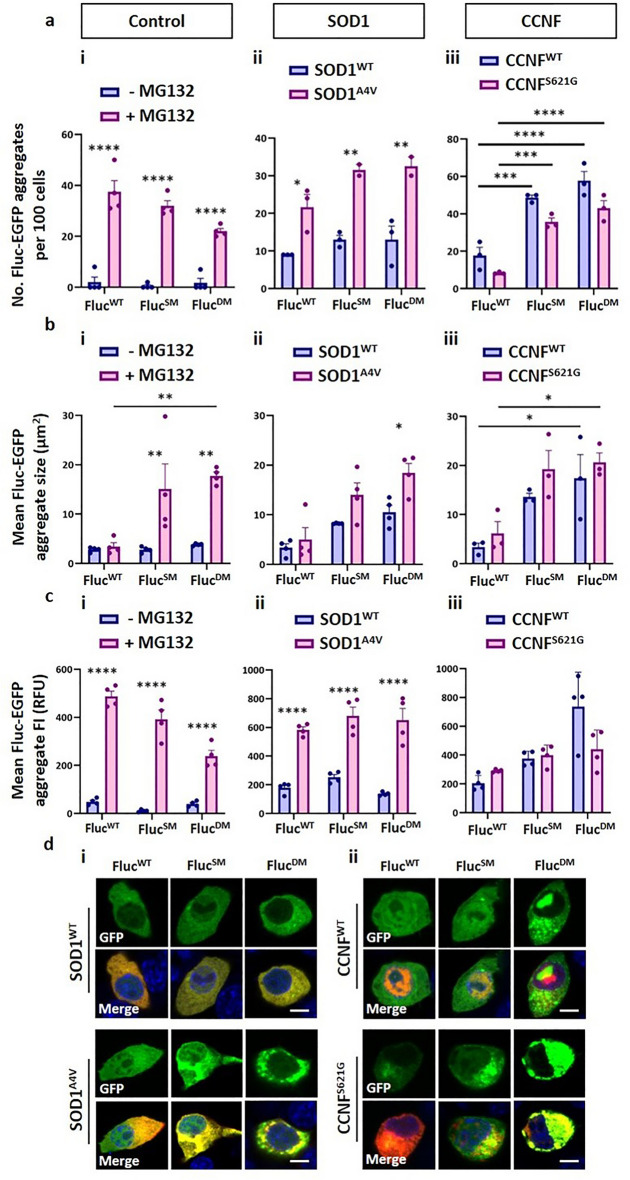
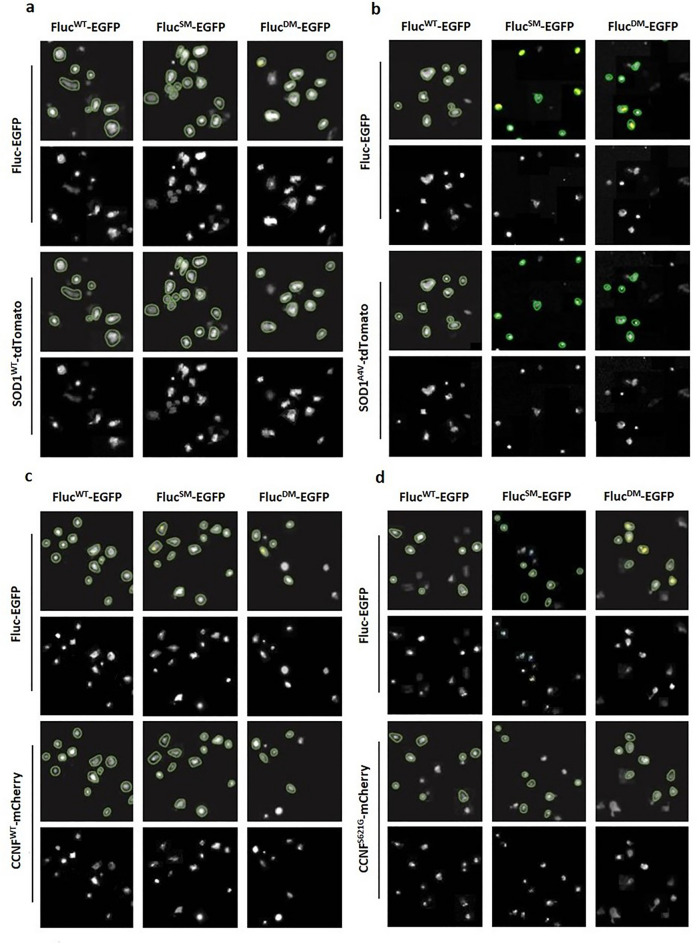
Disrupted proteome homeostasis (proteostasis) in amyotrophic lateral sclerosis (ALS) has been a major focus of research in the past two decades. However, the proteostasis processes that become disturbed in ALS are not fully understood. Obtaining more detailed knowledge of proteostasis disruption in association with different ALS-causing mutations will improve our understanding of ALS pathophysiology and may identify novel therapeutic targets and strategies for ALS patients. Here we describe the development and use of a novel high-content analysis (HCA) assay to investigate proteostasis disturbances caused by the expression of several ALS-causing gene variants. This assay involves the use of conformationally-destabilised mutants of firefly luciferase (Fluc) to examine protein folding/re-folding capacity in NSC-34 cells expressing ALS-associated mutations in the genes encoding superoxide dismutase-1 (SOD1) and cyclin F (CCNF). We demonstrate that these Fluc isoforms can be used in high-throughput format to report on reductions in the activity of the chaperone network that result from the expression of SOD1, providing multiplexed information at single-cell resolution. In addition to SOD1 and CCNF, NSC-34 models of ALS-associated TDP-43, FUS, UBQLN2, OPTN, VCP and VAPB mutants were generated that could be screened using this assay in future work. For ALS-associated mutant proteins that do cause reductions in protein quality control capacity, such as SOD1, this assay has potential to be applied in drug screening studies to identify candidate compounds that can ameliorate this deficiency.
在过去的二十年中,肌萎缩侧索硬化症(ALS)中失调的蛋白质组稳态(蛋白质稳态)一直是研究的主要焦点。然而,在 ALS 中变得紊乱的蛋白质稳态过程尚未完全了解。获得与不同 ALS 致病突变相关的蛋白质稳态破坏的更详细知识将提高我们对 ALS 病理生理学的理解,并可能确定针对 ALS 患者的新的治疗靶标和策略。在这里,我们描述了一种新型高通量分析(HCA)测定法的开发和使用,以研究由几种 ALS 致病基因突变表达引起的蛋白质稳态紊乱。该测定法涉及使用萤火虫荧光素酶(Fluc)的构象不稳定突变体来检查在表达 ALS 相关突变的 NSC-34 细胞中,超氧化物歧化酶 1(SOD1)和细胞周期蛋白 F(CCNF)基因编码的蛋白折叠/重折叠能力。我们证明,这些 Fluc 同工型可以以高通量格式用于报告由于 SOD1 的表达导致伴侣网络活性降低,从而提供单细胞分辨率的多路复用信息。除了 SOD1 和 CCNF 之外,还生成了与 ALS 相关的 TDP-43、FUS、UBQLN2、OPTN、VCP 和 VAPB 突变体的 NSC-34 模型,未来可以使用该测定法对其进行筛选。对于确实会降低蛋白质质量控制能力的 ALS 相关突变蛋白,例如 SOD1,该测定法有可能应用于药物筛选研究中,以鉴定可以改善这种缺陷的候选化合物。