Academy of Public Health Services, Kanzlerstraße 4, Duesseldorf, 40472, Germany.
Department of International Health, Care and Public Health Research Institute-CAPHRI, Faculty of Health, Medicine and Life Sciences, Maastricht University, Maastricht, The Netherlands.
BMC Infect Dis. 2024 Jun 17;24(1):589. doi: 10.1186/s12879-024-09271-7.
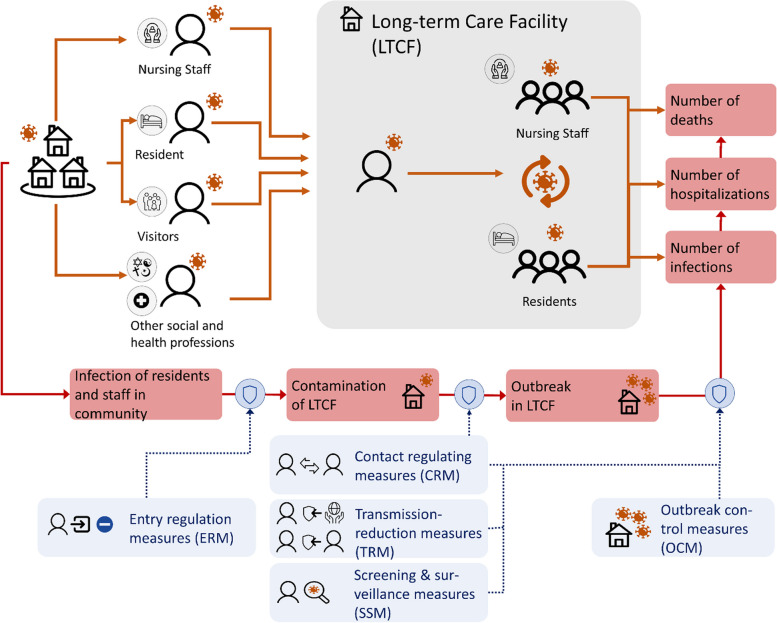
The SARS-CoV-2 pandemic underscored the need for pandemic preparedness, with respiratory-transmitted viruses considered as a substantial risk. In pandemics, long-term care facilities (LTCFs) are a high-risk setting with severe outbreaks and burden of disease. Non-pharmacological interventions (NPIs) constitute the primary defence mechanism when pharmacological interventions are not available. However, evidence on the effectiveness of NPIs implemented in LTCFs remains unclear.
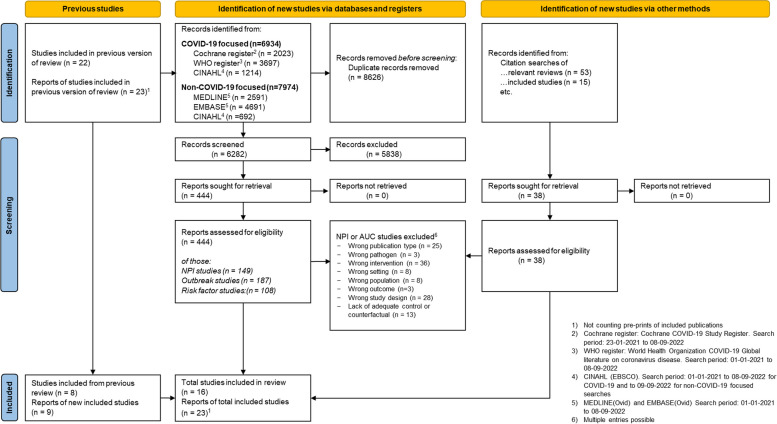
We conducted a systematic review assessing the effectiveness of NPIs implemented in LTCFs to protect residents and staff from viral respiratory pathogens with pandemic potential. We searched Medline, Embase, CINAHL, and two COVID-19 registries in 09/2022. Screening and data extraction was conducted independently by two experienced researchers. We included randomized controlled trials and non-randomized observational studies of intervention effects. Quality appraisal was conducted using ROBINS-I and RoB2. Primary outcomes encompassed number of outbreaks, infections, hospitalizations, and deaths. We synthesized findings narratively, focusing on the direction of effect. Certainty of evidence (CoE) was assessed using GRADE.
We analysed 13 observational studies and three (cluster) randomized controlled trials. All studies were conducted in high-income countries, all but three focused on SARS-CoV-2 with the rest focusing on influenza or upper-respiratory tract infections. The evidence indicates that a combination of different measures and hand hygiene interventions can be effective in protecting residents and staff from infection-related outcomes (moderate CoE). Self-confinement of staff with residents, compartmentalization of staff in the LTCF, and the routine testing of residents and/or staff in LTCFs, among others, may be effective (low CoE). Other measures, such as restricting shared spaces, serving meals in room, cohorting infected and non-infected residents may be effective (very low CoE). An evidence gap map highlights the lack of evidence on important interventions, encompassing visiting restrictions, pre-entry testing, and air filtration systems.
Although CoE of interventions was low or very low for most outcomes, the implementation of NPIs identified as potentially effective in this review often constitutes the sole viable option, particularly prior to the availability of vaccinations. Our evidence-gap map underscores the imperative for further research on several interventions. These gaps need to be addressed to prepare LTCFs for future pandemics.
CRD42022344149.
SARS-CoV-2 大流行凸显了大流行防范的必要性,呼吸道传播病毒被视为重大风险。在大流行期间,长期护理机构(LTCF)是一个高风险场所,会出现严重疫情和疾病负担。当无法进行药物干预时,非药物干预(NPI)是主要的防御机制。然而,关于在 LTCF 中实施的 NPI 的有效性的证据仍然不清楚。
我们进行了一项系统评价,评估了在长期护理机构中实施的 NPI 以保护居民和工作人员免受具有大流行潜力的病毒性呼吸道病原体的侵害。我们于 2022 年 09 月在 Medline、Embase、CINAHL 和两个 COVID-19 登记处进行了搜索。两名经验丰富的研究人员独立进行了筛选和数据提取。我们纳入了干预效果的随机对照试验和非随机观察性研究。使用 ROBINS-I 和 RoB2 进行质量评估。主要结局包括疫情爆发、感染、住院和死亡的数量。我们通过叙述性方法综合研究结果,重点关注效果方向。使用 GRADE 评估证据的确定性(CoE)。
我们分析了 13 项观察性研究和 3 项(集群)随机对照试验。所有研究均在高收入国家进行,除三项外,其余均针对 SARS-CoV-2,其余三项均针对流感或上呼吸道感染。证据表明,不同措施和手部卫生干预措施的组合可以有效保护居民和工作人员免受与感染相关的结果(中等 CoE)。对工作人员与居民的自我隔离、在 LTCF 中对工作人员进行分区以及对 LTCF 中的居民和/或工作人员进行常规检测等措施可能有效(低 CoE)。限制共享空间、在房间内用餐、将感染和未感染的居民分组等其他措施可能有效(非常低 CoE)。证据差距图突出表明,在重要干预措施方面缺乏证据,包括访客限制、入境前检测和空气过滤系统。
尽管大多数结果的干预措施的 CoE 为低或非常低,但在本综述中确定为潜在有效的 NPI 的实施通常是唯一可行的选择,尤其是在疫苗接种可用之前。我们的证据差距图强调了需要进一步研究几种干预措施。需要解决这些差距,为长期护理机构应对未来的大流行做好准备。
CRD42022344149。