Shumi Gemechu, Demissie Taye B, Koobotse Moses, Kenasa Girmaye, Beas Isaac N, Zachariah Matshediso, Desalegn Tegene
School of Applied Natural Science, Department of Applied Chemistry, Adama Science and Technology University, Adama 1888, Ethiopia.
Department of Chemistry, University of Botswana, Gaborone P/Bag 00704, Botswana.
ACS Omega. 2024 May 31;9(23):25014-25026. doi: 10.1021/acsomega.4c02129. eCollection 2024 Jun 11.
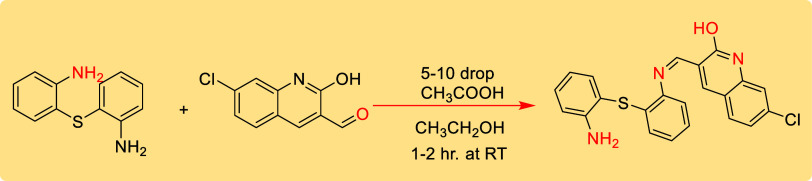
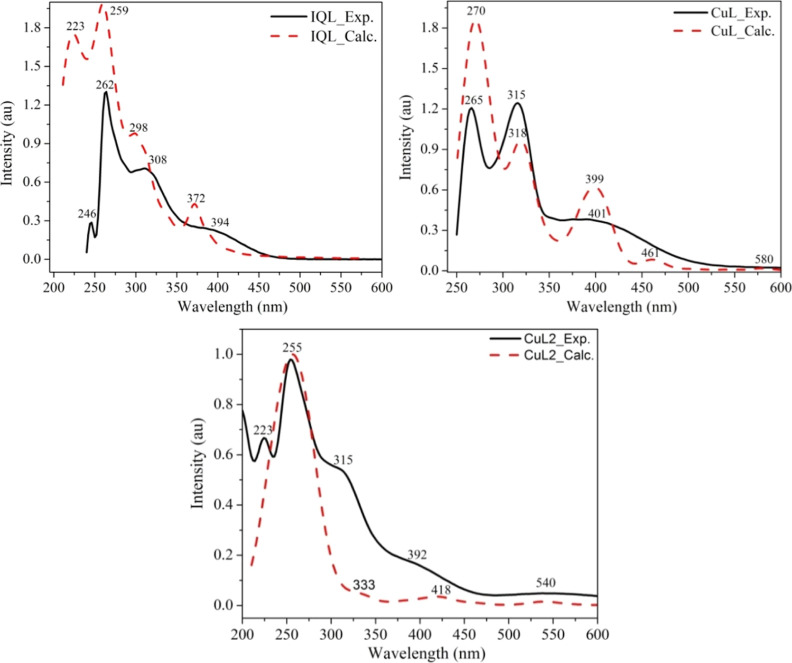
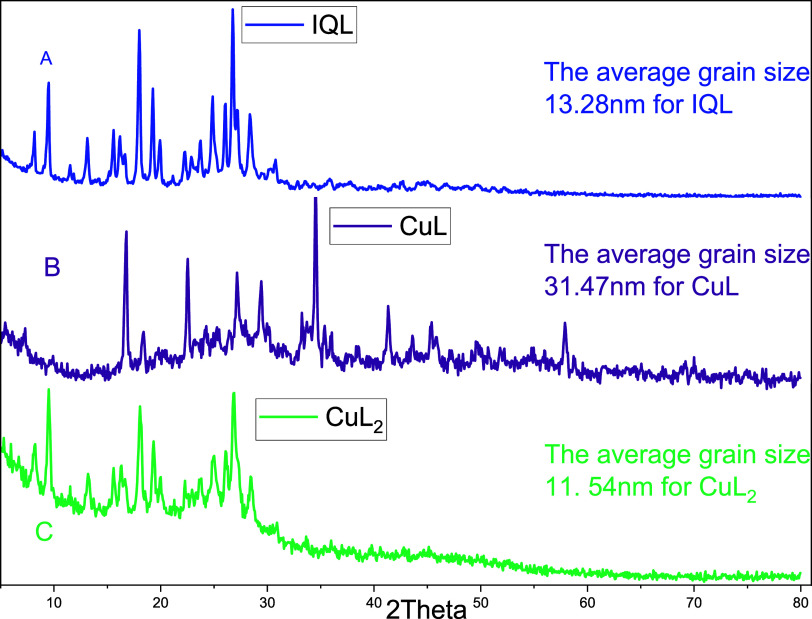
The utilization of metallodrugs as a viable alternative to organic molecules has gained significant attention in modern medicine. We hereby report synthesis of new imine quinoline ligand ()-based Cu(II) complexes and evaluation of their potential biological applications. Syntheses of the ligand and complexes were achieved by condensation of 7-chloro-2-hydroxyquinoline-3-carbaldehyde and 2,2'-thiodianiline, followed by complexation with Cu(II) metal ions. The synthesized ligand and complexes were characterized using UV-vis spectroscopy, TGA/DTA, FTIR spectroscopy, H and C NMR spectroscopy, and pXRD. The pXRD diffractogram analysis revealed that the synthesized ligand and its complexes were polycrystalline systems, with nanolevel average crystallite sizes of 13.28, 31.47, and 11.57 nm for , , and , respectively. The molar conductivity confirmed the nonelectrolyte nature of the Cu(II) complexes. The biological activity of the synthesized ligand and its Cu(II) complexes was evaluated with assays, to examine anticancer activity against the human breast cancer cell line and antibacterial activity against Gram-positive () and Gram-negative ( and ) bacterial strains. The complex had the highest cytotoxic potency against breast cancer cells, with an IC of 43.82 ± 2.351 μg/mL. At 100 μg/mL, induced the largest reduction of cancer cell proliferation by 97%, whereas reduced cell proliferation by 53% and by 28%. The minimum inhibitory concentration for was found to be 12.5 μg/mL against the three tested pathogens. Evaluation of antioxidant activity using 2,2-diphenyl-1-picrylhydrazyl revealed that exhibited the highest antioxidant activity with IC of 153.3 ± 1.02 μg/mL. Molecular docking results showed strong binding affinities of to active sites of , , and , indicating its high biological activity compared to and .
在现代医学中,金属药物作为有机分子的一种可行替代物的应用已受到广泛关注。在此,我们报告新型基于亚胺喹啉配体()的铜(II)配合物的合成及其潜在生物学应用的评估。通过7-氯-2-羟基喹啉-3-甲醛与2,2'-硫代二苯胺缩合,随后与铜(II)金属离子络合,实现了配体和配合物的合成。使用紫外可见光谱、热重/差示热分析、傅里叶变换红外光谱、氢和碳核磁共振光谱以及粉末X射线衍射对合成的配体和配合物进行了表征。粉末X射线衍射图谱分析表明,合成的配体及其配合物为多晶体系,、和的平均微晶尺寸分别为13.28、31.47和11.57纳米。摩尔电导率证实了铜(II)配合物的非电解质性质。通过实验评估了合成配体及其铜(II)配合物的生物活性,以检测其对人乳腺癌细胞系的抗癌活性以及对革兰氏阳性()和革兰氏阴性(和)细菌菌株的抗菌活性。配合物对乳腺癌细胞具有最高的细胞毒性效力,IC50为43.82±2.351μg/mL。在100μg/mL时,使癌细胞增殖的减少幅度最大,达97%,而使细胞增殖减少53%,使细胞增殖减少28%。对三种测试病原体的最小抑菌浓度为12.5μg/mL。使用2,2-二苯基-1-苦基肼评估抗氧化活性表明,具有最高的抗氧化活性,IC50为153.3±1.02μg/mL。分子对接结果显示与、和的活性位点具有很强的结合亲和力,表明与和相比其具有较高的生物活性。