
二氧化碳与氢气混合物的互扩散系数及其在盐水中的溶解度:分子模拟的见解
Mutual Diffusivities of Mixtures of Carbon Dioxide and Hydrogen and Their Solubilities in Brine: Insight from Molecular Simulations.
作者信息
Hulikal Chakrapani Thejas, Hajibeygi Hadi, Moultos Othonas A, Vlugt Thijs J H
机构信息
Reservoir Engineering, Geoscience and Engineering Department, Faculty of Civil Engineering and Geosciences, Delft University of Technology, Delft 2628 CN, The Netherlands.
Engineering Thermodynamics, Process and Energy Department, Faculty of Mechanical Engineering, Delft University of Technology, Delft 2628 CB, The Netherlands.
出版信息
Ind Eng Chem Res. 2024 May 31;63(23):10456-10481. doi: 10.1021/acs.iecr.4c01078. eCollection 2024 Jun 12.
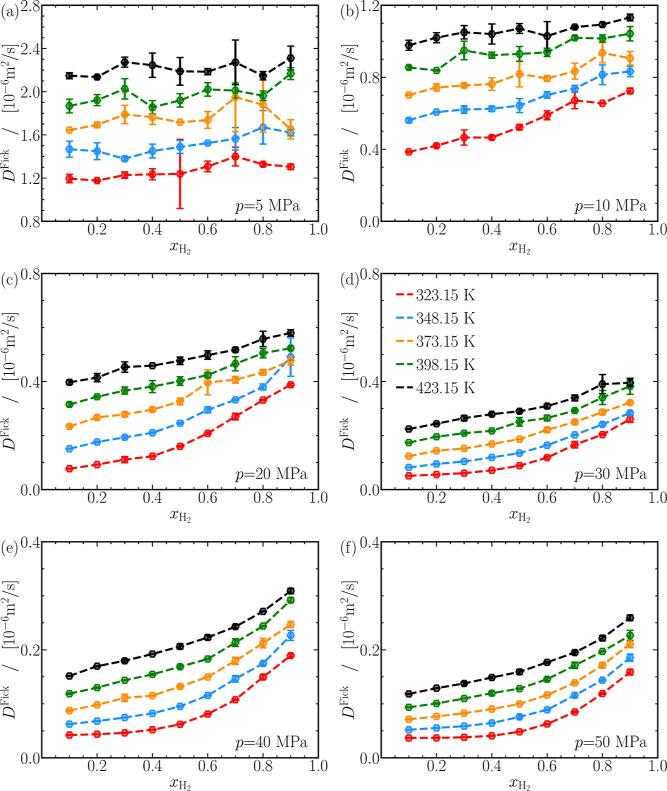
H-CO mixtures find wide-ranging applications, including their growing significance as synthetic fuels in the transportation industry, relevance in capture technologies for carbon capture and storage, occurrence in subsurface storage of hydrogen, and hydrogenation of carbon dioxide to form hydrocarbons and alcohols. Here, we focus on the thermodynamic properties of H-CO mixtures pertinent to underground hydrogen storage in depleted gas reservoirs. Molecular dynamics simulations are used to compute mutual (Fick) diffusivities for a wide range of pressures (5 to 50 MPa), temperatures (323.15 to 423.15 K), and mixture compositions (hydrogen mole fraction from 0 to 1). At 5 MPa, the computed mutual diffusivities agree within 5% with the kinetic theory of Chapman and Enskog at 423.15 K, albeit exhibiting deviations of up to 25% between 323.15 and 373.15 K. Even at 50 MPa, kinetic theory predictions match computed diffusivities within 15% for mixtures comprising over 80% H due to the ideal-gas-like behavior. In mixtures with higher concentrations of CO, the Moggridge correlation emerges as a dependable substitute for the kinetic theory. Specifically, when the CO content reaches 50%, the Moggridge correlation achieves predictions within 10% of the computed Fick diffusivities. Phase equilibria of ternary mixtures involving CO-H-NaCl were explored using Gibbs Ensemble (GE) simulations with the Continuous Fractional Component Monte Carlo (CFCMC) technique. The computed solubilities of CO and H in NaCl brine increased with the fugacity of the respective component but decreased with NaCl concentration (salting out effect). While the solubility of CO in NaCl brine decreased in the ternary system compared to the binary CO-NaCl brine system, the solubility of H in NaCl brine increased less in the ternary system compared to the binary H-NaCl brine system. The cooperative effect of H-CO enhances the H solubility while suppressing the CO solubility. The water content in the gas phase was found to be intermediate between H-NaCl brine and CO-NaCl brine systems. Our findings have implications for hydrogen storage and chemical technologies dealing with CO-H mixtures, particularly where experimental data are lacking, emphasizing the need for reliable thermodynamic data on H-CO mixtures.
H-CO混合物有着广泛的应用,包括在运输行业作为合成燃料的重要性日益增加、在碳捕获与封存的捕获技术中的相关性、在地下氢气储存中的出现情况以及二氧化碳加氢形成碳氢化合物和醇类。在此,我们关注与枯竭气藏中的地下氢气储存相关的H-CO混合物的热力学性质。分子动力学模拟用于计算在广泛的压力(5至50兆帕)、温度(323.15至423.15开尔文)和混合物组成(氢气摩尔分数从0到1)范围内的互扩散系数(菲克扩散系数)。在5兆帕时,计算得到的互扩散系数在423.15开尔文下与查普曼和恩斯科格的动力学理论的偏差在5%以内,尽管在323.15至373.15开尔文之间偏差高达25%。即使在50兆帕时,由于类似理想气体的行为,对于氢气含量超过80%的混合物,动力学理论预测与计算得到的扩散系数的偏差在15%以内。在CO浓度较高的混合物中,莫格里奇关联式成为动力学理论的可靠替代。具体而言,当CO含量达到50%时,莫格里奇关联式的预测与计算得到的菲克扩散系数的偏差在10%以内。使用吉布斯系综(GE)模拟和连续分数组分蒙特卡罗(CFCMC)技术研究了涉及CO-H-NaCl的三元混合物的相平衡。计算得到的CO和H在NaCl盐水中的溶解度随各自组分的逸度增加而增加,但随NaCl浓度降低(盐析效应)。虽然与二元CO-NaCl盐水体系相比,三元体系中CO在NaCl盐水中的溶解度降低,但与二元H-NaCl盐水体系相比,三元体系中H在NaCl盐水中的溶解度增加较少。H-CO的协同效应提高了H的溶解度,同时抑制了CO的溶解度。发现气相中的水含量介于H-NaCl盐水体系和CO-NaCl盐水体系之间。我们的研究结果对涉及CO-H混合物的氢气储存和化学技术具有启示意义,特别是在缺乏实验数据的情况下,强调了获取H-CO混合物可靠热力学数据的必要性。




 Zotero 插件