
端粒长度与新冠病毒疾病结局之间的因果关联和共同遗传学:来自最新大规模汇总统计数据的新证据
Causal association and shared genetics between telomere length and COVID-19 outcomes: New evidence from the latest large-scale summary statistics.
作者信息
Zhang Jingwei, Wen Jie, Dai Ziyu, Zhang Hao, Zhang Nan, Lei Ruoyan, Liu Zhixiong, Peng Luo, Cheng Quan
机构信息
Department of Neurosurgery, Xiangya Hospital, Central South University, Changsha, China.
Hypothalamic Pituitary Research Centre, Xiangya Hospital, Central South University, Changsha, China.
出版信息
Comput Struct Biotechnol J. 2024 May 10;23:2429-2441. doi: 10.1016/j.csbj.2024.05.012. eCollection 2024 Dec.
BACKGROUND
Observational studies suggested that leukocyte telomere length (LTL) is shortened in COVID-19 patients. However, the genetic association and causality remained unknown.
METHODS
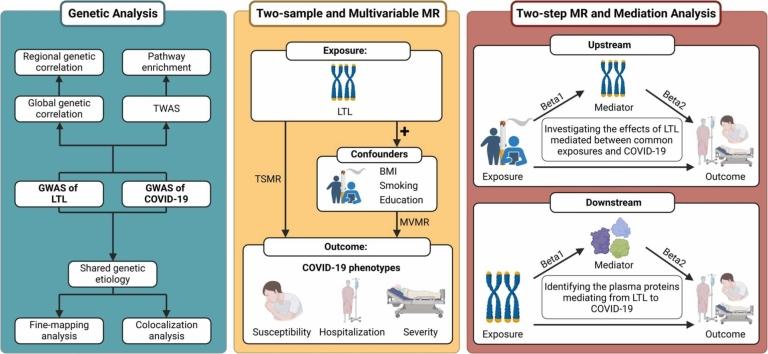
Based on the genome-wide association of LTL (N = 472,174) and COVID-19 phenotypes (N = 1086,211-2597,856), LDSC and SUPERGNOVA were used to estimate the genetic correlation. Cross-trait GWAS meta-analysis, colocalization, fine-mapping analysis, and transcriptome-wide association study were conducted to explore the shared genetic etiology. Mendelian randomization (MR) was utilized to infer the causality. Upstream and downstream two-step MR was performed to investigate the potential mediating effects.
RESULTS
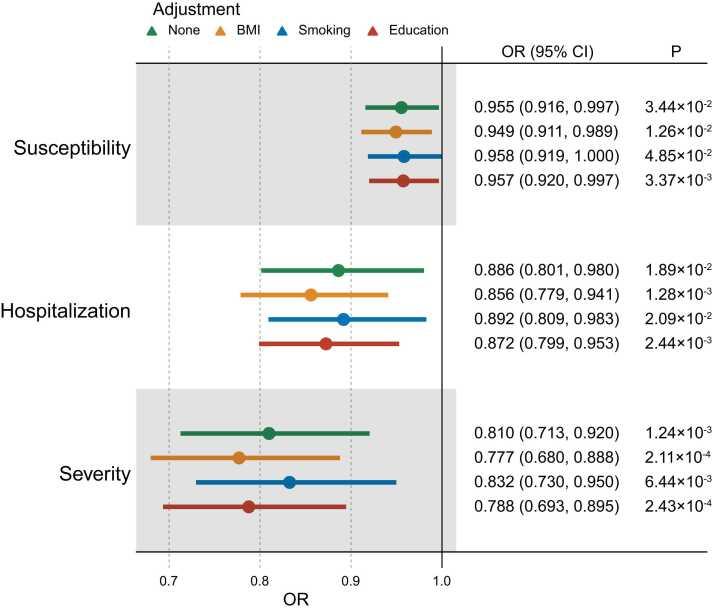
LDSC identified a significant genetic association between LTL and all COVID-19 phenotypes (rG < 0, < 0.05). Six significant regions were observed for LTL and COVID-19 susceptibility and hospitalization, respectively. Colocalization analysis found rs144204502, rs34517439, and rs56255908 were shared causal variants between LTL and COVID-19 phenotypes. Numerous biological pathways associated with LTL and COVID-19 outcomes were identified, mainly involved in -immune-related pathways. MR showed that longer LTL was significantly associated with a lower risk of COVID-19 severity (OR [95% CI] = 0.81 [0.71-0.92], = 1.24 ×10) and suggestively associated with lower risks of COVID-19 susceptibility (OR [95% CI] = 0.96 [0.92-1.00], = 3.44 ×10) and COVID-19 hospitalization (OR [95% CI] = 0.89 [0.80-0.98], = 1.89 ×10). LTL partially mediated the effects of BMI, smoking, and education on COVID-19 outcomes. Furthermore, six proteins partially mediated the causality of LTL on COVID-19 outcomes, including BNDF, QPCT, FAS, MPO, SFTPB, and APOF.
CONCLUSIONS
Our findings suggested that shorter LTL was genetically associated with a higher risk of COVID-19 phenotypes, with shared genetic etiology and potential causality.
背景
观察性研究表明,新冠病毒病(COVID-19)患者的白细胞端粒长度(LTL)缩短。然而,其遗传关联和因果关系仍不清楚。
方法
基于LTL(N = 472,174)和COVID-19表型(N = 1086,211 - 2597,856)的全基因组关联分析,使用连锁不平衡分数回归(LDSC)和SUPERGNOVA估计遗传相关性。进行跨性状全基因组关联研究(GWAS)荟萃分析、共定位分析、精细定位分析和转录组范围关联研究,以探索共同的遗传病因。利用孟德尔随机化(MR)推断因果关系。进行上游和下游两步MR以研究潜在的中介效应。
结果
LDSC确定LTL与所有COVID-19表型之间存在显著的遗传关联(rG < 0,P < 0.05)。分别观察到LTL与COVID-19易感性和住院治疗的6个显著区域。共定位分析发现rs144204502、rs34517439和rs56255908是LTL与COVID-19表型之间的共同因果变异。确定了许多与LTL和COVID-19结局相关的生物学途径,主要涉及免疫相关途径。MR显示,较长的LTL与较低的COVID-19严重程度风险显著相关(比值比[95%置信区间]=0.81[0.71 - 0.92],P = 1.24×10),并提示与较低的COVID-19易感性风险(比值比[95%置信区间]=0.96[0.92 - 1.00],P = 3.44×10)和COVID-19住院风险(比值比[95%置信区间]=0.89[0.80 - 0.98],P = 1.89×10)相关。LTL部分介导了体重指数、吸烟和教育对COVID-19结局的影响。此外,6种蛋白质部分介导了LTL对COVID-19结局的因果关系,包括脑源性神经营养因子(BNDF)、谷氨酰胺环化酶(QPCT)、凋亡相关因子配体(FAS)、髓过氧化物酶(MPO)、表面活性物质蛋白B(SFTPB)和载脂蛋白F(APOF)。
结论
我们的研究结果表明,较短的LTL与较高的COVID-19表型风险在遗传上相关,具有共同的遗传病因和潜在的因果关系。




 Zotero 插件