Jiang Li, Tang Bei-Sha, Guo Ji-Feng, Li Jin-Chen
National Clinical Research Center for Geriatric Disorders, Xiangya Hospital, Central South University, Changsha, China.
Center for Medical Genetics & Hunan Key Laboratory of Medical Genetics, School of Life Sciences, Central South University, Changsha, China.
Front Genet. 2022 May 23;13:805903. doi: 10.3389/fgene.2022.805903. eCollection 2022.
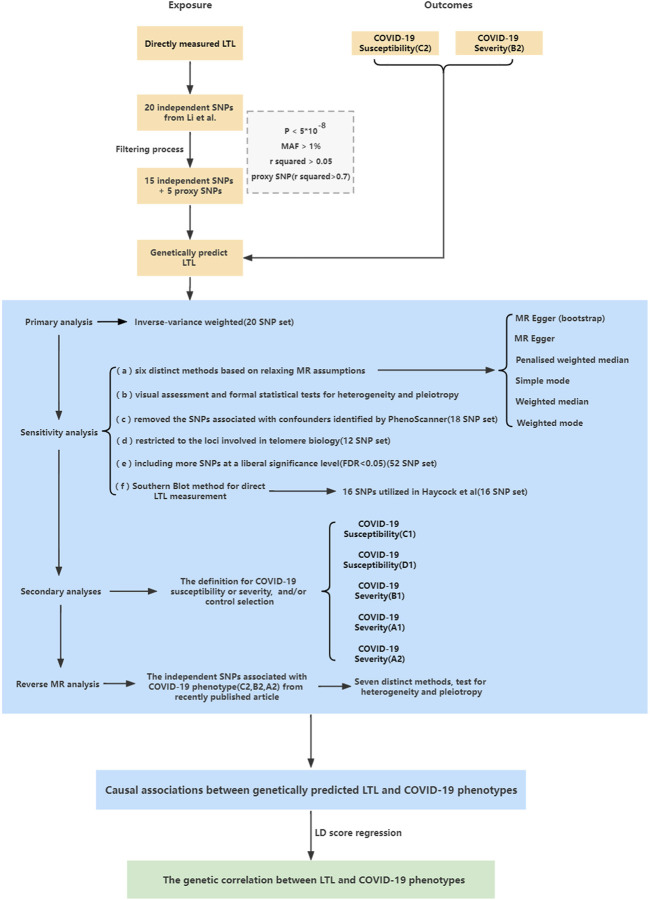
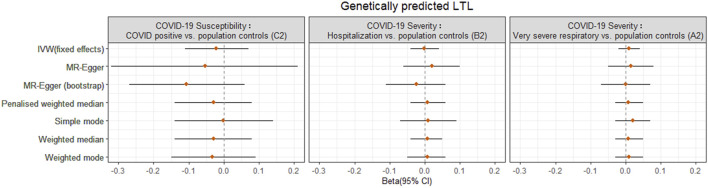
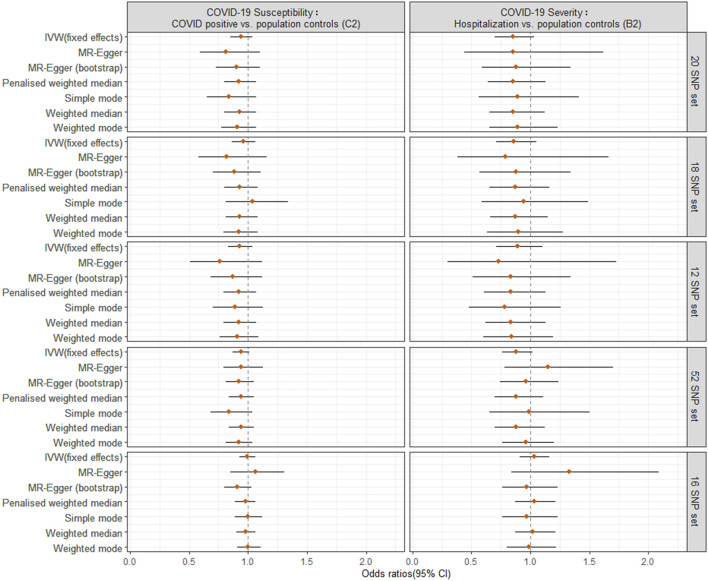
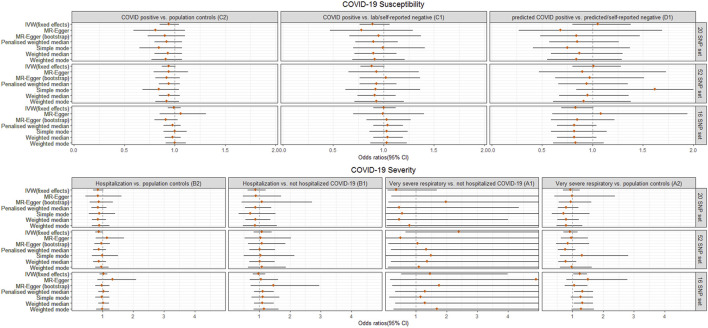
Observational studies have found a relationship between directly measured short leukocyte telomere length (LTL) and severe coronavirus disease 19 (COVID-19). We investigated the causal association between genetically predicted LTL and COVID-19 susceptibility or severity. A previous genome-wide association study (GWAS) of 78,592 European-ancestry participants identified single nucleotidepolymorphisms (SNPs) that can be utilized to genetically predict LTL. Summary-level data for COVID-19 outcomes were analyzed from the COVID-19 Host Genetics Initiative. A two-sample bidirectional Mendelian randomization (MR) study was designed to evaluate these causal relationships. Using an inverse-weighted MR analysis and population-based controls, genetically predicted LTL did not reveal any significant association with COVID-19 susceptibility (odds ratio (OR): 0.94; 95% CI: 0.85-1.04; = 0.202) or severity (OR: 0.85; 95% CI: 0.70-1.03; = 0.099). Similar results were found for five other definitions of cases/controls and/or COVID-19 outcomes. Six additional MR methods and sensitivity analyses were conducted after removing variants with potential horizontal pleiotropy and including variants at a liberal significance level, which produced similar results. Using SNPs identified for the prediction of LTL from another GWAS study, we found a non-significant association for COVID-19 susceptibility or severity with narrower CIs toward the null hypothesis. No proof of genetically predicted COVID-19 phenotypes remained causally associated with genetically predicted LTL, and the null association was consistent with a lack of significant genetic correlation. Genetic evidence does not support shorter LTL as a causal risk factor for COVID-19 susceptibility or severity.
观察性研究发现,直接测量的白细胞端粒短长度(LTL)与严重冠状病毒病19(COVID-19)之间存在关联。我们研究了基因预测的LTL与COVID-19易感性或严重程度之间的因果关系。先前一项针对78592名欧洲血统参与者的全基因组关联研究(GWAS)确定了可用于基因预测LTL的单核苷酸多态性(SNP)。从COVID-19宿主遗传学倡议中分析了COVID-19结果的汇总数据。设计了一项双样本双向孟德尔随机化(MR)研究来评估这些因果关系。使用反向加权MR分析和基于人群的对照,基因预测的LTL与COVID-19易感性(优势比(OR):0.94;95%置信区间:0.85-1.04;P = 0.202)或严重程度(OR:0.85;95%置信区间:0.70-1.03;P = 0.099)未显示出任何显著关联。对于病例/对照和/或COVID-19结果的其他五种定义也发现了类似结果。在去除具有潜在水平多效性的变体并纳入宽松显著性水平的变体后,进行了另外六种MR方法和敏感性分析,结果相似。使用从另一项GWAS研究中确定用于预测LTL的SNP,我们发现COVID-19易感性或严重程度与向零假设方向更窄的置信区间之间存在非显著关联。没有证据表明基因预测的COVID-19表型与基因预测的LTL存在因果关联,且零关联与缺乏显著的遗传相关性一致。遗传证据不支持较短的LTL作为COVID-19易感性或严重程度的因果风险因素。