Department of Anesthesiology Surgery, Shanxi Provincial People's Hospital, Taiyuan, Shanxi, China.
Department of Neurosurgery, Shanxi Provincial People's Hospital, Taiyuan, Shanxi, China.
Front Public Health. 2024 May 31;12:1408378. doi: 10.3389/fpubh.2024.1408378. eCollection 2024.
This prospective cohort study aims to evaluate the impact of digital health technology especially Personal Digital Assistants (PDA) in neurosurgical procedure management, focusing on surgical safety check accuracy, efficiency, and patient satisfaction.
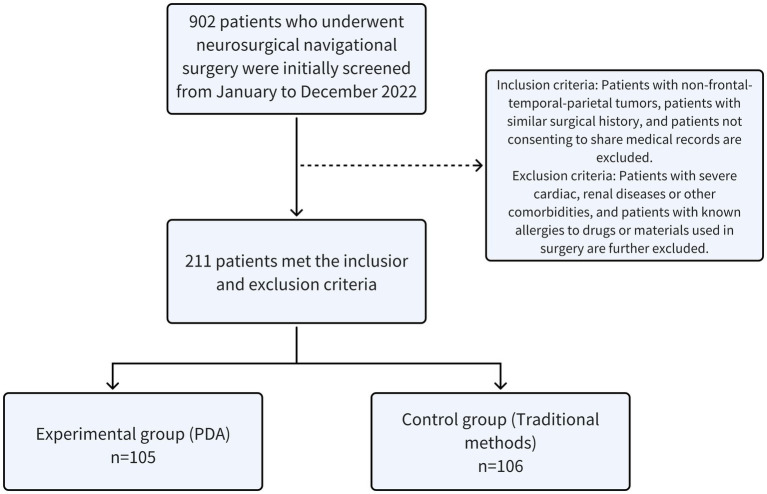
The study included 211 neurosurgical cases from January to December 2022. The control group of 106 patients followed traditional verification methods, while the experimental group of 105 patients used PDA. The PDA system facilitated real-time data collection, verification, and transmission. The study compared both groups in terms of check times, accuracy rates, and patient satisfaction, and used multivariate regression to assess the impact of baseline parameters on these outcomes.
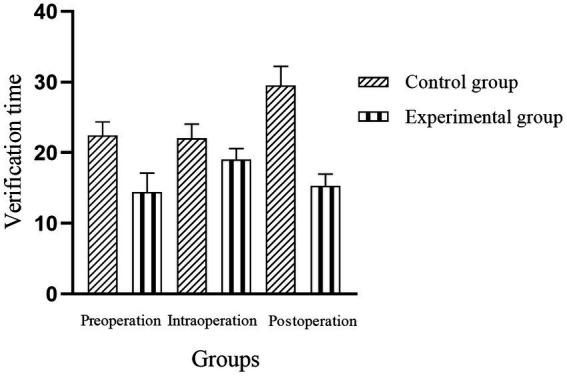
The study found that the experimental group using the PDA system reduced the average verification time by approximately 8 min, achieving 100.0% accuracy in preoperative and postoperative checks, significantly better than the control group (91.5% pre- and post-operation). Multivariate regression confirmed a 48.1% reduction in postoperative verification time due to the PDA system ( < 0.001), with the model showing high explanatory power (R = 0.911). Other examined factors, including patient age and nurse experience, had no significant effects. Similarly, the PDA's introduction markedly improved verification accuracy, with no significant impact from other variables ( = 0.010).
The application of the PDA system in neurosurgical operations significantly enhanced the accuracy and efficiency of surgical safety checks, reduced nursing errors, optimized nursing workflows, and improved patient satisfaction. These results provide valuable insights for the application of PDA technology in high-risk medical fields, demonstrating potential of digital health tools in enhancing surgical safety and efficiency.
本前瞻性队列研究旨在评估数字医疗技术(尤其是个人数字助理,PDA)在神经外科手术管理中的影响,重点关注手术安全核对的准确性、效率和患者满意度。
该研究纳入了 2022 年 1 月至 12 月期间的 211 例神经外科病例。对照组 106 例患者采用传统的验证方法,而实验组 105 例患者使用 PDA。PDA 系统便于实时数据收集、验证和传输。本研究比较了两组在核对次数、准确率和患者满意度方面的差异,并使用多变量回归评估了基线参数对这些结果的影响。
研究发现,实验组使用 PDA 系统将平均核对时间缩短了约 8 分钟,术前和术后核对准确率达到 100.0%,明显优于对照组(术前和术后分别为 91.5%)。多变量回归证实,由于使用了 PDA 系统,术后核对时间减少了 48.1%( <0.001),模型显示出较高的解释力(R2=0.911)。其他检查因素,包括患者年龄和护士经验,没有显著影响。同样,PDA 的引入显著提高了核对准确性,其他变量没有显著影响( =0.010)。
PDA 系统在神经外科手术中的应用显著提高了手术安全核对的准确性和效率,减少了护理差错,优化了护理工作流程,提高了患者满意度。这些结果为 PDA 技术在高风险医疗领域的应用提供了有价值的见解,展示了数字健康工具在提高手术安全性和效率方面的潜力。