
两性离子纳米颗粒用于热激活药物递送来治疗癌症的高温疗法。
Zwitterionic nanoparticles for thermally activated drug delivery in hyperthermia cancer treatment.
机构信息
Department of Chemistry, Materials and Chemical Engineering "G. Natta", Politecnico di Milano, piazza L. da Vinci 32, 20133 Milan, Italy.
Institute of Molecular Biology and Pathology, National Research Council (CNR), Rome 00185, Italy.
出版信息
Nanoscale. 2024 Jul 4;16(26):12635-12649. doi: 10.1039/d4nr00723a.
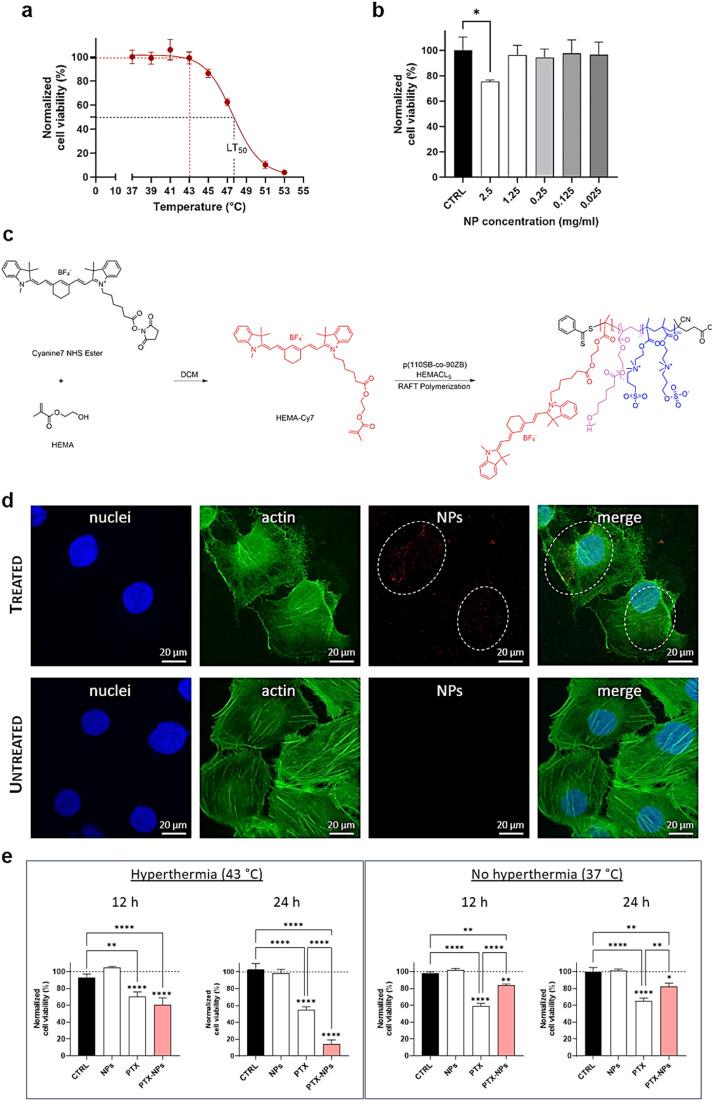
Hyperthermia is considered a promising strategy to boost the curative outcome of traditional chemotherapeutic treatments. However, this thermally mediated drug delivery is still affected by important limitations. First, the poor accumulation of the conventional anticancer formulations in the target site limits the bioavailability of the active ingredient and induces off-site effects. In addition, some tumoral scenarios, such as ovarian carcinoma, are characterized by cell thermotolerance, which induces tumoral cells to activate self-protecting mechanisms against high temperatures. To overcome these constraints, we developed thermoresponsive nanoparticles (NPs) with an upper critical solution temperature (UCST) to intracellularly deliver a therapeutic payload and release it on demand through hyperthermia stimulation. These NPs were synthesized reversible addition-fragmentation chain transfer (RAFT) emulsion polymerization and combine polyzwitterionic stabilizing segments and an oligoester-based biodegradable core. By leveraging the pseudo-living nature of RAFT polymerization, important physicochemical properties of the NPs were controlled and optimized, including their cloud point () and size. We have tuned the of NPs to match the therapeutic needs of hyperthermia treatments at 43 °C and tested the nanocarriers in the controlled delivery of paclitaxel, a common anticancer drug. The NPs released almost entirely the encapsulated drug only following 1 h incubation at 43 °C, whereas they retained more than 95% of the payload in the physiological environment (37 °C), thus demonstrating their efficacy as on-demand drug delivery systems. The administration of drug-loaded NPs to ovarian cancer cells led to therapeutic effects outperforming the conventional administration of non-encapsulated paclitaxel, which highlights the potential of the zwitterionic UCST-type NPs as an innovative hyperthermia-responsive drug delivery system.
热疗被认为是一种有前途的策略,可以提高传统化学治疗的治疗效果。然而,这种热介导的药物递送仍然受到重要限制。首先,常规抗癌制剂在靶部位的积累不良限制了有效成分的生物利用度,并诱导了非靶部位的作用。此外,一些肿瘤情况,如卵巢癌,其特征是细胞耐热性,这会诱导肿瘤细胞激活针对高温的自我保护机制。为了克服这些限制,我们开发了具有上临界溶液温度(UCST)的热响应性纳米粒子(NPs),以在细胞内递送治疗有效载荷,并通过热疗刺激按需释放。这些 NPs 通过可逆加成-断裂链转移(RAFT)乳液聚合合成,结合聚两性离子稳定段和基于低聚酯的可生物降解核。通过利用 RAFT 聚合的假活性质,可以控制和优化 NPs 的重要物理化学性质,包括其浊点()和尺寸。我们已经调整了 NPs 的 以匹配 43°C 热疗的治疗需求,并在紫杉醇(一种常见的抗癌药物)的受控递送上测试了纳米载体。只有在 43°C 孵育 1 小时后,NP 才几乎完全释放包裹的药物,而在生理环境(37°C)中保留超过 95%的载药量,从而证明了它们作为按需药物递送系统的功效。载药 NP 的给药导致的治疗效果优于非包裹紫杉醇的常规给药,这突出了两性离子 UCST 型 NPs 作为一种创新的热响应性药物递送系统的潜力。




 Zotero 插件