
适体靶向的Ecoflex纳米颗粒用于多西他赛递送治疗卵巢癌的药代动力学及体内外抗肿瘤疗效
Pharmacokinetics and in vitro/in vivo antitumor efficacy of aptamer-targeted Ecoflex nanoparticles for docetaxel delivery in ovarian cancer.
作者信息
Ghassami Erfaneh, Varshosaz Jaleh, Jahanian-Najafabadi Ali, Minaiyan Mohsen, Rajabi Parvin, Hayati Effat
机构信息
Department of Pharmaceutics, School of Pharmacy and Novel Drug Delivery Systems Research Centre.
Department of Pharmaceutical Biotechnology.
出版信息
Int J Nanomedicine. 2018 Jan 23;13:493-504. doi: 10.2147/IJN.S152474. eCollection 2018.
PURPOSE
Epithelixal ovarian cancer is the fourth cause of cancer death in developed countries with 77% of ovarian cancer cases diagnosed with regional or distant metastasis, with poor survival rates. Docetaxel (DTX) is a well-known anticancer agent, with clinically proven efficacy in several malignancies, including ovarian cancer. However, the adverse effects caused by the active ingredient or currently marketed formulations could even deprive the patient of the advantages of treatment. Therefore, in the current study, polymeric nanoparticles (NPs) equipped with aptamer molecules as targeting agents were proposed to minimize the adverse effects and enhance the antitumor efficacy through directing the drug cargo toward its site of action.
MATERIALS AND METHODS
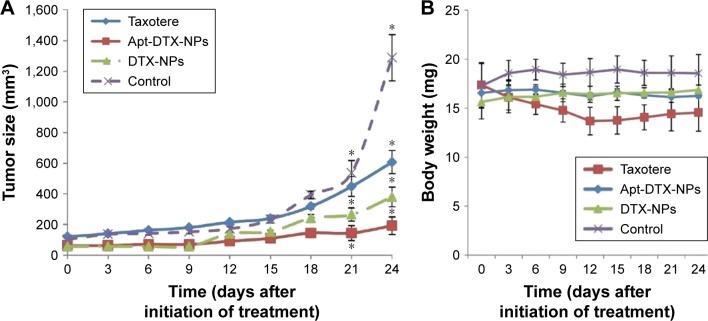
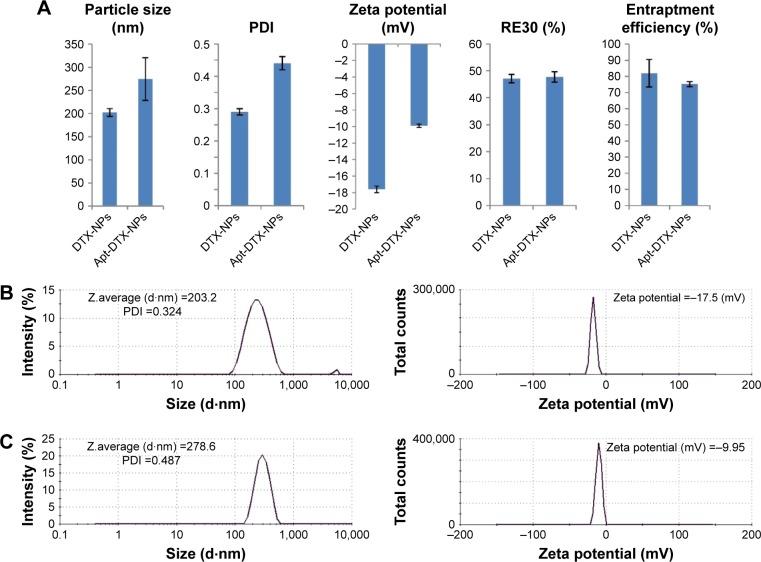
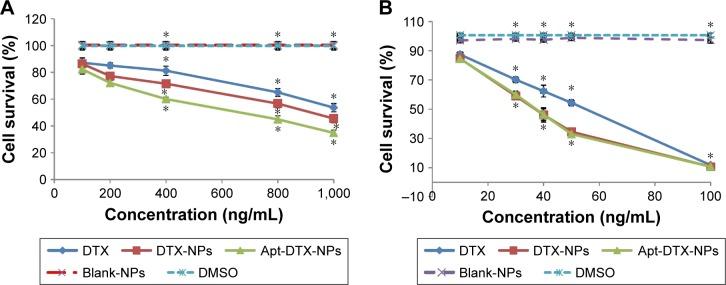
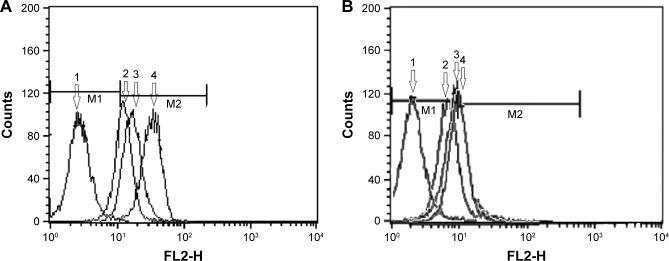
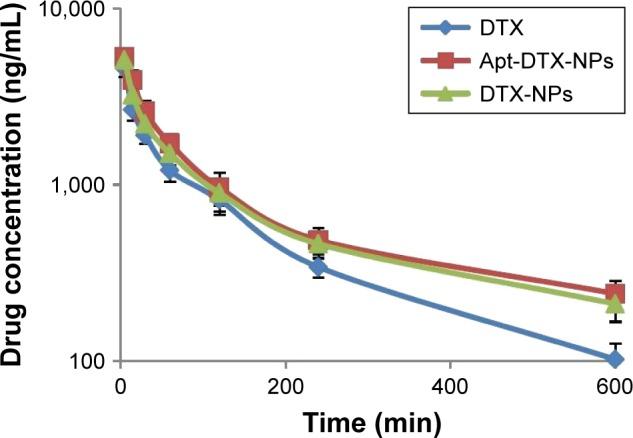
Electrospraying technique was implemented to fabricate poly (butylene adipate-co-butylene terephthalate) (Ecoflex) NPs loaded with DTX (DTX-NPs). Afterward, aptamer molecules were added to the DTX-NPs, which bound via covalent bonds (Apt-DTX-NPs). The particle size, size distribution, zeta potential, entrapment efficiency, and release profile of the NPs were characterized. Using MTT assay and flow-cytometry analysis, the in vitro cytotoxicity and cellular uptake of the NPs were compared to those of the free drug. Following intravenous administration of Taxotere, DTX-NPs, and Apt-DTX-NPs (at an equivalent dose of 5 mg/kg of DTX), pharmacokinetic parameters and antitumor efficacy were compared in female Balb/c and HER-2-overexpressing tumor-bearing B6 athymic mice, respectively.
RESULTS
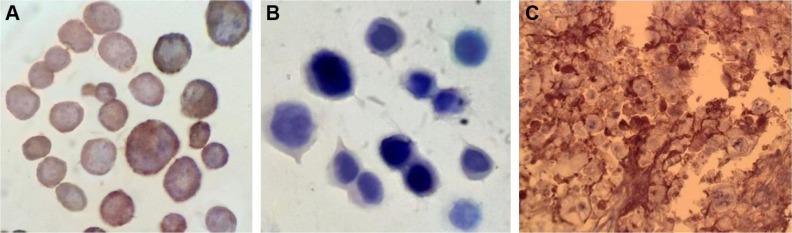
The obtained results demonstrated significantly enhanced in vitro cytotoxicity and cellular uptake of Apt-DTX-NPs in a HER-2-overexpressing cell line, comparing to DTX-NPs and the free drug. The results of in vivo studies indicated significant increment in pharmacokinetic parameters including the area under the plasma concentration-time curve, mean residence time, and elimination half-life. Significant increment in antitumor efficacy was also observed, probably due to the targeted delivery of DTX to the tumor site and enhanced cellular uptake as evaluated in the aforementioned tests.
CONCLUSION
Hence, the proposed drug delivery system could be considered as an appropriate potential substitute for currently marketed DTX formulations.
目的
上皮性卵巢癌是发达国家癌症死亡的第四大原因,77%的卵巢癌病例在诊断时已出现局部或远处转移,生存率较低。多西他赛(DTX)是一种知名的抗癌药物,在包括卵巢癌在内的多种恶性肿瘤中具有临床证实的疗效。然而,活性成分或目前市售制剂所引起的不良反应甚至可能使患者无法享受治疗的益处。因此,在本研究中,提出了配备适配体分子作为靶向剂的聚合物纳米颗粒(NPs),以通过将药物输送至其作用部位来最小化不良反应并增强抗肿瘤疗效。
材料与方法
采用电喷雾技术制备负载多西他赛的聚(己二酸丁二醇酯 - 对苯二甲酸丁二醇酯)(Ecoflex)纳米颗粒(DTX - NPs)。随后,将适配体分子添加到DTX - NPs中,通过共价键结合(Apt - DTX - NPs)。对纳米颗粒的粒径、粒径分布、zeta电位、包封率和释放曲线进行了表征。使用MTT法和流式细胞术分析,将纳米颗粒的体外细胞毒性和细胞摄取与游离药物进行了比较。分别在雌性Balb/c小鼠和HER - 2过表达的荷瘤B6无胸腺小鼠中静脉注射泰索帝、DTX - NPs和Apt - DTX - NPs(等效剂量为5mg/kg DTX)后,比较了药代动力学参数和抗肿瘤疗效。
结果
所得结果表明,与DTX - NPs和游离药物相比,在HER - 2过表达的细胞系中,Apt - DTX - NPs的体外细胞毒性和细胞摄取显著增强。体内研究结果表明,药代动力学参数包括血浆浓度 - 时间曲线下面积、平均驻留时间和消除半衰期均显著增加。还观察到抗肿瘤疗效显著提高,这可能是由于如上述试验所评估的,DTX靶向递送至肿瘤部位并增强了细胞摄取。
结论
因此,所提出的药物递送系统可被视为目前市售DTX制剂的合适潜在替代品。
 Zotero 插件