Population Health Research Institute, St George's University of London, London, UK
Department of Rheumatology, Aarhus University Hospital, Aarhus, Denmark.
RMD Open. 2024 Jun 17;10(2):e004032. doi: 10.1136/rmdopen-2023-004032.
To understand (1) what guidance exists to assess the methodological quality of qualitative research; (2) what methods exist to grade levels of evidence from qualitative research to inform recommendations within European Alliance of Associations for Rheumatology (EULAR).
A systematic literature review was performed in multiple databases including PubMed/Medline, EMBASE, Web of Science, COCHRANE and PsycINFO, from inception to 23 October 2020. Eligible studies included primary articles and guideline documents available in English, describing the: (1) development; (2) application of validated tools (eg, checklists); (3) guidance on assessing methodological quality of qualitative research and (4) guidance on grading levels of qualitative evidence. A narrative synthesis was conducted to identify key similarities between included studies.
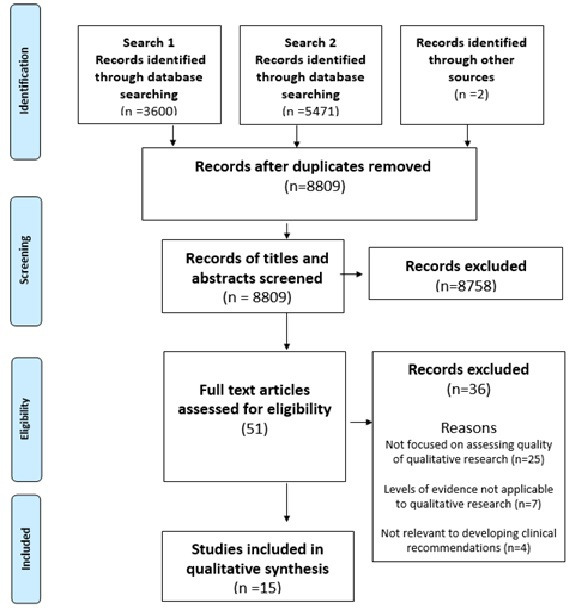
Of 9073 records retrieved, 51 went through to full-manuscript review, with 15 selected for inclusion. Six articles described methodological tools to assess the quality of qualitative research. The tools evaluated research design, recruitment, ethical rigour, data collection and analysis. Seven articles described one approach, focusing on four key components to determine how much confidence to place in findings from systematic reviews of qualitative research. Two articles focused on grading levels of clinical recommendations based on qualitative evidence; one described a qualitative evidence hierarchy, and another a research pyramid.
There is a lack of consensus on the use of tools, checklists and approaches suitable for appraising the methodological quality of qualitative research and the grading of qualitative evidence to inform clinical practice. This work is expected to facilitate the inclusion of qualitative evidence in the process of developing recommendations at EULAR level.
了解(1)评估定性研究方法学质量的指南有哪些;(2)有哪些方法可以对定性研究的证据水平进行分级,为欧洲抗风湿病联盟(EULAR)的建议提供信息。
在多个数据库中进行了系统的文献回顾,包括 PubMed/Medline、EMBASE、Web of Science、COCHRANE 和 PsycINFO,时间范围为从开始到 2020 年 10 月 23 日。符合条件的研究包括描述以下内容的原始文章和指南文件:(1)制定;(2)使用经过验证的工具(例如检查表);(3)评估定性研究方法学质量的指南;(4)定性证据分级的指南。进行了叙述性综合,以确定纳入研究之间的关键相似之处。
从 9073 条记录中检索到的 51 条记录进行了全文审查,其中 15 条被选中纳入。六篇文章描述了评估定性研究质量的方法学工具。这些工具评估了研究设计、招募、伦理严谨性、数据收集和分析。七篇文章描述了一种方法,重点关注四个关键组成部分,以确定对系统性评价定性研究结果的置信度。两篇文章专注于基于定性证据的临床推荐分级;一篇描述了定性证据等级,另一篇描述了研究金字塔。
在评估定性研究的方法学质量和分级定性证据以指导临床实践方面,缺乏对工具、检查表和方法的共识。这项工作有望促进在 EULAR 层面制定建议的过程中纳入定性证据。