Department of Hepatobiliary Surgery, The First Affiliated Hospital of Chongqing Medical University, Chongqing, China.
Department of Hepatopancreatobiliary Surgery, Taizhou Hospital of Zhejiang Province Affiliated to Wenzhou Medical University, Taizhou, Zhejiang, China.
Front Immunol. 2024 Jun 3;15:1390938. doi: 10.3389/fimmu.2024.1390938. eCollection 2024.
Multiple investigations and scholarly articles have presented compelling evidence indicating that tertiary lymphoid structures (TLS) play a pivotal role in inhibiting and controlling the advancement of tumors. While there is an abundance of information highlighting the importance of TLS in different cancer types, their prognostic significance specifically in hepatocellular carcinoma (HCC) cancers remains unclear. Thus, this meta-analysis aimed to explore the prognostic relevance of TLS in HCC.
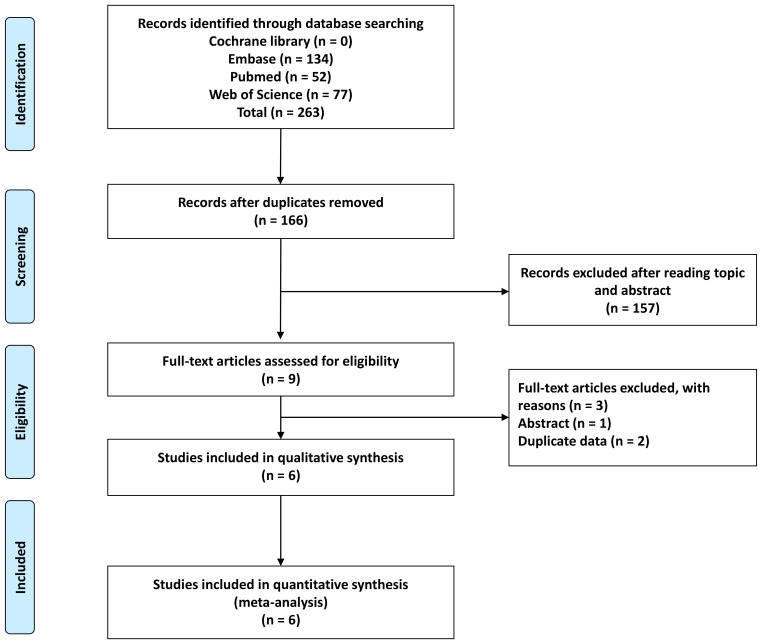
We conducted a thorough search across four databases, namely Web of Science, PubMed, Embase, and the Cochrane Library, to identify pertinent studies. The search utilized the keywords "tertiary lymphoid structures" and "hepatocellular carcinoma." The primary outcomes of interest encompassed overall survival (OS), recurrence-free survival (RFS), early recurrence, and late recurrence. The statistical effect size for these measures was expressed in terms of hazard ratios (HR).
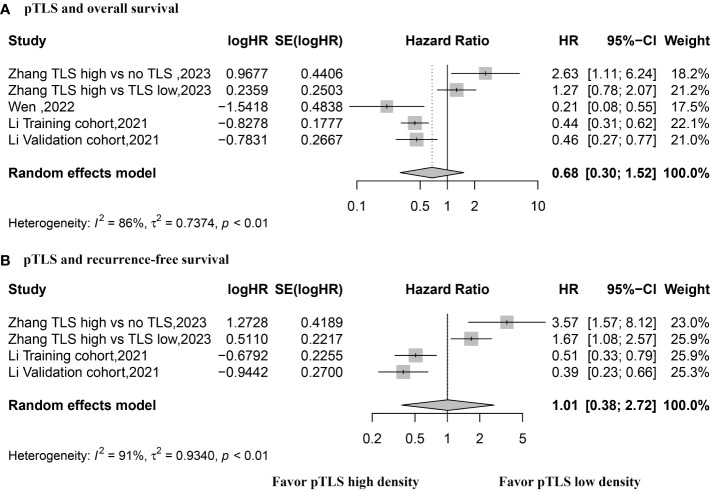
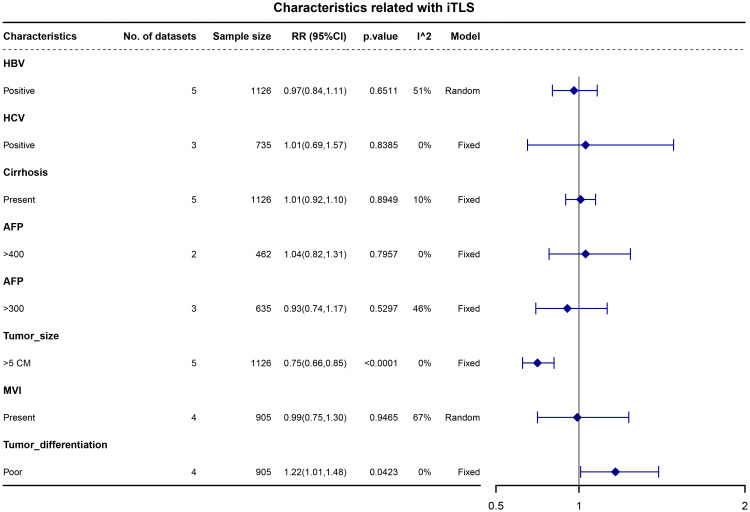
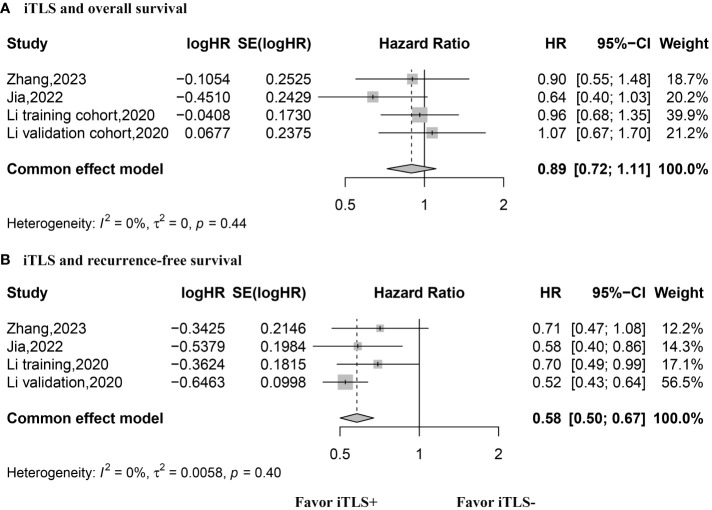
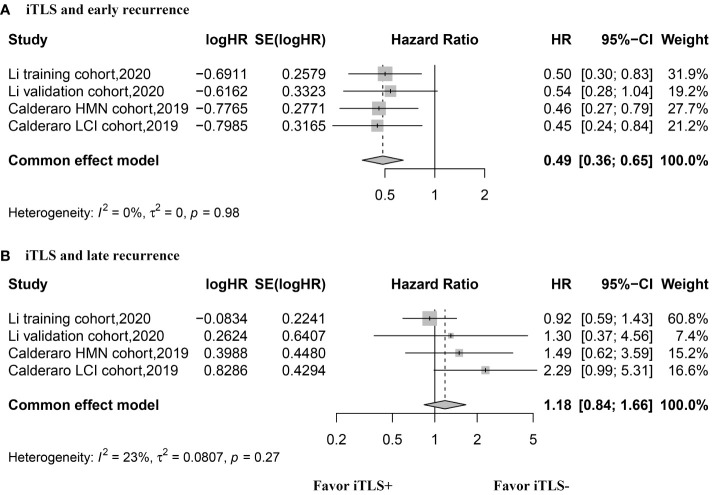
Six studies were incorporated into the analysis. Among them, four studies, encompassing 6 datasets and involving 1490 patients, and three studies, comprising 5 datasets and involving 656 patients, respectively, investigated the correlation between intratumoral and peritumoral TLSs and the prognosis in HCC patients. The meta-analysis revealed that the presence of intratumoral TLSs is linked to longer RFS and reduced early recurrence (HR, 0.60; 95% CI, 0.50-0.67; p <0.001 and HR, 0.49; 95% CI, 0.36-0.65; p <0.001, respectively). However, no significant association was observed with OS and late recurrence. Sensitivity analysis demonstrated the robustness of these findings, and heterogeneities were minimal. Additionally, the meta-analysis did not detect a relationship between peritumoral TLSs and OS or RFS in HCC patients.
The presence of intratumoral TLSs is correlated with better RFS and reduced early recurrence in HCC patients. Further investigation is warranted to elucidate the roles of peritumoral TLSs in the prognosis of HCC patients.
https://www.crd.york.ac.uk/PROSPERO/#recordDetails, identifier CRD42023466793.
多项研究和学术文章提供了令人信服的证据,表明三级淋巴结构 (TLS) 在抑制和控制肿瘤进展方面发挥着关键作用。虽然有大量信息强调了 TLS 在不同癌症类型中的重要性,但它们在肝细胞癌 (HCC) 中的预后意义尚不清楚。因此,这项荟萃分析旨在探讨 TLS 在 HCC 中的预后相关性。
我们在 Web of Science、PubMed、Embase 和 Cochrane Library 这四个数据库中进行了全面搜索,以确定相关研究。搜索使用了“三级淋巴结构”和“肝细胞癌”这两个关键词。主要的研究结果包括总生存期 (OS)、无复发生存期 (RFS)、早期复发和晚期复发。这些指标的统计效应大小用风险比 (HR) 表示。
有 6 项研究被纳入分析。其中,4 项研究,包括 6 个数据集,涉及 1490 名患者,3 项研究,包括 5 个数据集,涉及 656 名患者,分别研究了肿瘤内和肿瘤周围 TLS 与 HCC 患者预后之间的相关性。荟萃分析显示,肿瘤内 TLS 的存在与更长的 RFS 和减少早期复发相关 (HR,0.60;95%CI,0.50-0.67;p<0.001 和 HR,0.49;95%CI,0.36-0.65;p<0.001)。然而,与 OS 和晚期复发无显著相关性。敏感性分析证明了这些发现的稳健性,且异质性很小。此外,荟萃分析并未发现肿瘤周围 TLS 与 HCC 患者的 OS 或 RFS 之间存在关系。
肿瘤内 TLS 的存在与 HCC 患者的 RFS 延长和早期复发减少相关。需要进一步研究以阐明肿瘤周围 TLS 在 HCC 患者预后中的作用。
https://www.crd.york.ac.uk/PROSPERO/#recordDetails,标识符 CRD42023466793。