From the Queen Square MS Centre (O.C., F.B., A.E., A.T.T.), Department of Neuroinflammation, UCL Queen Square Institute of Neurology, Faculty of Brain Sciences, University College London; National Institute for Health and Care Research (NIHR) (O.C.), University College London Hospitals (UCLH) Biomedical Research Centre; Centre for Medical Image Computing (F.B.), University College London, United Kingdom; Department of Radiology and Nuclear Medicine (F.B.), Amsterdam UMC, Vrije Universiteit Amsterdam, the Netherlands; Department of Neurosciences, Biomedicine and Movement Sciences (M.C.), University of Verona; Department of Medicine, Surgery and Neuroscience (N.D.S.), University of Siena; Neuroimaging Research Unit (M.F., M.A.R.), Division of Neuroscience, and Neurology Unit (M.F., M.A.R.), Neurorehabilitation Unit, Neurophysiology Service, IRCCS San Raffaele Scientific Institute; Vita-Salute San Raffaele University (M.F., M.A.R.), Milan; Department of Neuroscience (C. Gasperini), San Camillo Hospital, Rome, Italy; Translational Imaging in Neurology (ThINK) Basel (C. Granziera, L.K.), Department of Biomedical Engineering, Faculty of Medicine, University Hospital Basel and University of Basel; Research Center for Clinical Neuroimmunology and Neuroscience Basel (RC2NB) (C. Granziera, L.K.); University Hospital Basel and University of Basel (C. Granziera, L.K.), Switzerland; Section of Neuroradiology (À.R.), Department of Radiology, and Multiple Sclerosis Centre of Catalonia (J.S.-G., C.T.), Department of Neurology, Hospital Universitari Vall d'Hebron, Universitat Autònoma de Barcelona, Spain; Department of Health Sciences (M.P.S.), University of Genova; and IRCCS Ospedale Policlinico San Martino (M.P.S.), Genova, Italy.
Neurology. 2024 Jul 9;103(1):e209444. doi: 10.1212/WNL.0000000000209444. Epub 2024 Jun 18.
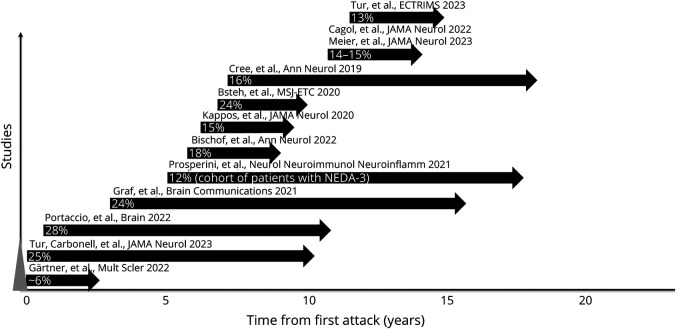
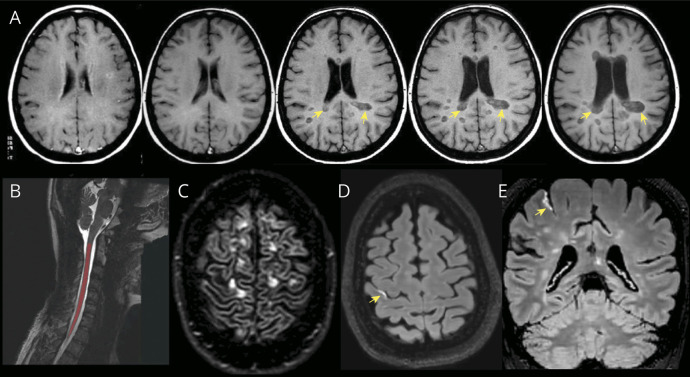
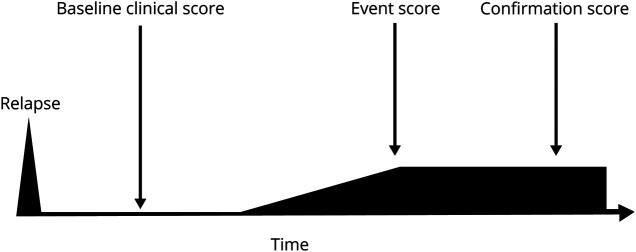
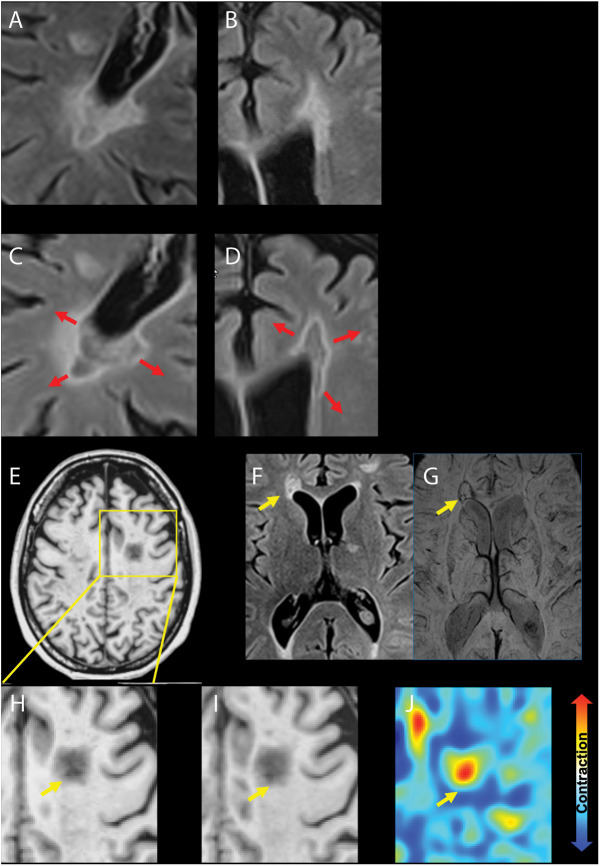
Progression independent of relapse activity (PIRA), a recent concept to formalize disability accrual in multiple sclerosis (MS) independent of relapses, has gained popularity as a potential clinical trial outcome. We discuss its shortcomings and appraise the challenges of implementing it in clinical settings, experimental trials, and research. The current definition of PIRA assumes that acute inflammation, which can manifest as a relapse, and neurodegeneration, manifesting as progressive disability accrual, can be disentangled by introducing specific time windows between the onset of relapses and the observed increase in disability. The term PIRMA (progression independent of relapse and MRI activity) was recently introduced to indicate disability accrual in the absence of both clinical relapses and new brain and spinal cord MRI lesions. Assessing PIRMA in clinical practice is highly challenging because it necessitates frequent clinical assessments and brain and spinal cord MRI scans. PIRA is commonly assessed using Expanded Disability Status Scale, a scale heavily weighted toward motor disability, whereas a more granular assessment of disability deterioration, including cognitive decline, using composite measures or other tools, such as digital tools, would possess greater utility. Similarly, using PIRA as an outcome measure in randomized clinical trials is also challenging and requires methodological considerations. The underpinning pathobiology of disability accumulation, that is not associated with relapses, may encompass chronic active lesions (slowly expanding lesions and paramagnetic rim lesions), cortical lesions, brain and spinal cord atrophy, particularly in the gray matter, diffuse and focal microglial activation, persistent leptomeningeal enhancement, and white matter tract damage. We propose to use PIRA to understand the main determinant of disability accrual in observational, cohort studies, where regular MRI scans are not included, and introduce the term of "advanced-PIRMA" to investigate the contributions to disability accrual of the abovementioned processes, using conventional and advanced imaging. This is supported by the knowledge that MRI reflects the MS pathogenic mechanisms better than purely clinical descriptors. Any residual disability accrual, which remains unexplained after considering all these mechanisms with imaging, will highlight future research priorities to help complete our understanding of MS pathogenesis.
进展独立于复发活动(PIRA),这是一个最近的概念,旨在将多发性硬化症(MS)中的残疾累积形式化,独立于复发,已作为潜在的临床试验结果而受到欢迎。我们讨论了其缺点,并评估了在临床环境、实验试验和研究中实施它的挑战。目前 PIRA 的定义假设急性炎症(表现为复发)和神经退行性变(表现为进行性残疾累积)可以通过在复发开始和观察到的残疾增加之间引入特定的时间窗口来分开。最近引入了 PIRMA(无复发和 MRI 活动的进展)一词,以表示在无临床复发和新的脑和脊髓 MRI 病变的情况下残疾的累积。在临床实践中评估 PIRMA 具有很高的挑战性,因为它需要频繁的临床评估和脑和脊髓 MRI 扫描。PIRA 通常使用扩展残疾状态量表(EDSS)进行评估,该量表严重偏向于运动残疾,而使用综合措施或其他工具(如数字工具)对残疾恶化进行更精细的评估,例如认知能力下降,将具有更大的实用性。同样,在随机临床试验中使用 PIRA 作为结局指标也具有挑战性,需要考虑方法学。与复发无关的残疾累积的潜在病理生物学可能包括慢性活动性病变(缓慢扩大的病变和顺磁性边缘病变)、皮质病变、脑和脊髓萎缩,特别是灰质、弥漫性和局灶性小胶质细胞激活、持续的软脑膜增强和白质束损伤。我们建议使用 PIRA 来理解在没有定期 MRI 扫描的观察性队列研究中残疾累积的主要决定因素,并引入“高级 PIRMA”一词,使用常规和先进的成像技术来研究上述过程对残疾累积的贡献。这是基于这样的认识,即 MRI 比单纯的临床描述更能反映 MS 的发病机制。考虑到所有这些具有影像学特征的机制后,仍有未解释的残余残疾累积,这将突出未来的研究重点,以帮助我们更好地理解 MS 的发病机制。