Department of Clinical and Experimental Sciences, Section of Neuroscience, Observatory of Perinatal Clinical Psychology, University of Brescia, Viale Europa 11, Brescia, 25123, Italy.
School of Psychology and Clinical Language Sciences, University of Reading, Reading, UK.
Trials. 2024 Jun 19;25(1):395. doi: 10.1186/s13063-024-08232-4.
Research in the neurosciences has highlighted the importance of intersubjective relationships in promoting neuromental development of the child. Children's learning in early childhood occurs mainly in a dyadic context of an interaction with their parents: from this perspective, good dialogic parent-child communication is required to be promoted also through good educational practices. Dialogic Book-Sharing (DBS), a dialogic form of parent-child communication through the use of wordless picture books, provides a privileged 'intersubjective' space and is highly effective in promoting communication, language, attention, behavioural development and the parent-child relationship. DBS programme, successfully previously trialled in South Africa and the UK, will be applied for the first time in Italy for research purposes in Italian health, educational and maternal-child centres.
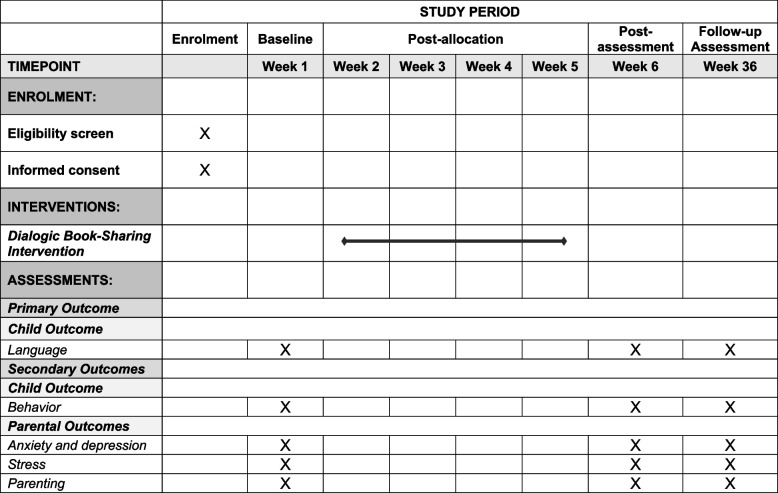
A multicentre randomised controlled trial is being conducted to evaluate DBS parenting intervention for children aged between 14 and 20 months. Parent-child dyads are randomly allocated to a book-sharing intervention group or to a wait-list control group. In the intervention, parents are trained in supportive book-sharing with their children by local staff of the centres. DBS intervention is carried out in small groups over a period of 4 weeks. Data are collected at baseline, post-intervention and at 6 months post-intervention with a questionnaire and video recording of parent-child interaction.
DBS programme in early childhood could enhance the educational resources offered by Italian health, educational and maternal-child centres, in support of child's development and parenting. DBS represents a strategic opportunity for bringing about positive effects, also in terms of prevention of socio-emotional and cognitive difficulties. As such it represents a promising response to the new social, health and educational needs of the post-COVID-19 pandemic era caused by the social isolation measures. Furthermore, the application of the DBS methodology is a way to promote the use of books, and thereby counteract the excessive use of technological devices already present in early childhood.
The trial is registered on the International Standard Randomised Controlled Trial Number database, registration number ISRCTN11755019 Registered on 2 November 2023. This is version 1 of the protocol for the trial.
神经科学研究强调了主体间关系在促进儿童神经心理发展中的重要性。儿童在幼儿期的学习主要发生在与父母互动的二元环境中:从这个角度来看,需要通过良好的教育实践来促进良好的对话式亲子沟通。对话式绘本分享(DBS)是一种通过使用无字图画书进行对话式亲子沟通的形式,提供了一个特殊的“主体间”空间,非常有效地促进了沟通、语言、注意力、行为发展和亲子关系。DBS 计划此前在南非和英国进行了成功的试验,将首次在意大利的意大利卫生、教育和母婴中心进行研究。
正在进行一项多中心随机对照试验,以评估 14 至 20 个月儿童的 DBS 育儿干预。亲子二人组被随机分配到绘本分享干预组或候补对照组。在干预中,由中心的当地工作人员对父母进行支持性的绘本分享培训。DBS 干预在 4 周内分小组进行。在基线、干预后和干预后 6 个月使用问卷和亲子互动视频记录收集数据。
在幼儿期实施 DBS 计划可以增强意大利卫生、教育和母婴中心提供的教育资源,以支持儿童的发展和育儿。DBS 代表了一个带来积极影响的战略机会,也可以预防社会情感和认知困难。因此,它是应对 COVID-19 大流行后社会隔离措施引起的新的社会、健康和教育需求的有希望的回应。此外,DBS 方法的应用是促进书籍使用的一种方式,从而可以抵消幼儿期已经存在的过度使用技术设备的情况。
该试验在国际标准随机对照试验编号数据库中注册,注册号为 ISRCTN11755019,于 2023 年 11 月 2 日注册。这是该试验的第 1 版方案。