Bondar Galyna, Mahapatra Abhinandan Das, Bao Tra-Mi, Silacheva Irina, Hairapetian Adrian, Vu Thomas, Su Stephanie, Katappagari Ananya, Galan Liana, Chandran Joshua, Adamov Ruben, Mancusi Lorenzo, Lai Isabel, Rahman Anca, Grogan Tristan, Hsu Jeffrey J, Cappelletti Monica, Ping Peipei, Elashoff David, Reed Elaine F, Deng Mario C
David Geffen School of Medicine, University of California Los Angeles Medical Center, Los Angeles, CA 90095, USA.
Strand NGS, Strand Life Sciences Pvt. Ltd., San Francisco, CA 94104, USA.
J Clin Med. 2024 May 29;13(11):3200. doi: 10.3390/jcm13113200.
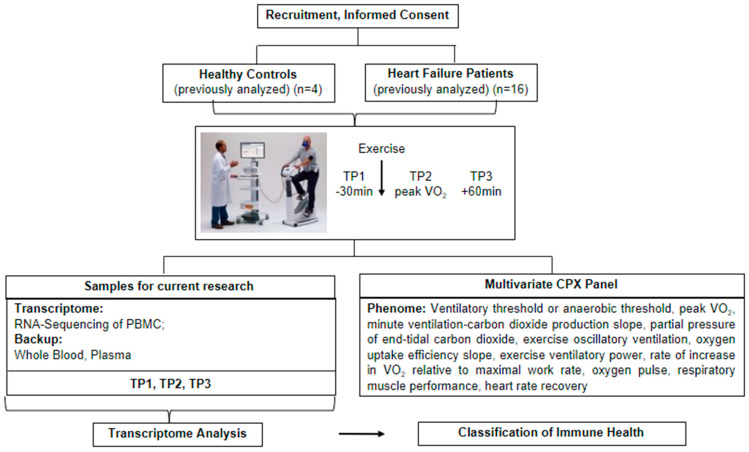
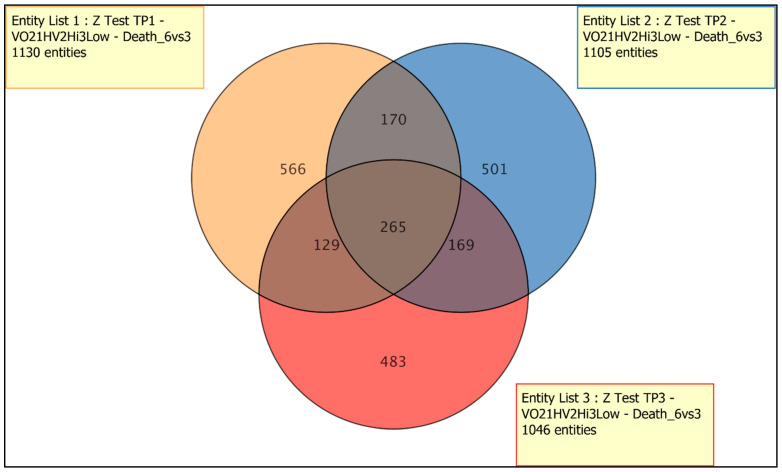
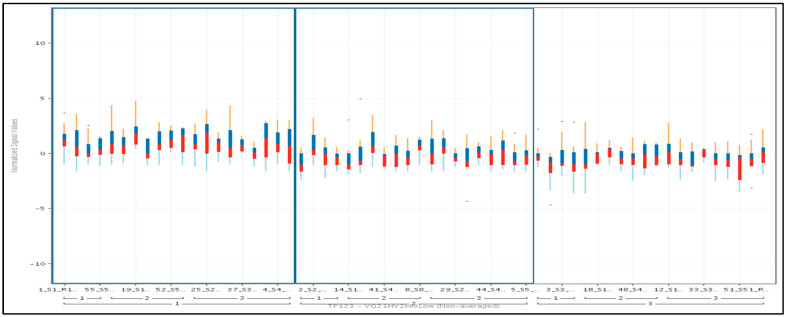
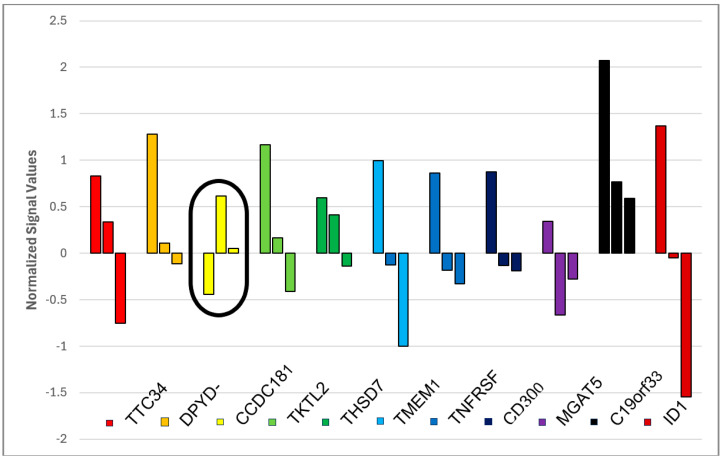
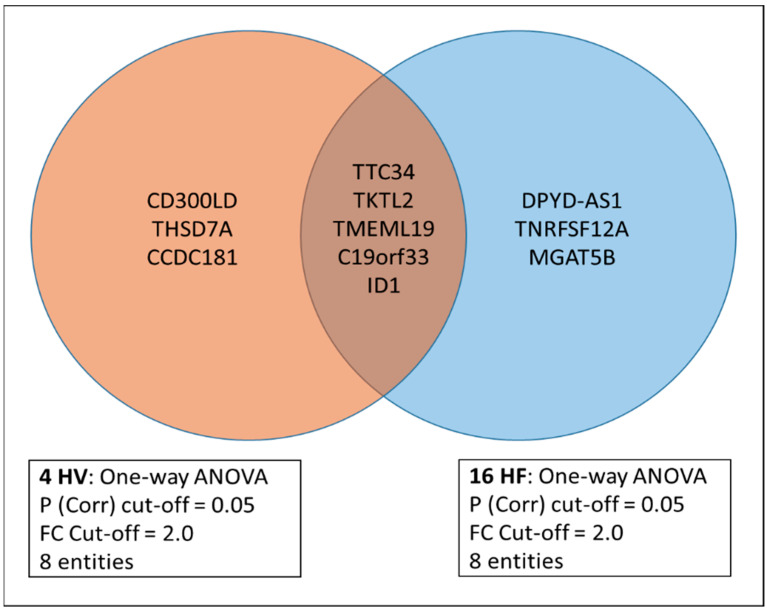
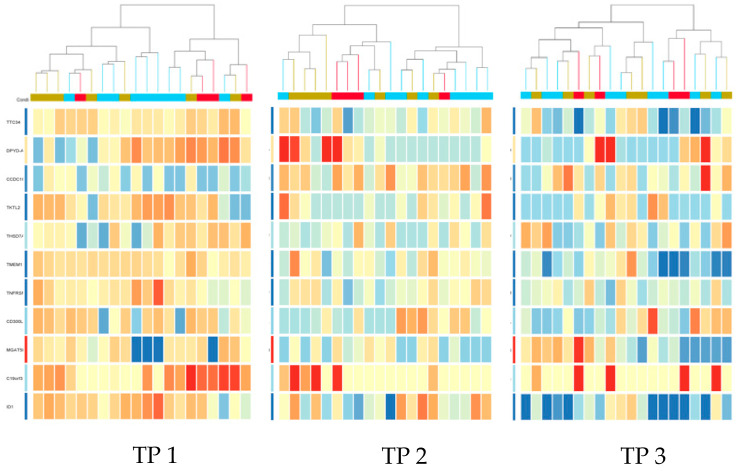
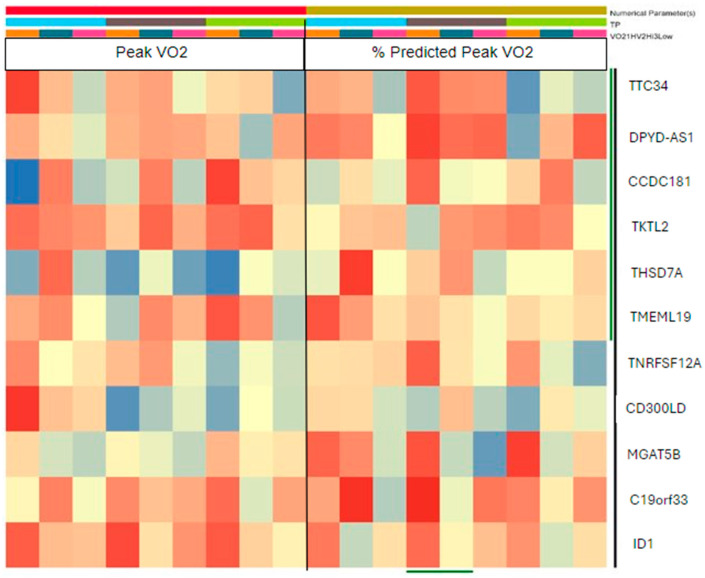
: Cardiorespiratory fitness positively correlates with longevity and immune health. Regular exercise may provide health benefits by reducing systemic inflammation. In chronic disease conditions, such as chronic heart failure and chronic fatigue syndrome, mechanistic links have been postulated between inflammation, muscle weakness, frailty, catabolic/anabolic imbalance, and aberrant chronic activation of immunity with monocyte upregulation. We hypothesize that (1) temporal changes in transcriptome profiles of peripheral blood mononuclear cells during strenuous acute bouts of exercise using cardiopulmonary exercise testing are present in adult subjects, (2) these temporal dynamic changes are different between healthy persons and heart failure patients and correlate with clinical exercise-parameters and (3) they portend prognostic information. : In total, 16 Heart Failure (HF) patients and 4 healthy volunteers (HV) were included in our proof-of-concept study. All participants underwent upright bicycle cardiopulmonary exercise testing. Blood samples were collected at three time points (TP) (TP1: 30 min before, TP2: peak exercise, TP3: 1 h after peak exercise). We divided 20 participants into 3 clinically relevant groups of cardiorespiratory fitness, defined by peak VO: HV ( = 4, VO ≥ 22 mL/kg/min), mild HF (HF1) ( = 7, 14 < VO < 22 mL/kg/min), and severe HF (HF2) ( = 9, VO ≤ 14 mL/kg/min). : Based on the statistical analysis with 20-100% restriction, FDR correction (-value 0.05) and 2.0-fold change across the three time points (TP1, TP2, TP3) criteria, we obtained 11 differentially expressed genes (DEG). Out of these 11 genes, the median Gene Expression Profile value decreased from TP1 to TP2 in 10 genes. The only gene that did not follow this pattern was . By performing 1-way ANOVA, we identified 8/11 genes in each of the two groups (HV versus HF) while 5 of the genes (, , , , ) overlapped between the two groups. We found 265 genes which are differentially expressed between those who survived and those who died. : From our proof-of-concept heart failure study, we conclude that gene expression correlates with VO peak in both healthy individuals and HF patients, potentially by regulating various physiological processes involved in oxygen uptake and utilization during exercise. Multi-omics profiling may help identify novel biomarkers for assessing exercise capacity and prognosis in HF patients, as well as potential targets for therapeutic intervention to improve VO peak and quality of life. We anticipate that our results will provide a novel metric for classifying immune health.
心肺适能与长寿和免疫健康呈正相关。规律运动可能通过减轻全身炎症来提供健康益处。在慢性疾病状态下,如慢性心力衰竭和慢性疲劳综合征,炎症、肌肉无力、身体虚弱、分解代谢/合成代谢失衡以及免疫异常慢性激活与单核细胞上调之间的机制联系已被提出。我们假设:(1)在成年受试者中,使用心肺运动测试进行剧烈急性运动期间外周血单核细胞转录组谱存在时间变化;(2)这些时间动态变化在健康人和心力衰竭患者之间不同,且与临床运动参数相关;(3)它们预示着预后信息。
在我们的概念验证研究中,总共纳入了16名心力衰竭(HF)患者和4名健康志愿者(HV)。所有参与者都进行了直立式自行车心肺运动测试。在三个时间点(TP)采集血样(TP1:运动前30分钟,TP2:运动峰值,TP3:运动峰值后1小时)。我们将20名参与者分为3个与心肺适能临床相关的组,由峰值VO₂定义:HV组(n = 4,VO₂≥22 mL/kg/min)、轻度HF组(HF1)(n = 7,14 < VO₂< 22 mL/kg/min)和重度HF组(HF2)(n = 9,VO₂≤14 mL/kg/min)。
基于20 - 100%限制的统计分析、FDR校正(p值<0.05)以及三个时间点(TP1、TP2、TP3)标准下2.0倍的变化,我们获得了11个差异表达基因(DEG)。在这11个基因中,10个基因的中位基因表达谱值从TP1到TP2下降。唯一不符合此模式的基因是[基因名称未给出]。通过进行单因素方差分析,我们在两组(HV组与HF组)中分别鉴定出8/11个基因,其中5个基因([基因名称未给出])在两组之间重叠。我们发现265个基因在存活者和死亡者之间存在差异表达。
从我们的心力衰竭概念验证研究中,我们得出结论,基因表达在健康个体和HF患者中均与VO₂峰值相关,可能是通过调节运动期间参与氧气摄取和利用的各种生理过程。多组学分析可能有助于识别用于评估HF患者运动能力和预后的新型生物标志物,以及改善VO₂峰值和生活质量的治疗干预潜在靶点。我们预计我们的结果将为分类免疫健康提供一种新的指标。