Syrnioti Antonia, Petousis Stamatios, Newman Lisa A, Margioula-Siarkou Chrysoula, Papamitsou Theodora, Dinas Konstantinos, Koletsa Triantafyllia
Department of Pathology, School of Medicine, Aristotle University of Thessaloniki, 54124 Thessaloniki, Greece.
2nd Department of Obstetrics and Gynaecology, Aristotle University of Thessaloniki, 54124 Thessaloniki, Greece.
Cancers (Basel). 2024 May 31;16(11):2094. doi: 10.3390/cancers16112094.
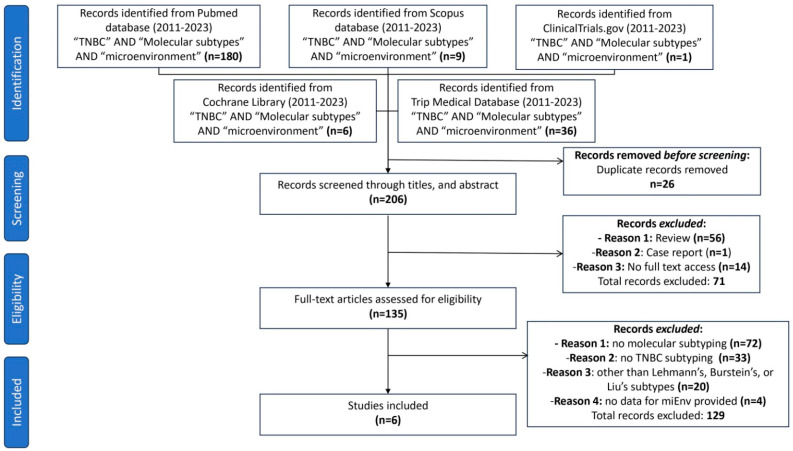
Triple Negative Breast Cancer (TNBC) is characterized by distinct molecular subtypes with unique biological and clinical features. This systematic review aimed to identify articles examining the differences in the tumor immune microenvironment (TIME) across different TNBC molecular subtypes. Six studies meeting inclusion criteria were analyzed, utilizing gene expression profiling and bioinformatic analyses to classify TNBC samples into molecular subtypes, as well as immunohistochemistry and cell deconvolution methods to characterize the TIME. Results revealed significant heterogeneity in immune cell composition among TNBC subtypes, with the immunomodulatory (IM) subtype demonstrating robust immune infiltration, composed mainly of adaptive immune cells along with an increased density of CTLA-4+ and PD-1+ TILs, high PD-L1 tumor cell expression, and upregulation of FOXP3+ Tregs. A more immunosuppressive TIME with a predominance of innate immune cells and lower levels of tumor-infiltrating lymphocytes (TILs) was observed in luminal androgen receptor (LAR) tumors. In mesenchymal stem-like (MSL) tumors, the TIME was mainly composed of innate immune cells, with a high number of M2 tumor-associated macrophages (TAMs), while the BL and M tumors displayed poor adaptive and innate immune responses, indicating an "immune-cold" phenotype. Differential activation of signaling pathways, genomic diversity, and metabolic reprogramming were identified as contributors to TIME heterogeneity. Understanding this interplay is crucial for tailoring therapeutic strategies, especially regarding immunotherapy.
三阴性乳腺癌(TNBC)具有不同的分子亚型,具有独特的生物学和临床特征。本系统评价旨在识别研究不同TNBC分子亚型间肿瘤免疫微环境(TIME)差异的文章。分析了六项符合纳入标准的研究,利用基因表达谱和生物信息学分析将TNBC样本分类为分子亚型,以及采用免疫组织化学和细胞反卷积方法来表征TIME。结果显示,TNBC亚型间免疫细胞组成存在显著异质性,免疫调节(IM)亚型表现出强大的免疫浸润,主要由适应性免疫细胞组成,同时CTLA-4+和PD-1+肿瘤浸润淋巴细胞(TILs)密度增加、PD-L1肿瘤细胞高表达以及FOXP3+调节性T细胞(Tregs)上调。在腔面雄激素受体(LAR)肿瘤中观察到一种以固有免疫细胞为主且肿瘤浸润淋巴细胞(TILs)水平较低的免疫抑制性更强的TIME。在间充质干细胞样(MSL)肿瘤中,TIME主要由固有免疫细胞组成,有大量M2肿瘤相关巨噬细胞(TAM),而基底样(BL)和M型肿瘤表现出较差的适应性和固有免疫反应,表明是一种“免疫冷”表型。信号通路的差异激活、基因组多样性和代谢重编程被确定为TIME异质性的促成因素。了解这种相互作用对于制定治疗策略至关重要,尤其是在免疫治疗方面。