Wine & Viticulture Department, California Polytechnic State University, One Grand Ave., San Luis Obispo, CA 93407, USA.
Food Science & Nutrition Department, California Polytechnic State University, One Grand Ave., San Luis Obispo, CA 93407, USA.
Molecules. 2024 May 26;29(11):2509. doi: 10.3390/molecules29112509.
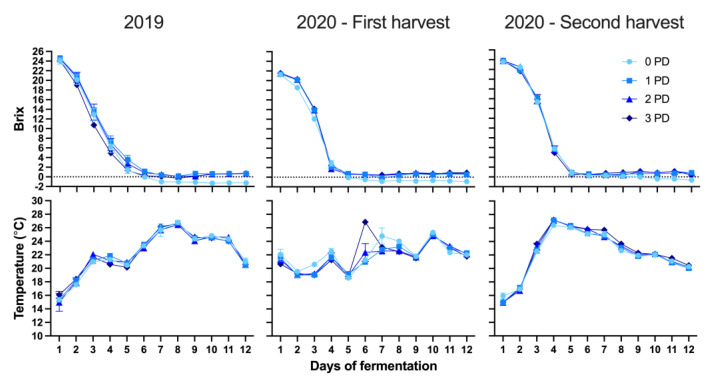
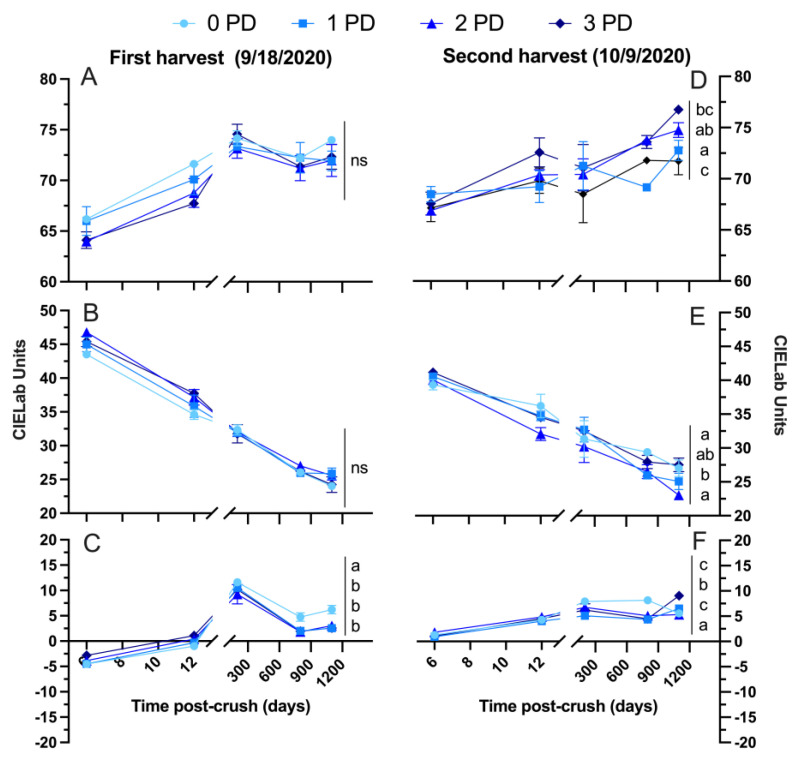
Cabernet Sauvignon from the California Paso Robles AVA was processed with a contrasting array of cap management frequencies, consisting of punch-down (PD) frequencies (0, 1, 2, and 3 PD/day) over two vintages, one of which the fruit was harvested at two contrasting maturity levels. Wines followed with up to 3 years of bottle aging for basic and phenolic chemistry, and the wines of the second harvest of 2020 were submitted to sensory analysis. There were almost non-existent effects due to the frequency of punch downs on parameters such as ethanol, pH, titratable acidity, lactic acid, and glucose + fructose. In 2019, the chromatic differences between different PD regimes were subtle, and minor effects of the punch-down frequency were observed for tannins and total phenolics. During the early stages of alcoholic fermentation, higher levels of all anthocyanin classes were observed in 1 PD wines and the lowest levels in 0 PD wines. The anthocyanin content of the wines of the first harvest (unripe) was 27% higher than that of the wines of the second harvest (ripe), but these differences disappeared after 3 years of bottle aging irrespective of the vintage and harvest date. Acylated anthocyanins were preferentially lost during aging, especially in 2019 wines and, to a lesser extent, in 2020 wines. In 2020, the polymeric pigment content of the wines of the second harvest was higher than in the wines of the first harvest, with 3 PD wines showing higher polymeric pigments and yellow hues than 0 and 2 PD wines after 3 years of bottle aging. Sensory analysis of the second harvest of the 2020 wines showed that the wines of all four PD regimes were perceived as drying, signifying they were perceived as equally astringent, which is consistent with comparable tannin levels on said wines. The perception of bitterness increased with the frequency of punch downs; thus, 3 PD wines showed the highest bitterness perception. It was concluded that in sufficiently warm fermentations and small volumes, phenolic extraction occurs regardless of fruit maturity and under conditions of minimum mixing.
来自加利福尼亚州帕索罗布尔斯 AVA 的赤霞珠采用了一系列对比鲜明的帽管理频率进行处理,包括两个年份的打孔频率(0、1、2 和 3 次/天),其中一个年份的果实采摘于两个不同的成熟度水平。这些葡萄酒在基本和酚类化学方面进行了长达 3 年的瓶陈,2020 年第二次收获的葡萄酒则进行了感官分析。由于打孔频率的不同,对乙醇、pH 值、可滴定酸度、乳酸和葡萄糖+果糖等参数几乎没有影响。2019 年,不同 PD 处理之间的色度差异较小,打孔频率对单宁和总酚类物质的影响较小。在酒精发酵的早期阶段,1 PD 葡萄酒中观察到所有花色苷类别的含量较高,而 0 PD 葡萄酒中含量最低。第一次收获(未成熟)的葡萄酒中的花色苷含量比第二次收获(成熟)的葡萄酒高 27%,但这些差异在 3 年的瓶陈后消失,无论年份和收获日期如何。酰化花色苷在陈酿过程中优先丢失,尤其是在 2019 年的葡萄酒中,在 2020 年的葡萄酒中则较少。2020 年,第二次收获的葡萄酒的聚合色素含量高于第一次收获的葡萄酒,经过 3 年的瓶陈,3 PD 葡萄酒的聚合色素和黄色色调高于 0 和 2 PD 葡萄酒。对 2020 年第二次收获的葡萄酒进行感官分析显示,所有四种 PD 处理的葡萄酒都被认为是干燥的,这意味着它们被认为具有相同的涩味,这与这些葡萄酒上相当的单宁水平一致。苦味的感知随着打孔频率的增加而增加;因此,3 PD 葡萄酒表现出最高的苦味感知。研究得出的结论是,在足够温暖的发酵和小体积的情况下,无论果实成熟度如何,在最小混合条件下,酚类物质都会被提取出来。