
一种具有梯形横截面的高通量环形肿瘤细胞分选芯片。
A High-Throughput Circular Tumor Cell Sorting Chip with Trapezoidal Cross Section.
机构信息
School of Microelectronics, Shanghai University, 20 Chengzhong Road, Shanghai 201899, China.
National Key Laboratory of Materials for Integrated Circuits, Shanghai Institute of Microsystem and Information Technology, Chinese Academy of Sciences, 865 Changning Road, Shanghai 200050, China.
出版信息
Sensors (Basel). 2024 May 31;24(11):3552. doi: 10.3390/s24113552.
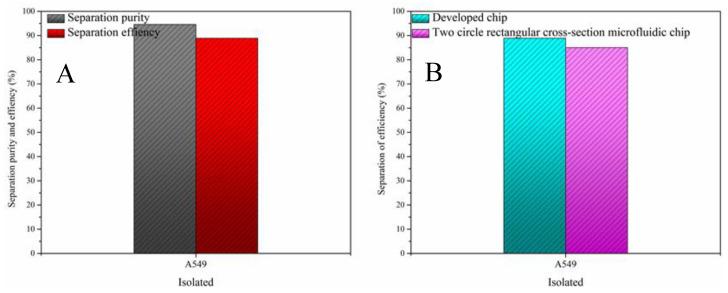
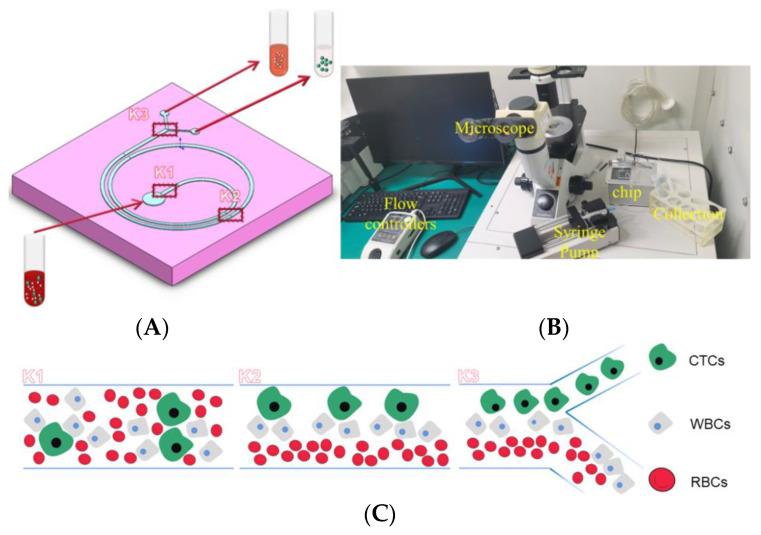
Circulating tumor cells are typically found in the peripheral blood of patients, offering a crucial pathway for the early diagnosis and prediction of cancer. Traditional methods for early cancer diagnosis are inefficient and inaccurate, making it difficult to isolate tumor cells from a large number of cells. In this paper, a new spiral microfluidic chip with asymmetric cross-section is proposed for rapid, high-throughput, label-free enrichment of CTCs in peripheral blood. A mold of the desired flow channel structure was prepared and inverted to make a trapezoidal cross-section using a micro-nanotechnology process of 3D printing. After a systematic study of how flow rate, channel width, and particle concentration affect the performance of the device, we utilized the device to simulate cell sorting of 6 μm, 15 μm, and 25 μm PS (Polystyrene) particles, and the separation efficiency and separation purity of 25 μm PS particles reached 98.3% and 96.4%. On this basis, we realize the enrichment of a large number of CTCs in diluted whole blood (5 mL). The results show that the separation efficiency of A549 was 88.9% and the separation purity was 96.4% at a high throughput of 1400 μL/min. In conclusion, we believe that the developed method is relevant for efficient recovery from whole blood and beneficial for future automated clinical analysis.
循环肿瘤细胞通常存在于患者的外周血液中,为癌症的早期诊断和预测提供了重要途径。传统的癌症早期诊断方法效率低下且不准确,难以从大量细胞中分离肿瘤细胞。本文提出了一种具有非对称横截面的新型螺旋微流控芯片,用于快速、高通量、无标记地从外周血中富集 CTC。通过微纳技术的 3D 打印工艺,制备所需流道结构的模具,并将其倒置以形成梯形横截面。在系统研究流速、通道宽度和粒子浓度如何影响器件性能后,我们利用该器件模拟了 6μm、15μm 和 25μm PS(聚苯乙烯)粒子的细胞分选,25μm PS 粒子的分离效率和分离纯度分别达到了 98.3%和 96.4%。在此基础上,我们实现了对大量稀释全血(5mL)中 CTC 的富集。结果表明,在 1400μL/min 的高通量下,A549 的分离效率为 88.9%,分离纯度为 96.4%。综上所述,我们认为所开发的方法与从全血中高效回收相关,有助于未来的自动化临床分析。


 Zotero 插件