Al-Halhouli Ala'aldeen, Albagdady Ahmed, Dietzel Andreas
NanoLab, School of Applied Technical Sciences, German Jordanian University (GJU) Amman Jordan
Institut für Mikrotechnik, Technische Universität Braunschweig Braunschweig Germany.
RSC Adv. 2019 Dec 18;9(71):41970-41976. doi: 10.1039/c9ra05916d. eCollection 2019 Dec 13.
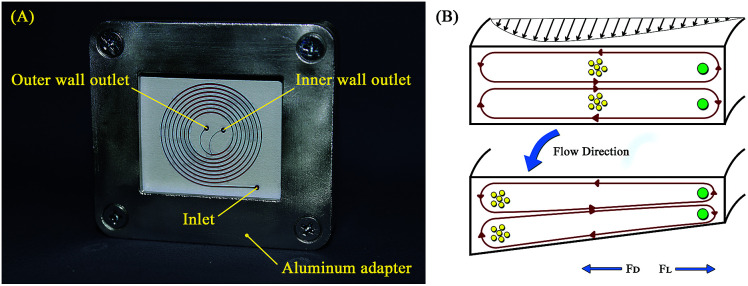
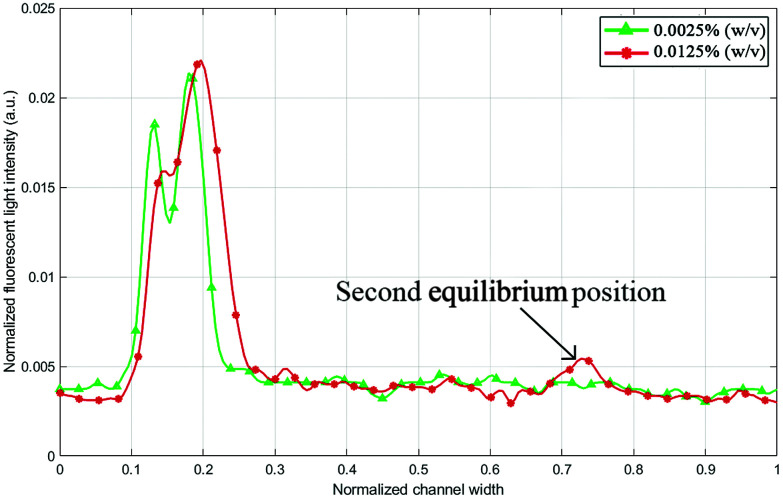
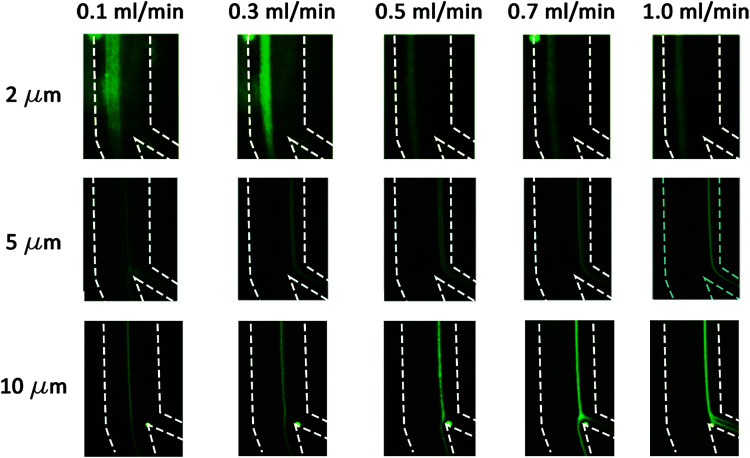
Various mechanisms of different designs have emerged for the purpose of microparticle separation and cell sorting. The main goals behind such designs are to create high throughput and high purity sample isolation. In this study, high efficiency, high throughput and precise separation of microparticles under inertial lift and drag forces induced by trapezoidal curvilinear channels are reported. This work is the first to focus and recover 2 from 5 μm and 2 from 10 μm particles in spiral channels in a sheath-less flow device, which reduces the overall complexity of the system and allows for higher throughput. The new microfluidic chip design is fabricated in glass using femtosecond laser ablation. In addition, mathematical force calculations were conducted during the design phase of the microfluidic channels and compared with experiments. The results show a close prediction of the equilibrium position of the tested microparticles.
为了实现微粒分离和细胞分选,已经出现了各种不同设计的机制。这些设计背后的主要目标是实现高通量和高纯度的样品分离。在本研究中,报道了在梯形曲线通道诱导的惯性升力和阻力作用下,微粒的高效、高通量和精确分离。这项工作首次在无鞘流装置的螺旋通道中聚焦并回收了2至5微米和2至10微米的颗粒,这降低了系统的整体复杂性并实现了更高的通量。这种新型微流控芯片设计是使用飞秒激光烧蚀在玻璃中制造的。此外,在微流控通道的设计阶段进行了数学力计算,并与实验进行了比较。结果显示对测试微粒的平衡位置有密切的预测。