Marcos Tamika A, Crutzen Rik, Leitner Veronika, Smeddinck Jan D, Strumegger Eva-Maria, Wurhofer Daniela, Kulnik Stefan T
Department of Work and Social Psychology, Maastricht University, Maastricht, The Netherlands.
Ludwig Boltzmann Institute for Digital Health and Prevention, Salzburg, Austria.
Digit Health. 2024 Jun 17;10:20552076241260974. doi: 10.1177/20552076241260974. eCollection 2024 Jan-Dec.
Digital health interventions for behaviour change are usually complex interventions, and intervention developers should 'articulate programme theory', that is, they should offer detailed descriptions of individual intervention components and their proposed mechanisms of action. However, such detailed descriptions often remain lacking. The objective of this work was to provide a conceptual case study with an applied example of 'articulating programme theory' for a newly developed digital health intervention.
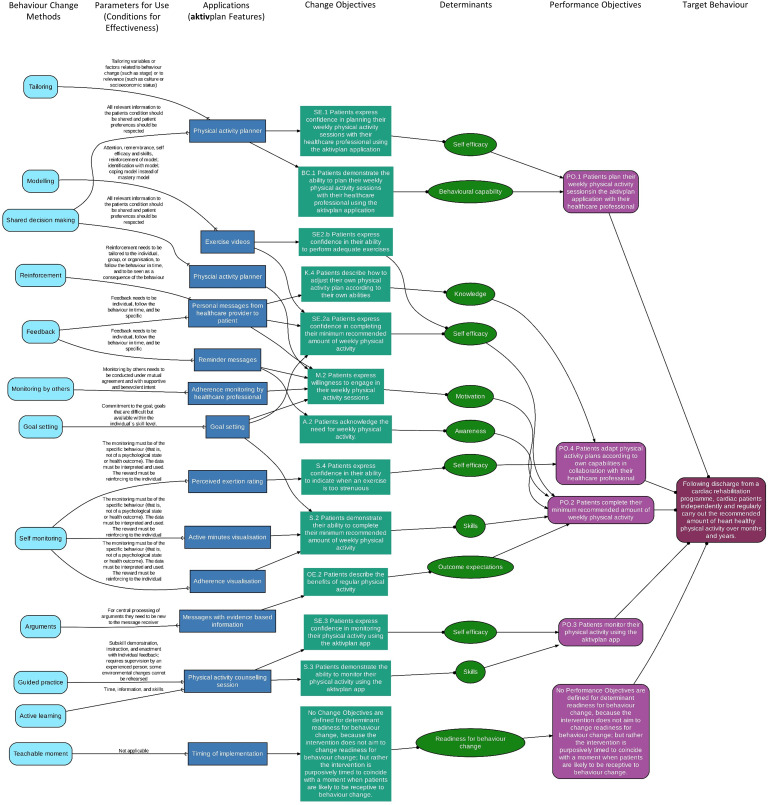
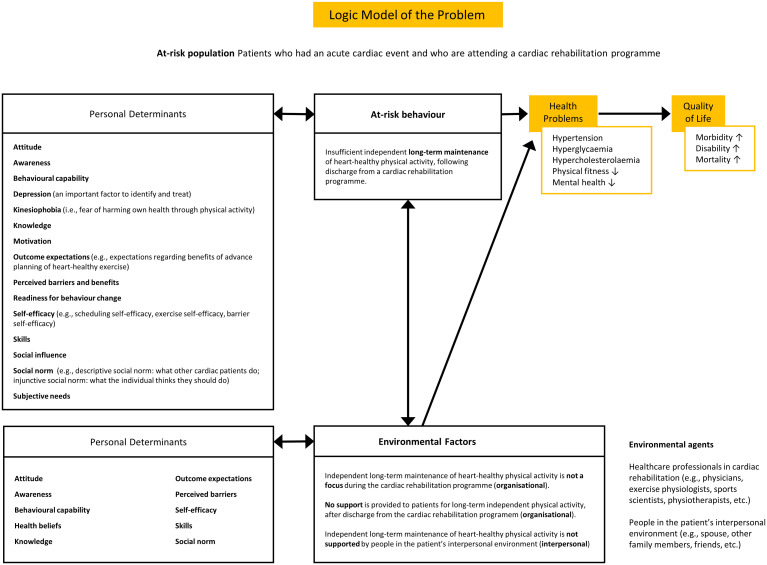
Intervention Mapping methodology was applied to arrive at a detailed description of programme theory for a newly developed digital health intervention that aims to support cardiac rehabilitation patients in establishing heart-healthy physical activity habits. Based on a Predisposing, Reinforcing, and Enabling Constructs in Educational Diagnosis and Evaluation (PRECEDE) logic model of the problem, a logic model of change was developed. The proposed mechanisms of action were visualised in an acyclic behaviour change diagram.
Programme theory for this digital health intervention includes 4 sub-behaviours of the main target behaviour (i.e. habitual heart-healthy physical activity), 8 personal determinants and 12 change objectives (i.e. changes needed at the determinant level to achieve the sub-behaviours). These are linked to 12 distinct features of the digital health intervention and 12 underlying behaviour change methods.
This case study offers a worked example of articulating programme theory for a digital health intervention using Intervention Mapping. Intervention developers and researchers may draw on this example to replicate the method, or to reflect on most suitable approaches for their own behaviour change interventions.
用于行为改变的数字健康干预通常是复杂的干预措施,干预措施开发者应“阐明项目理论”,也就是说,他们应详细描述各个干预组成部分及其拟议的作用机制。然而,此类详细描述往往仍然缺失。本研究的目的是提供一个概念性案例研究,并给出一个应用示例,说明如何为新开发的数字健康干预“阐明项目理论”。
应用干预映射方法,对一项新开发的数字健康干预措施的项目理论进行详细描述,该干预旨在支持心脏康复患者养成有益于心脏健康的体育活动习惯。基于教育诊断与评估中的诱发、强化和促成因素(PRECEDE)问题逻辑模型,开发了一个变化逻辑模型。拟议的作用机制在一个非循环行为改变图中可视化呈现。
这项数字健康干预的项目理论包括主要目标行为(即习惯性的有益于心脏健康的体育活动)的4个子行为、8个个人决定因素和12个变化目标(即为实现这些子行为在决定因素层面所需的变化)。这些与数字健康干预的12个不同特征以及12种潜在的行为改变方法相关联。
本案例研究提供了一个使用干预映射为数字健康干预阐明项目理论的实例。干预开发者和研究人员可以借鉴这个例子来复制该方法,或者思考适合他们自己行为改变干预的最佳方法。