Franceschini Erica, Menozzi Valentina, Todisco Vera, Pellegrino Mariachiara, Cantergiani Samuele, Dessilani Andrea, Spadoni Anna, Romani Federico, Mazzocchi Alice, Santoro Antonella, Meschiari Marianna, Cervo Adriana, Gilioli Andrea, Bettelli Francesca, Fregni-Serpini Giulia, Grottola Antonella, Candoni Anna, Guaraldi Giovanni, Sarti Mario, Luppi Mario, Mussini Cristina
Department of Surgical, Medical, Dental, and Morphological Sciences, University of Modena and Reggio Emilia, Infectious Disease Clinic University of Modena and Reggio Emilia AOU Policlinico di Modena Modena Italy.
Department of Medical and Surgical Sciences Section of Hematology University of Modena and Reggio Emilia AOU Policlinico di Modena Modena Italy.
EJHaem. 2024 Apr 9;5(3):505-515. doi: 10.1002/jha2.867. eCollection 2024 Jun.
Patients with hematological malignancies (HM) have a high risk of severe coronavirus disease 2019 (COVID-19), also in the Omicron period.
Retrospective single-center study including HM patients with severe acute respiratory syndrome Coronavirus 2 (SARS-CoV2) infection from January 2022 to March 2023. Study outcomes were respiratory failure (RF), mechanical ventilation (MV), and COVID-related mortality, comparing patients according to SARS-CoV2 serology.
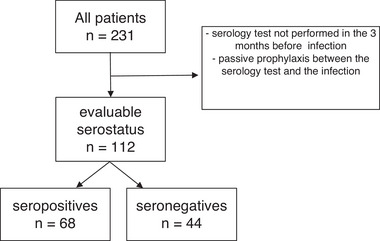
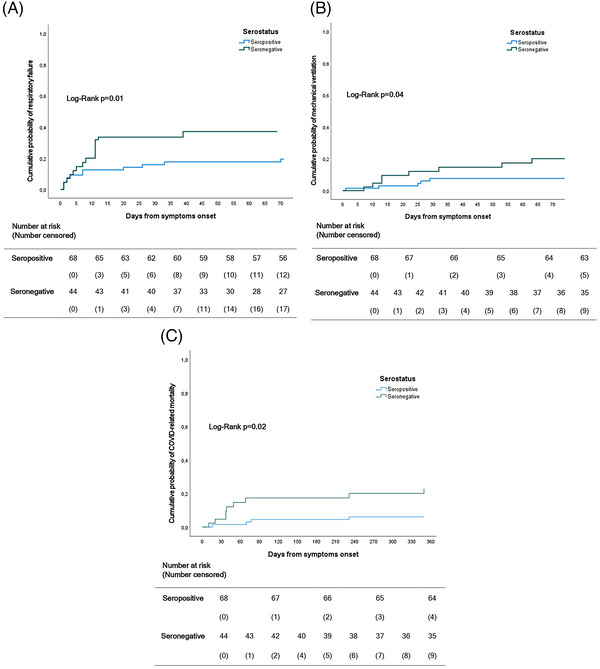
Note that, 112 patients were included: 39% had negative SARS-CoV2 serology. Seronegative were older (71.5 vs. 65.0 years, = 0.04), had more often a lymphoid neoplasm (88.6% vs. 69.1%, = 0.02), underwent anti-CD20 therapy (50.0% vs. 30.9% = 0.04) and had more frequently a severe disease (23.0% vs. 3.0%, = 0.02) than seropositive.Kaplan-Meier showed a higher risk for seronegative patients for RF (= 0.014), MV (= 0.044), and COVID-related mortality (= 0.021). Negative SARS-CoV2 serostatus resulted in a risk factor for RF (hazards ratio [HR] 2.19, 95% confidence interval [CI] 1.03-4.67, = 0.04), MV (HR 3.37, 95% CI 1.06-10.68, = 0.04), and COVID-related mortality (HR 4.26, 95% CI 1.09-16.71, = 0.04).
: HM patients with negative SARS-CoV2 serology, despite vaccinations and previous infections, have worse clinical outcomes compared to seropositive patients in the Omicron era. The use of serology for SARS-CoV2 diagnosis could be an easy tool to identify patients prone to developing complications.
血液系统恶性肿瘤(HM)患者发生重症2019冠状病毒病(COVID-19)的风险很高,在奥密克戎时期亦是如此。
一项回顾性单中心研究,纳入了2022年1月至2023年3月期间感染严重急性呼吸综合征冠状病毒2(SARS-CoV-2)的HM患者。研究结局为呼吸衰竭(RF)、机械通气(MV)和COVID-19相关死亡率,根据SARS-CoV-2血清学对患者进行比较。
请注意,共纳入112例患者:39%的患者SARS-CoV-2血清学检测为阴性。血清学阴性的患者年龄更大(71.5岁对65.0岁,P = 0.04),更常患有淋巴系统肿瘤(88.6%对69.1%,P = 0.02),接受抗CD20治疗的比例更高(50.0%对30.9%,P = 0.04),且与血清学阳性的患者相比,重症疾病的发生率更高(23.0%对3.0%,P = 0.02)。Kaplan-Meier分析显示,血清学阴性的患者发生RF(P = 0.014)、MV(P = 0.044)和COVID-19相关死亡的风险更高(P = 0.021)。SARS-CoV-2血清学阴性状态是RF的危险因素(风险比[HR] 2.19,95%置信区间[CI] 1.03 - 4.67,P = 0.04)、MV的危险因素(HR 3.37,95% CI 1.06 - 10.68,P = 0.04)以及COVID-相关死亡的危险因素(HR 4.26,95% CI 1.09 - 16.71,P = 0.04)。
在奥密克戎时代,SARS-CoV-2血清学检测为阴性的HM患者,尽管接种了疫苗且既往有感染史,但与血清学阳性的患者相比,临床结局更差。使用血清学进行SARS-CoV-2诊断可能是一种识别易发生并发症患者的简便工具。