
糖尿病周围神经病变中的细胞焦亡及其治疗调控
Pyroptosis in Diabetic Peripheral Neuropathy and its Therapeutic Regulation.
作者信息
Al Mamun Abdullah, Shao Chuxiao, Geng Peiwu, Wang Shuanghu, Xiao Jian
机构信息
Central Laboratory of The Lishui Hospital of Wenzhou Medical University, Lishui People's Hospital, Lishui, Zhejiang, 323000, People's Republic of China.
Molecular Pharmacology Research Center, School of Pharmaceutical Sciences, Wenzhou Medical University, Wenzhou, Zhejiang, 325000, People's Republic of China.
出版信息
J Inflamm Res. 2024 Jun 14;17:3839-3864. doi: 10.2147/JIR.S465203. eCollection 2024.
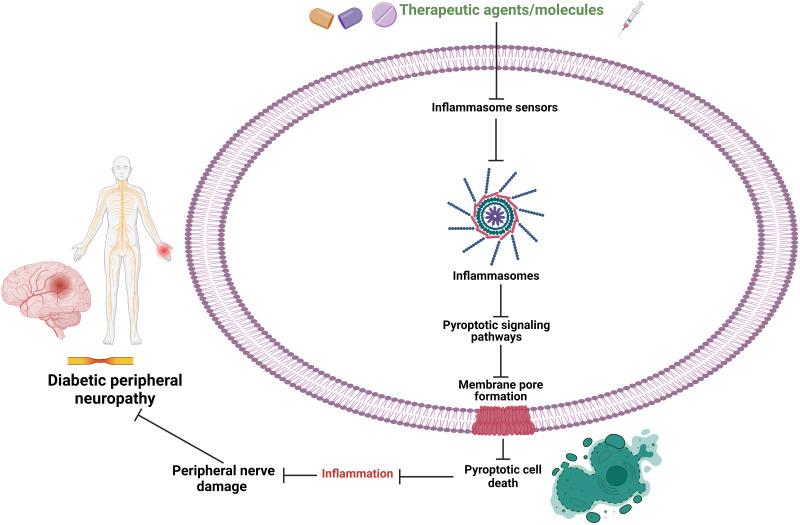
Pyroptosis is a pro-inflammatory form of cell death resulting from the activation of gasdermins (GSDMs) pore-forming proteins and the release of several pro-inflammatory factors. However, inflammasomes are the intracellular protein complexes that cleave gasdermin D (GSDMD), leading to the formation of robust cell membrane pores and the initiation of pyroptosis. Inflammasome activation and gasdermin-mediated membrane pore formation are the important intrinsic processes in the classical pyroptotic signaling pathway. Overactivation of the NOD-like receptor thermal protein domain associated protein 3 (NLRP3) inflammasome triggers pyroptosis and amplifies inflammation. Current evidence suggests that the overactivation of inflammasomes and pyroptosis may further induce the progression of cancers, nerve injury, inflammatory disorders and metabolic dysfunctions. Current evidence also indicates that pyroptosis-dependent cell death accelerates the progression of diabetes and its frequent consequences including diabetic peripheral neuropathy (DPN). Pyroptosis-mediated inflammatory reaction further exacerbates DPN-mediated CNS injury. Accumulating evidence shows that several molecular signaling mechanisms trigger pyroptosis in insulin-producing cells, further leading to the development of DPN. Numerous studies have suggested that certain natural compounds or drugs may possess promising pharmacological properties by modulating inflammasomes and pyroptosis, thereby offering potential preventive and practical therapeutic approaches for the treatment and management of DPN. This review elaborates on the underlying molecular mechanisms of pyroptosis and explores possible therapeutic strategies for regulating pyroptosis-regulated cell death in the pharmacological treatment of DPN.
细胞焦亡是一种由gasdermin(GSDMs)成孔蛋白激活和多种促炎因子释放所导致的促炎性细胞死亡形式。然而,炎性小体是切割gasdermin D(GSDMD)的细胞内蛋白质复合物,从而导致形成强大的细胞膜孔并引发细胞焦亡。炎性小体激活和gasdermin介导的膜孔形成是经典细胞焦亡信号通路中的重要内在过程。NOD样受体热蛋白结构域相关蛋白3(NLRP3)炎性小体的过度激活会引发细胞焦亡并放大炎症。目前的证据表明,炎性小体的过度激活和细胞焦亡可能会进一步促进癌症、神经损伤、炎症性疾病和代谢功能障碍的进展。目前的证据还表明,依赖细胞焦亡的细胞死亡会加速糖尿病及其常见后果(包括糖尿病性周围神经病变,DPN)的进展。细胞焦亡介导的炎症反应会进一步加重DPN介导的中枢神经系统损伤。越来越多的证据表明,几种分子信号机制会触发胰岛素产生细胞中的细胞焦亡,进而导致DPN的发生。众多研究表明,某些天然化合物或药物可能通过调节炎性小体和细胞焦亡而具有有前景的药理特性,从而为DPN的治疗和管理提供潜在的预防和实际治疗方法。本综述阐述了细胞焦亡的潜在分子机制,并探讨了在DPN的药物治疗中调节细胞焦亡调节的细胞死亡的可能治疗策略。


 Zotero 插件