Duyar Aysun, Carrasco Marisa
Department of Psychology, New York University, New York, NY, USA.
Center for Neural Science, New York University, New York, NY, USA.
bioRxiv. 2024 Jun 8:2024.06.07.598015. doi: 10.1101/2024.06.07.598015.
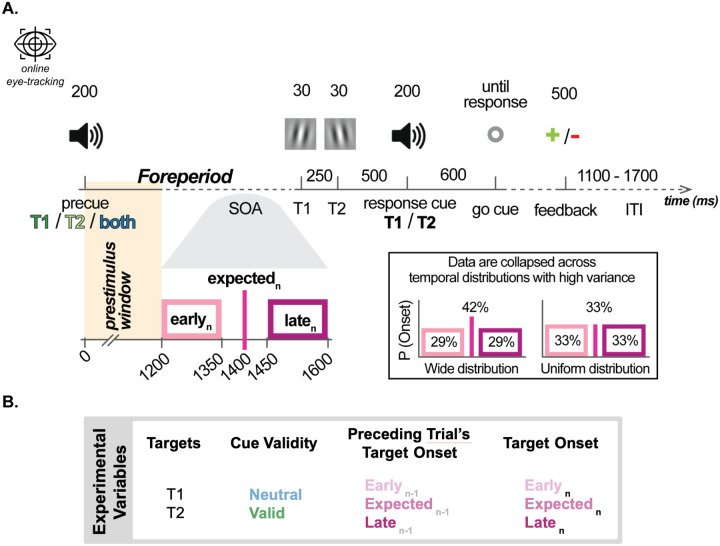
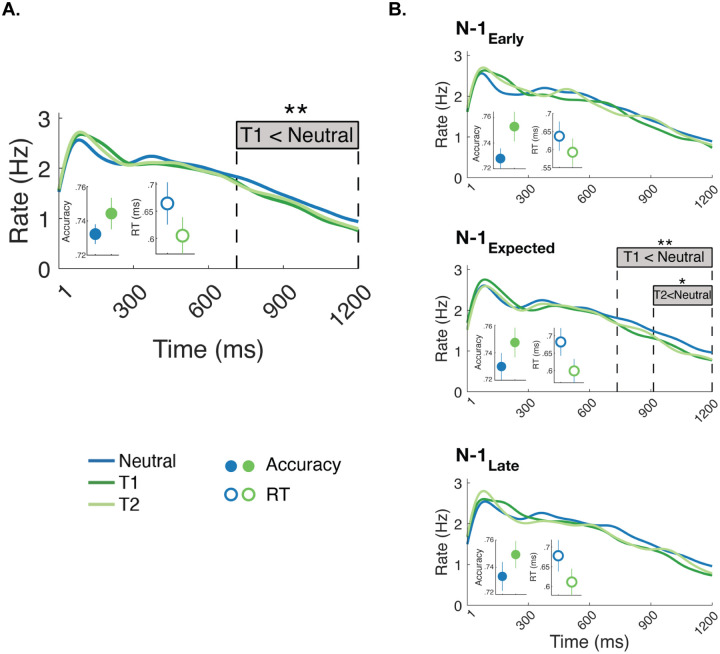
Temporal expectation and temporal attention distinctly improve performance and gaze stability, and interact at the behavioral and neural levels. Foreperiod-the interval between the preparatory signal and stimulus onset-facilitates temporal expectation. Preceding foreperiod-the foreperiod in the previous trial-modulates expectation at behavioral and oculomotor levels. Here, we investigated whether preceding foreperiod guides temporal attention. Regardless of the preceding foreperiod, temporal attention improved performance, particularly at early moments,and consistently accelerated gaze stability onset and offset by shifting microsaccade timing. However, only with preceding expected foreperiods, attention inhibited microsaccade rates. Moreover, preceding late foreperiods weakened expectation effects on microsaccade rates, but such a weakening was overridden by attention. Altogether, these findings reveal that the oculomotor system's flexibility does not translate to performance, and suggest that although selection history can be utilized as one of the sources of expectation in subsequent trials, it does not necessarily determine, strengthen, or guide attentional deployment.
时间预期和时间注意力能显著提高表现和注视稳定性,并在行为和神经层面相互作用。前周期——预备信号与刺激开始之间的间隔——促进时间预期。前一个前周期——前一次试验中的前周期——在行为和动眼神经层面调节预期。在此,我们研究了前一个前周期是否引导时间注意力。无论前一个前周期如何,时间注意力都能提高表现,尤其是在早期阶段,并通过改变微扫视时间一致地加速注视稳定性的开始和结束。然而,只有在前一个预期的前周期时,注意力才会抑制微扫视速率。此外,前一个较长的前周期会削弱预期对微扫视速率的影响,但这种削弱会被注意力克服。总之,这些发现表明动眼系统的灵活性并不能转化为表现,并表明尽管选择历史可以作为后续试验中预期的来源之一,但它不一定决定、加强或引导注意力的部署。