Kuo Chao-Cheng, McCall Jordan G
Department of Anesthesiology, Washington University in St. Louis, St. Louis, MO, USA; Center for Clinical Pharmacology, University of Health Sciences and Pharmacy in St. Louis and Washington University School of Medicine, St. Louis, MO, USA; Washington University Pain Center, Washington University in St. Louis, St. Louis, MO, USA.
bioRxiv. 2024 Aug 28:2024.06.08.598059. doi: 10.1101/2024.06.08.598059.
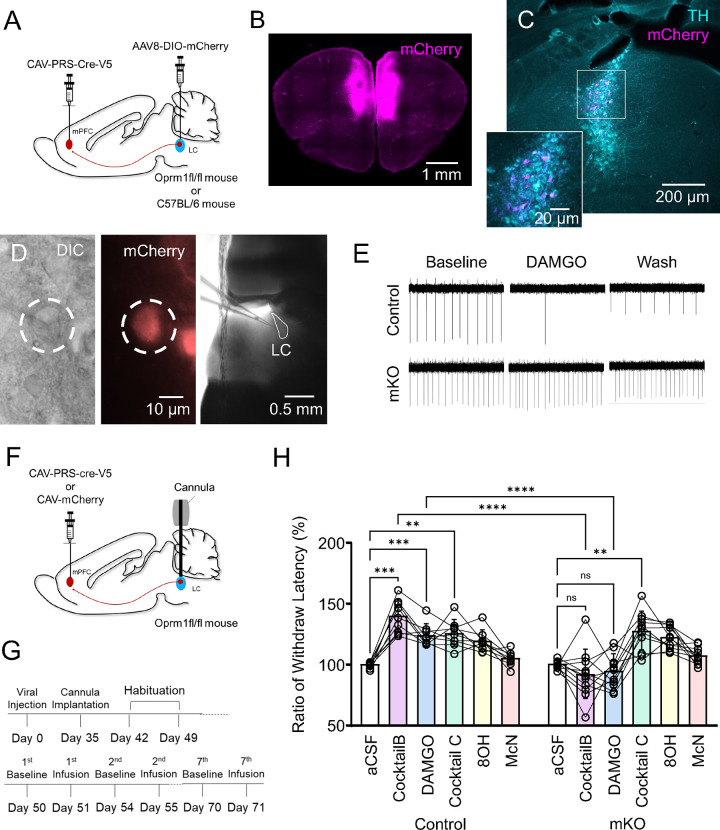
Selective manipulation of neural circuits using optogenetics and chemogenetics holds great translational potential but requires genetic access to neurons. Here, we demonstrate a general framework for identifying genetic tool-independent, pharmacological strategies for neural circuit-selective modulation. We developed an economically accessible calcium imaging-based approach for large-scale pharmacological scans of endogenous receptor-mediated neural activity. As a testbed for this approach, we used the mouse locus coeruleus due to the combination of its widespread, modular efferent neural circuitry and its wide variety of endogenously expressed GPCRs. Using machine learning-based action potential deconvolution and retrograde tracing, we identified an agonist cocktail that selectively inhibits medial prefrontal cortex-projecting locus coeruleus neurons. , this cocktail produces synergistic antinociception, consistent with selective pharmacological blunting of this neural circuit. This framework has broad utility for selective targeting of other neural circuits under different physiological and pathological states, facilitating non-genetic translational applications arising from cell type-selective discoveries.
利用光遗传学和化学遗传学对神经回路进行选择性操纵具有巨大的转化潜力,但需要对神经元进行基因改造。在这里,我们展示了一个通用框架,用于识别与基因工具无关的、用于神经回路选择性调节的药理学策略。我们开发了一种经济可行的基于钙成像的方法,用于对内源性受体介导的神经活动进行大规模药理学扫描。作为该方法的测试平台,我们使用了小鼠蓝斑核,这是因为它具有广泛的、模块化的传出神经回路,并且内源性表达多种GPCR。通过基于机器学习的动作电位反卷积和逆行追踪,我们确定了一种激动剂混合物,它能选择性抑制投射到内侧前额叶皮质的蓝斑核神经元。这种混合物能产生协同镇痛作用,这与该神经回路的选择性药理学减弱相一致。该框架对于在不同生理和病理状态下选择性靶向其他神经回路具有广泛的用途,有助于细胞类型选择性发现所产生的非基因转化应用。