The First Affiliated Hospital of Guangzhou University of Chinese Medicine, Guangzhou, 510405, China.
The Affiliated TCM Hospital of Guangzhou Medical University, Guangzhou, 510120, China.
J Orthop Surg Res. 2024 Jun 19;19(1):363. doi: 10.1186/s13018-024-04857-y.
The zero-profile implant system (Zero-P) and conventional plates have been widely used in anterior cervical discectomy and fusion (ACDF) to treat cervical spondylosis. The purpose of this study was to compare the effects of the application of Zero-P and new conventional plates (ZEVO, Skyline) in ACDF on the sagittal imaging parameters of cervical spondylosis patients and to analyze their clinical efficacy.
We conducted a retrospective study on 119 cervical spondylosis patients from January 2018 to December 2021, comparing outcomes between those receiving the Zero-P device (n = 63) and those receiving a novel conventional plate (n = 56, including 46 ZEVO and 10 Skyline plates) through ACDF. Cervical sagittal alignment was assessed pre- and postoperatively via lateral radiographs. The Japanese Orthopedic Association (JOA), Neck Disability Index (NDI), and visual analog scale (VAS) scores were recorded at baseline, after surgery, and at the 2-year follow-up to evaluate patient recovery and intervention success.
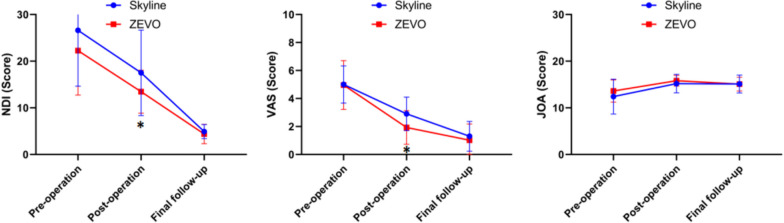
There were significant differences in the postoperative C0-C2 Cobb angle and postoperative sagittal segmental angle (SSA) between patients in the novel conventional plate group and those in the Zero-P group (P < 0.05). Postoperatively, there were significant changes in the C2‒C7 Cobb angle, C0‒C2 Cobb angle, SSA, and average surgical disc height (ASDH) compared to the preoperative values in both patient groups (P < 0.05). Dysphagia in the immediate postoperative period was lower in the Zero-P group than in the new conventional plate group (0% in the Zero-P group, 7.14% in the novel conventional plate group, P = 0.046), and the symptoms disappeared within 2 years in both groups. There was no statistically significant difference between the two groups in terms of complications of adjacent spondylolisthesis (ASD) at 2 years postoperatively (3.17% in the Zero-P group, 8.93% in the novel conventional plate group; P = 0.252). According to the subgroup analysis, there were significant differences in the postoperative C2‒C7 Cobb angle, C0‒C2 Cobb angle, T1 slope, and ASDH between the ZEVO group and the Skyline group (P < 0.05). Compared with the preoperative scores, the JOA, NDI, and VAS scores of all groups significantly improved at the 2-year follow-up (P < 0.01). According to the subgroup analysis, the immediate postoperative NDI and VAS scores of the ZEVO group were significantly better than those of the Skyline group (P < 0.05).
In ACDF, both novel conventional plates and Zero-P can improve sagittal parameters and related scale scores. Compared to the Zero-P plate, the novel conventional plate has a greater advantage in correcting the curvature of the surgical segment, but the Zero-P plate is less likely to produce postoperative dysphagia.
零切迹植入系统(Zero-P)和传统钢板已广泛应用于前路颈椎间盘切除融合术(ACDF)治疗颈椎病。本研究旨在比较 Zero-P 和新型传统钢板(ZEVO、Skyline)在 ACDF 中应用于颈椎病患者的颈椎矢状影像学参数的效果,并分析其临床疗效。
我们对 2018 年 1 月至 2021 年 12 月的 119 例颈椎病患者进行了回顾性研究,通过 ACDF 将患者分为 Zero-P 装置组(n=63)和新型传统钢板组(n=56,包括 46 例 ZEVO 和 10 例 Skyline 钢板),比较两组之间的结果。术前和术后通过侧位 X 线片评估颈椎矢状位排列。记录基线、术后和 2 年随访时的日本骨科协会(JOA)、颈部残疾指数(NDI)和视觉模拟评分(VAS),以评估患者的恢复和干预效果。
新型传统钢板组和 Zero-P 组患者术后 C0-C2 Cobb 角和术后矢状节段角(SSA)存在显著差异(P<0.05)。术后,两组患者 C2-C7 Cobb 角、C0-C2 Cobb 角、SSA 和平均手术椎间盘高度(ASDH)与术前相比均有显著变化(P<0.05)。Zero-P 组患者术后即刻吞咽困难发生率低于新型传统钢板组(0% vs. 7.14%,P=0.046),两组患者症状均在 2 年内消失。术后 2 年,两组患者相邻脊椎滑脱(ASD)并发症发生率无统计学差异(Zero-P 组 3.17%,新型传统钢板组 8.93%;P=0.252)。根据亚组分析,ZEVO 组和 Skyline 组患者术后 C2-C7 Cobb 角、C0-C2 Cobb 角、T1 斜率和 ASDH 存在显著差异(P<0.05)。与术前评分相比,所有组在 2 年随访时 JOA、NDI 和 VAS 评分均显著改善(P<0.01)。根据亚组分析,ZEVO 组术后即刻 NDI 和 VAS 评分明显优于 Skyline 组(P<0.05)。
在 ACDF 中,新型传统钢板和 Zero-P 均可改善矢状参数和相关量表评分。与 Zero-P 板相比,新型传统钢板在矫正手术节段曲率方面具有更大的优势,但 Zero-P 板术后发生吞咽困难的可能性较小。