Shengli Clinical Medical College of Fujian Medical University, Fuzhou, 350000, China.
Department of Anesthesiology, Xiangyang Central Hospital, Affiliated Hospital of Hubei University of Arts and Science, Xiangyang, 441021, Hubei, China.
J Orthop Surg Res. 2024 Jun 19;19(1):364. doi: 10.1186/s13018-024-04729-5.
In recent years, the zero-profile implant (Zero-p) has emerged as a promising internal fixation technique. Although studies have indicated its potential superiority over conventional cage-plate implant (Cage-plate) in the treatment of degenerative cervical spondylosis, there remains a lack of definitive comparative reports regarding its indications, safety, and efficacy.
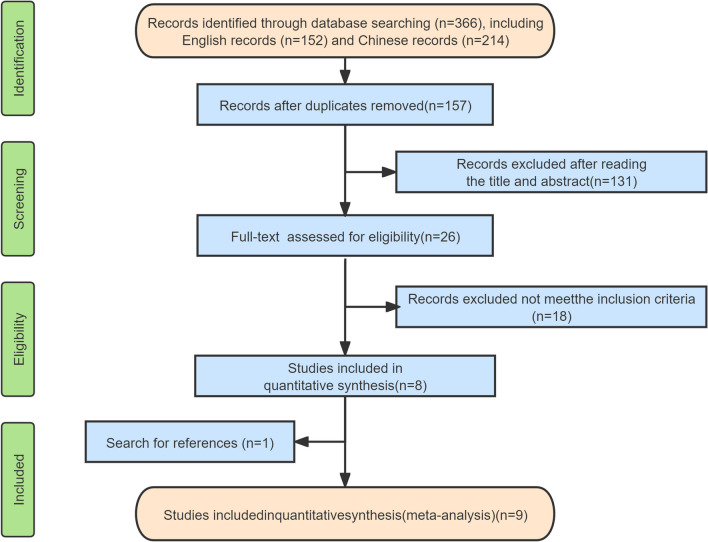
A computerized search was conducted on English and Chinese databases, including PubMed, Web of Science, Cochrane Library, EMBASE, CNKI, Wanfang and VIP. Additionally, a manual search was meticulously carried out on Chinese medical journals, spanning from the inception of the respective databases until August 2023. The meta-analysis utilized a case-control study approach and was executed through the utilization of RevMan 5.3 software. Stringent quality evaluation and data extraction procedures were implemented to guarantee the reliability and validity of the findings.
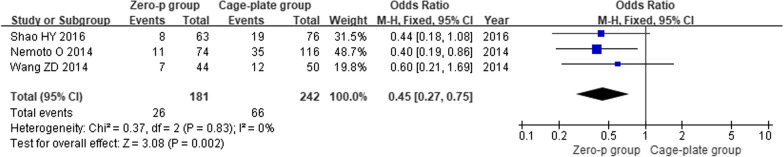
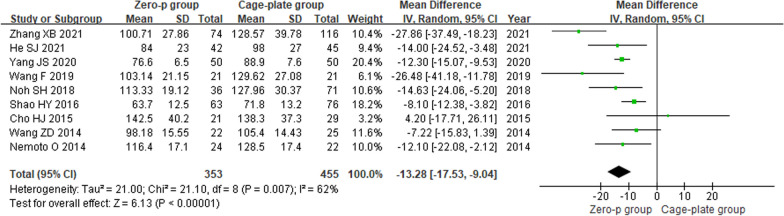
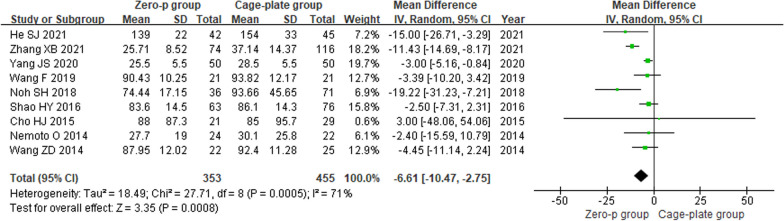
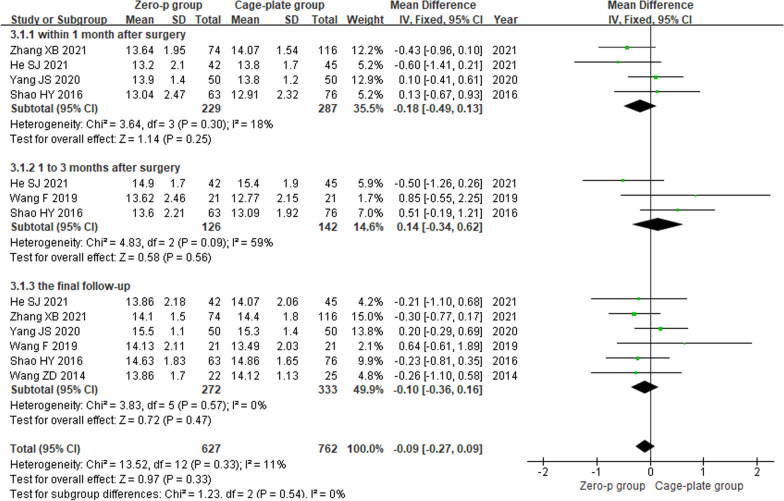
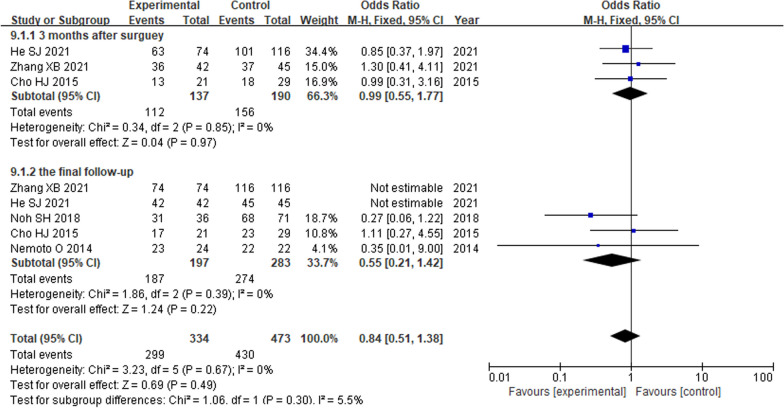
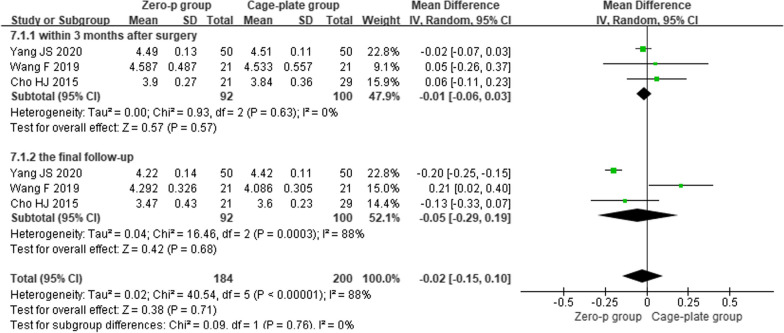
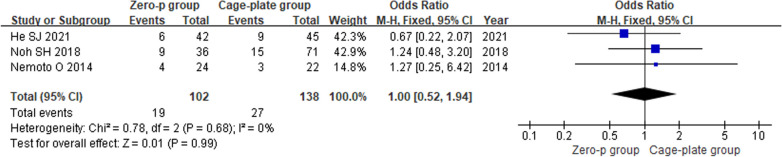
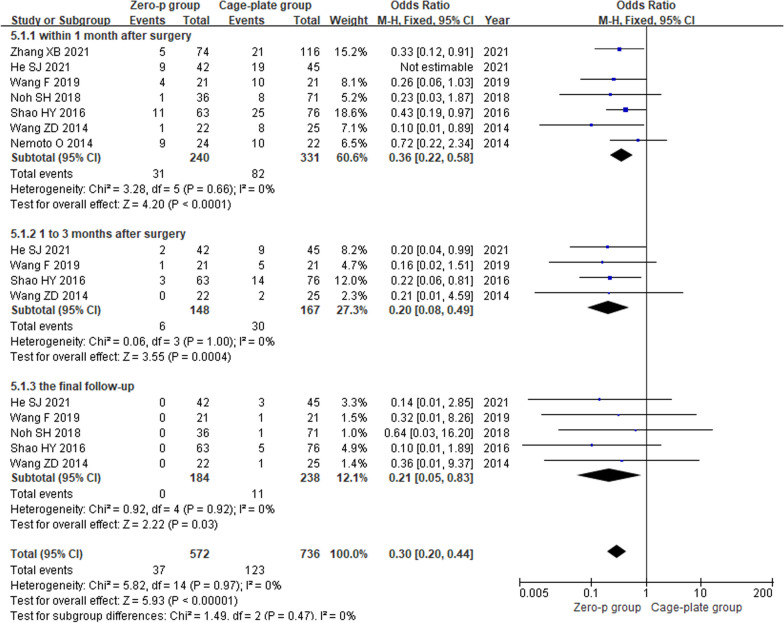
Nine high-quality studies with 808 patients were included. Meta-analysis showed that the operation time (MD = - 13.28; 95% CI (- 17.53, - 9.04), P < 0.00001), intraoperative blood loss (MD = - 6.61; 95% CI (- 10.47, - 2.75), P = 0.0008), incidence of postoperative dysphagia at various time points: within the first month after surgery (OR = 0.36; 95% CI (0.22, 0.58), P < 0.0001), 1-3 months after surgery (OR = 0.20; 95% CI (0.08, 0.49), P = 0.0004), the final follow-up (OR = 0.21; 95% CI (0.05, 0.83), P = 0.003) and the rate of postoperative adjacent disc degeneration (OR = 0.46; 95% CI (0.25, 0.84), P = 0.01) were significantly lower in the Zero-p group than in the Cage-plate group. Additionally, was also significantly lower in the Zero-p group. However, there were no significant differences in the JOA score, the final follow-up NDI score, surgical segmental fusion rate, postoperative height of adjacent vertebrae, or postoperative subsidence rate between the two groups.
In summary, when treating single-segment degenerative cervical spondylosis, both internal fixation techniques are reliable and effective. However, Zero-P implant offer several advantages over cage-plate implant, including shorter operation duration, less intraoperative blood loss, reduced postoperative dysphagia, and slower adjacent disc degeneration. Additionally, Zero-P implant has a broader application space, making them a preferred choice in certain cases.
近年来,零切迹植入物(Zero-p)已成为一种有前途的内固定技术。虽然研究表明其在治疗退行性颈椎病方面优于传统的笼板植入物(Cage-plate),但对于其适应证、安全性和疗效仍缺乏明确的对比报告。
计算机检索英文和中文数据库,包括 PubMed、Web of Science、Cochrane 图书馆、EMBASE、CNKI、万方和 VIP。此外,还对中文医学期刊进行了细致的手工检索,检索范围从各个数据库的建立到 2023 年 8 月。该荟萃分析采用病例对照研究方法,使用 RevMan 5.3 软件进行分析。严格的质量评估和数据提取程序确保了研究结果的可靠性和有效性。
纳入 9 项高质量研究,共 808 例患者。Meta 分析显示,手术时间(MD=-13.28;95%CI(-17.53,-9.04),P<0.00001)、术中出血量(MD=-6.61;95%CI(-10.47,-2.75),P=0.0008)、术后各时间点吞咽困难的发生率:术后 1 个月内(OR=0.36;95%CI(0.22,0.58),P<0.0001)、术后 1-3 个月(OR=0.20;95%CI(0.08,0.49),P=0.0004)、末次随访(OR=0.21;95%CI(0.05,0.83),P=0.003)和术后邻近节段椎间盘退变率(OR=0.46;95%CI(0.25,0.84),P=0.01)显著低于 Cage-plate 组。此外,Zero-p 组的术后邻近节段高度丢失率和术后下沉率也明显低于 Cage-plate 组。然而,两组间 JOA 评分、末次随访 NDI 评分、手术节段融合率、术后邻近椎体高度、术后下沉率无统计学差异。
综上所述,在治疗单节段退行性颈椎病时,两种内固定技术均可靠有效。然而,Zero-p 植入物在手术时间、术中出血量、术后吞咽困难和邻近节段椎间盘退变方面优于 Cage-plate 植入物。此外,Zero-p 植入物的应用空间更广泛,在某些情况下是首选。