Borzych-Dużałka Dagmara, Shroff Rukshana, Ranchin Bruno, Zhai Yihui, Paglialonga Fabio, Kari Jameela A, Ahn Yo H, Awad Hazem S, Loza Reyner, Hooman Nakysa, Ericson Robin, Drożdz Dorota, Kaur Amrit, Bakkaloglu Sevcan A, Samaille Charlotte, Lee Marsha, Tellier Stephanie, Thumfart Julia, Fila Marc, Warady Bradley A, Schaefer Franz, Schmitt Claus P
Department for Pediatrics, Nephrology and Hypertension, Medical University of Gdansk, Gdansk, Poland.
UCL Great Ormond Street Hospital and Institute of Child Health, London, UK.
Kidney Int Rep. 2024 Mar 18;9(6):1694-1704. doi: 10.1016/j.ekir.2024.03.016. eCollection 2024 Jun.
Fluid and salt overload in patients on dialysis result in high blood pressure (BP), left ventricular hypertrophy (LVH) and hemodynamic instability, resulting in cardiovascular morbidity.
Analysis of 910 pediatric patients on maintenance hemodialysis/hemodiafiltration (HD/HDF), prospectively followed-up with 2758 observations recorded every 6-months in the International Pediatric Hemodialysis Network (IPHN).
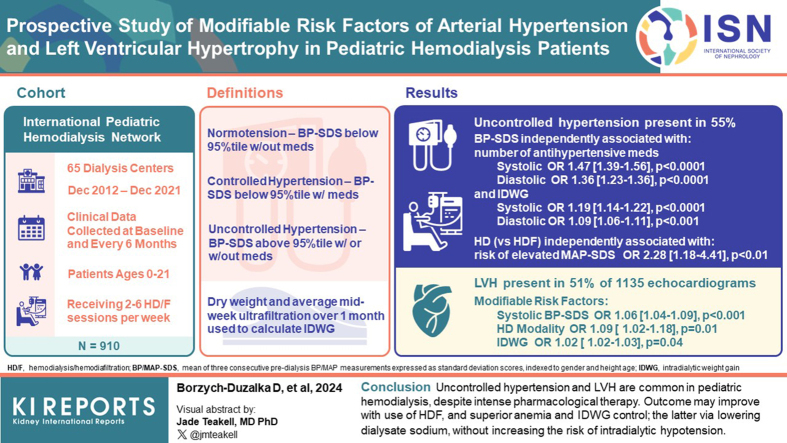
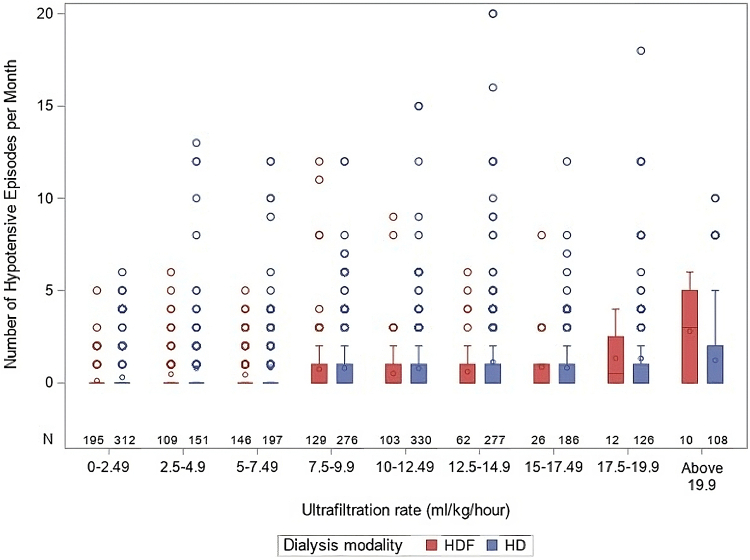
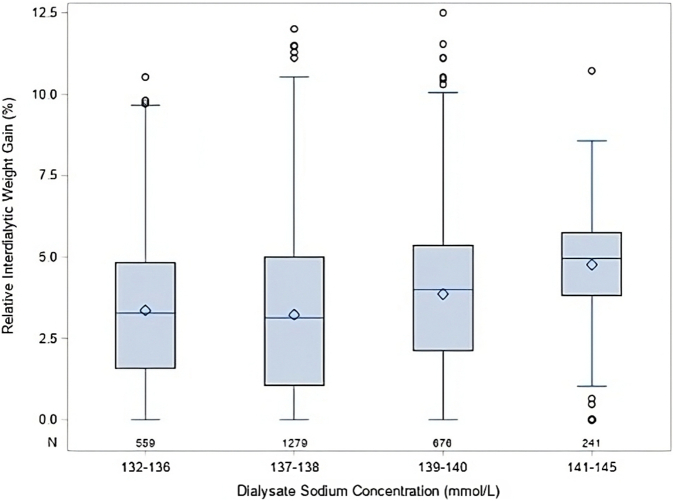
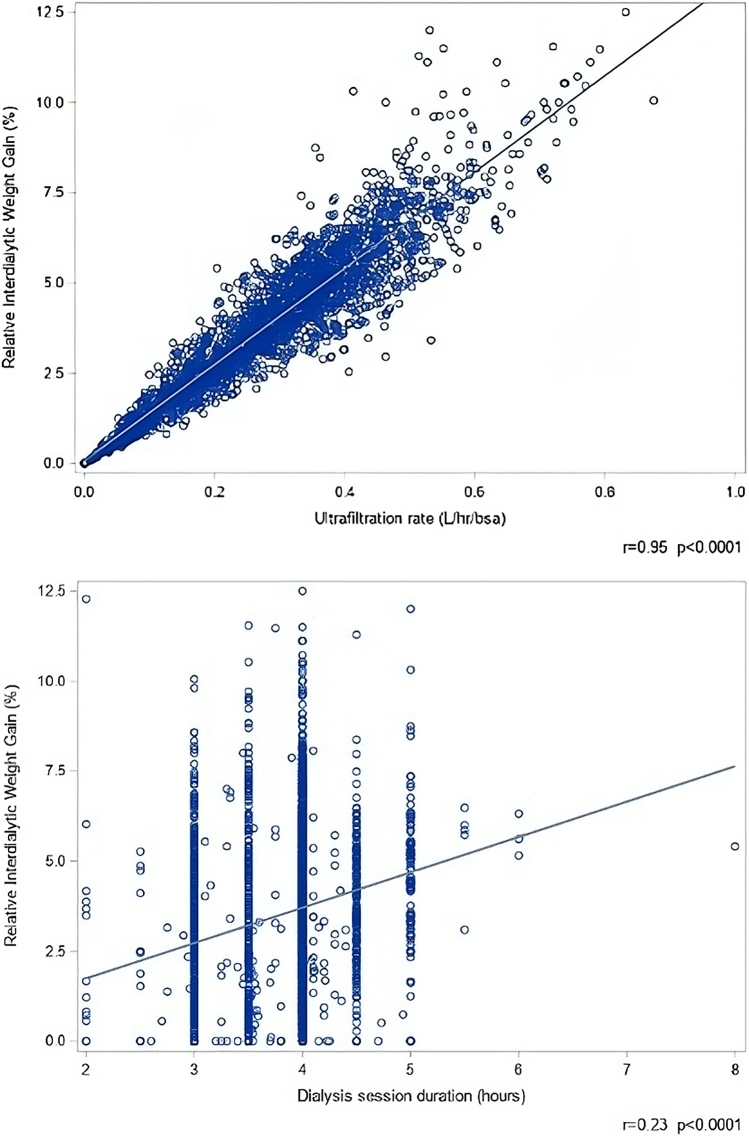
Uncontrolled hypertension was present in 55% of observations, with 27% of patients exhibiting persistently elevated predialysis BP. Systolic and diastolic age- and height-standardized BP (BP-SDS) were independently associated with the number of antihypertensive medications (odds ratio [OR] = 1.47, 95% confidence interval 1.39-1.56, 1.36 [1.23-1.36]) and interdialytic weight gain (IDWG; 1.19 [1.14-1.22], 1.09 [1.06-1.11]; all < 0.0001). IDWG was related to urine output (OR = 0.27 [0.23-0.32]) and dialysate sodium (dNa; 1.06 [1.01-1.10]; all < 0.0001). The prevalence of masked hypertension was 24%, and HD versus HDF use was an independent risk factor of elevated age- and height-standardized mean arterial pressure (MAP-SDS) (OR = 2.28 [1.18-4.41], = 0.01). Of the 1135 echocardiograms, 51% demonstrated LVH. Modifiable risk factors included predialysis systolic BP-SDS (OR = 1.06 [1.04-1.09], < 0.0001), blood hemoglobin (0.97 [0.95-0.99], = 0.004), HD versus HDF modality (1.09 [1.02-1.18], = 0.01), and IDWG (1.02 [1.02-1.03], = 0.04). In addition, HD modality increased the risk of LVH progression (OR = 1.23 [1.03-1.48], = 0.02). Intradialytic hypotension (IDH) was prevalent in patients progressing to LVH and independently associated with predialysis BP-SDS below 25th percentile, lower number of antihypertensives, HD versus HDF modality, ultrafiltration (UF) rate, and urine output, but not with dNa.
Uncontrolled hypertension and LVH are common in pediatric HD, despite intense pharmacologic therapy. The outcome may improve with use of HDF, and superior anemia and IDWG control; the latter via lowering dNa, without increasing the risk of IDH.
透析患者的液体和盐分过载会导致高血压(BP)、左心室肥厚(LVH)和血流动力学不稳定,进而引发心血管疾病。
对910例接受维持性血液透析/血液透析滤过(HD/HDF)的儿科患者进行分析,在国际儿科血液透析网络(IPHN)中每6个月进行一次前瞻性随访,共记录2758次观察结果。
55%的观察结果存在未控制的高血压,27%的患者透析前血压持续升高。收缩压和舒张压的年龄和身高标准化血压(BP-SDS)与抗高血压药物的数量(优势比[OR]=1.47,95%置信区间1.39-1.56,1.36[1.23-1.36])和透析间期体重增加(IDWG;1.19[1.14-1.22],1.09[1.06-1.11];均P<0.0001)独立相关。IDWG与尿量(OR=0.27[0.23-0.32])和透析液钠(dNa;1.06[1.01-1.10];均P<0.0001)有关。隐匿性高血压的患病率为24%,使用HD与HDF是年龄和身高标准化平均动脉压(MAP-SDS)升高的独立危险因素(OR=2.28[1.18-4.41],P=0.01)。在1135份超声心动图中,51%显示有LVH。可改变的危险因素包括透析前收缩压-SDS(OR=1.06[1.04-1.09],P<0.0001)、血红蛋白(0.97[0.95-0.99],P=~0.004)、HD与HDF模式(1.09[1.02-1.18],P=0.01)和IDWG(1.02[1.02-1.03],P=0.04)。此外,HD模式增加了LVH进展的风险(OR=1.23[1.03-1.48],P=0.02)。透析中低血压(IDH)在进展为LVH的患者中普遍存在,并且与透析前BP-SDS低于第25百分位数、抗高血压药物数量较少、HD与HDF模式、超滤(UF)率和尿量独立相关,但与dNa无关。
尽管进行了强化药物治疗,但未控制的高血压和LVH在儿科HD中很常见。使用HDF以及更好地控制贫血和IDWG可能会改善预后;后者通过降低dNa实现,且不增加IDH的风险。