Department of Rheumatology, Ajou University School of Medicine, 164 Worldcup-ro, Yeongtong-gu, Suwon, 16499, Republic of Korea.
Department of Pathology, Ajou University School of Medicine, 164 Worldcup-ro, Yeongtong-gu, Suwon, 16499, Republic of Korea.
Clin Exp Med. 2024 Jun 20;24(1):133. doi: 10.1007/s10238-024-01401-4.
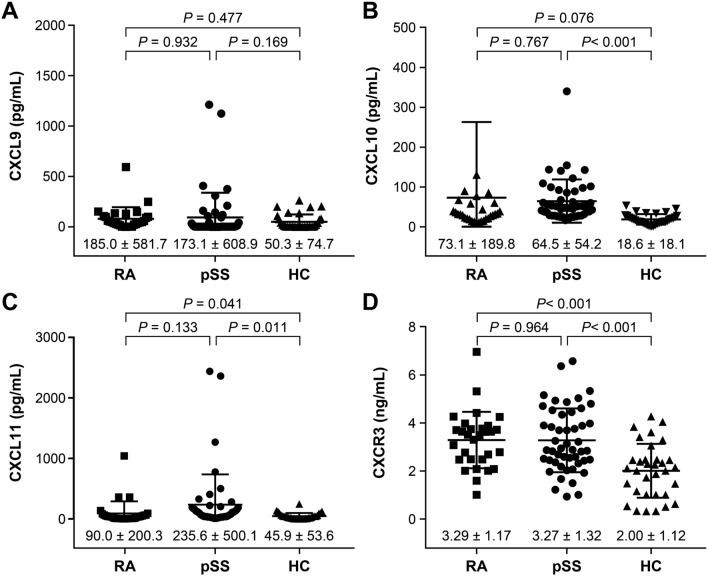
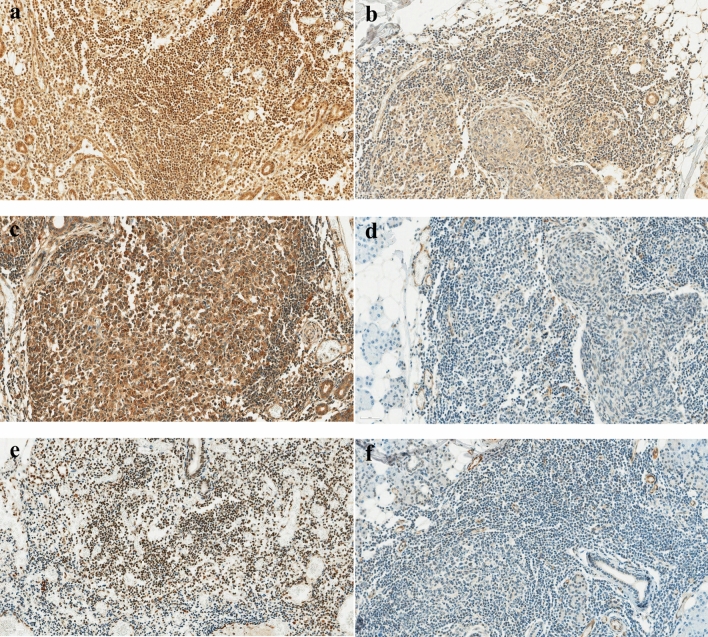
This study aimed to investigate the serum and expression levels of C-X-C motif chemokine ligand 9 (CXCL9), CXCL10, CXCL11, and CXC receptor 3 (CXCR3) in minor salivary glands (MSGs) of patients with primary Sjögren's syndrome (pSS), and to explore their correlations with clinical parameters. Serum samples from 49 patients diagnosed with pSS, 33 patients with rheumatoid arthritis (RA), and 30 healthy controls (HCs) were collected for measurements of CXCL9, CXCL10, CXCL11, and CXCR3. Additionally, CXCL levels in the MSG tissues were measured in 41 patients who underwent MSG biopsy. Correlations between CXCL and CXCL/CXCR levels in serum/MSG tissues and clinical factors/salivary scintigraphy parameters were analyzed. Serum CXCL11 and CXCR3 showed statistically significant differences among patients with pSS and RA and HCs (serum CXCL11, pSS:RA:HC = 235.6 ± 500.1 pg/mL:90.0 ± 200.3 pg/mL:45.9 ± 53.6 pg/mL; p = 0.041, serum CXCR3, pSS:RA:HC = 3.27 ± 1.32 ng/mL:3.29 ± 1.17 ng/mL:2.00 ± 1.12 ng/mL; p < 0.001). Serum CXCL10 showed a statistically significant difference between pSS (64.5 ± 54.2 pg/mL) and HCs (18.6 ± 18.1 pg/mL, p < 0.001), while serum CXCL9 did not exhibit a significant difference among the groups. Correlation analysis of clinical factors revealed that serum CXCL10 and CXCL11 levels positively correlated with erythrocyte sedimentation rate (r = 0.524, p < 0.001 and r = 0.707, p < 0.001, respectively), total protein (r = 0.375, p = 0.008 and r = 0.535, p < 0.001, respectively), globulin (r = 0.539, p < 0.001 and r = 0.639, p < 0.001, respectively), and European Alliance of Associations for Rheumatology SS Disease Activity Index (r = 0.305, p = 0.033 and r = 0.321, p = 0.025). Additionally, serum CXCL10 negatively correlated with the Schirmer test score (r = - 0.354, p = 0.05), while serum CXCL11 positively correlated with the biopsy focus score (r = 0.612, p = 0.02). In the MSG tissue, the percentage of infiltrating CXCL9-positive cells was highest (75.5%), followed by CXCL10 (29.1%) and CXCL11 (27.9%). In the correlation analysis, CXCL11-expressing cells were inversely related to the mean washout percentage on salivary gland scintigraphy (r = - 0.448, p = 0.007). Our study highlights distinct serum and tissue chemokine patterns in pSS, emphasizing CXCL9's potential for early diagnosis. This suggests that CXCL10 and CXCL11 are indicators of disease progression, warranting further investigation into their roles in autoimmune disorders beyond pSS.
本研究旨在探讨原发性干燥综合征(pSS)患者的小唾液腺(MSG)中细胞-趋化因子配体 9(CXCL9)、CXCL10、CXCL11 和 CXC 受体 3(CXCR3)的血清和表达水平,并探讨其与临床参数的相关性。收集了 49 例 pSS 患者、33 例类风湿关节炎(RA)患者和 30 名健康对照者(HCs)的血清样本,用于测量 CXCL9、CXCL10、CXCL11 和 CXCR3。此外,还对 41 例行 MSG 活检的患者进行了 MSG 组织中 CXCL 水平的测量。分析了血清/MSG 组织中 CXCL 和 CXCL/CXCR 水平与临床因素/唾液闪烁扫描参数之间的相关性。pSS 患者与 RA 患者和 HCs 之间的血清 CXCL11 和 CXCR3 存在统计学差异(血清 CXCL11,pSS:RA:HC = 235.6 ± 500.1 pg/mL:90.0 ± 200.3 pg/mL:45.9 ± 53.6 pg/mL;p = 0.041,血清 CXCR3,pSS:RA:HC = 3.27 ± 1.32 ng/mL:3.29 ± 1.17 ng/mL:2.00 ± 1.12 ng/mL;p < 0.001)。血清 CXCL10 与 pSS(64.5 ± 54.2 pg/mL)和 HCs(18.6 ± 18.1 pg/mL,p < 0.001)之间存在统计学差异,而血清 CXCL9 在各组之间无显著差异。与临床因素的相关性分析表明,血清 CXCL10 和 CXCL11 水平与红细胞沉降率(r = 0.524,p < 0.001 和 r = 0.707,p < 0.001)、总蛋白(r = 0.375,p = 0.008 和 r = 0.535,p < 0.001)、球蛋白(r = 0.539,p < 0.001 和 r = 0.639,p < 0.001)和欧洲抗风湿病联盟 SS 疾病活动指数(r = 0.305,p = 0.033 和 r = 0.321,p = 0.025)呈正相关。此外,血清 CXCL10 与 Schirmer 试验评分呈负相关(r = -0.354,p = 0.05),而血清 CXCL11 与活检焦点评分呈正相关(r = 0.612,p = 0.02)。在 MSG 组织中,CXCL9 阳性细胞浸润的百分比最高(75.5%),其次是 CXCL10(29.1%)和 CXCL11(27.9%)。在相关性分析中,CXCL11 表达细胞与唾液闪烁扫描的平均洗脱百分比呈负相关(r = -0.448,p = 0.007)。本研究强调了 pSS 中不同的血清和组织趋化因子模式,突出了 CXCL9 在早期诊断中的潜力。这表明 CXCL10 和 CXCL11 是疾病进展的指标,值得进一步研究其在 pSS 之外的自身免疫性疾病中的作用。