Department of Diagnostics and Public Health, University of Verona, Piazzale L.A. Scuro, 10, 37134, Verona, Italy.
Department of Medicine, University of Verona, Verona, Italy.
Drug Saf. 2024 Oct;47(10):1011-1023. doi: 10.1007/s40264-024-01449-x. Epub 2024 Jun 22.
The safety profile of COVID-19 vaccines in immunocompromised patients has not been comprehensively evaluated.
To measure the frequency of patient-reported adverse drug reactions (ADRs) related to the first/second/booster dose of COVID-19 vaccine in immunocompromised subject versus matched cohort. As a secondary objective, the time course, evaluated as time to onset (TTO) and time to recovery (TTR), of COVID-19 vaccine-related ADRs was explored.
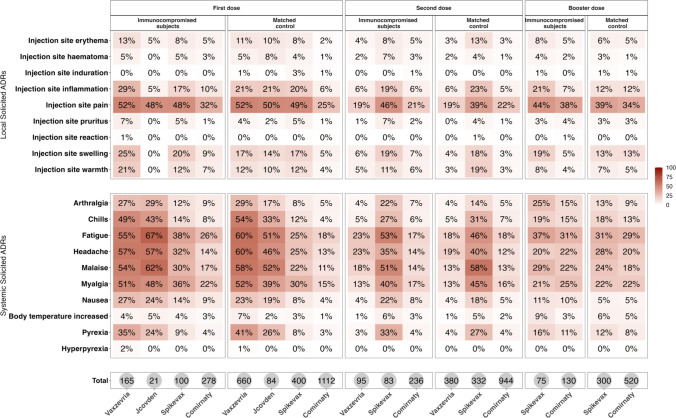
A prospective cohort study, based on electronic questionnaires filled by vaccinees from 11 European countries in the period February 2021 to February 2023 was conducted. All immunocompromised vaccinees who provided informed consent and registered to the project's web-app within 48 h after first/booster vaccine dose administration of any EMA-authorised COVID-19 vaccine were recruited. Participants filled baseline and up to six follow-up questionnaires (FU-Qs) over 6 months from vaccination, collecting information on suspected COVID-19 vaccine-related ADRs. As a control group, non-immunocompromised vaccinees from the same source population were 1:4 matched by sex, age, vaccine dose, and brand. A descriptive analysis of demographic/clinical characteristics of vaccinees was conducted. Heatmaps of the frequency of solicited ADRs, stratified by gender and vaccine brand, were generated. Median TTO/TTR of reported ADRs were visualised using violin/box-plots.
A total of 773 immunocompromised vaccines were included in the analyses. Most participants were females (F/M ratio: 2.1 and 1.6) with a median age of 56 (43-74) and 51 (41-60) years, at the first vaccination cycle and booster dose, respectively. Injection-site pain and fatigue were the most frequently reported ADRs in immunocompromised vaccinees with higher frequency than matched control, especially after the first dose (41.2% vs 37.8% and 38.2% vs 32.9%, respectively). For both cohorts, all solicited ADRs were more frequently reported in females than males, and in those who had received a first dose of the Vaxzevria vaccine. Dizziness was the most frequently reported unsolicited ADR after the first dose in both groups (immunocompromised subjects: 2.5% and matched controls: 2.1%). At the booster dose, lymphadenopathy (3.9%) and lymphadenitis (1.8%) were the most reported unsolicited ADRs for immunocompromised subjects and matched controls, respectively. A very low number of subjects reported adverse event of special interest (AESI) (2 immunocompromised, 3 matched controls) and serious ADRs (5 immunocompromised, 5 matched controls). A statistically significant difference among study cohorts was observed for median TTO after the booster dose, and for median TTR after the first vaccination cycle and booster dose (p < 0.001).
The overall safety profile of COVID-19 vaccines in immunocompromised people was favourable, with minor differences as compared to non-immunocompromised vaccinees. Participants mostly experienced mild ADRs, mainly reported after the first dose of Vaxzevria and Jcovden vaccines. Serious ADRs and AESI were rare.
COVID-19 疫苗在免疫功能低下患者中的安全性特征尚未得到全面评估。
测量免疫功能低下患者首次/第二剂/加强剂 COVID-19 疫苗接种后与匹配队列相比,患者报告的药物不良反应(ADR)的频率。作为次要目标,探索 COVID-19 疫苗相关 ADR 的时间过程,评估为发病时间(TTO)和恢复时间(TTR)。
进行了一项基于电子问卷的前瞻性队列研究,参与者来自 11 个欧洲国家,时间为 2021 年 2 月至 2023 年 2 月。所有提供知情同意并在首次/加强疫苗剂量接种后 48 小时内注册到项目网络应用程序的免疫功能低下疫苗接种者均被招募。参与者在接种疫苗后 6 个月内填写基线和最多六份随访问卷(FU-Q),收集疑似 COVID-19 疫苗相关 ADR 的信息。作为对照组,来自同一来源人群的非免疫功能低下疫苗接种者按性别、年龄、疫苗剂量和品牌以 1:4 匹配。对疫苗接种者的人口统计学/临床特征进行描述性分析。按性别和疫苗品牌分层生成征集 ADR 频率的热图。使用小提琴/箱形图可视化报告 ADR 的中位数 TTO/TTR。
共纳入 773 名免疫功能低下疫苗接种者进行分析。大多数参与者为女性(F/M 比:2.1 和 1.6),中位年龄分别为 56(43-74)和 51(41-60)岁,分别为首次接种周期和加强剂量。免疫功能低下疫苗接种者中,注射部位疼痛和疲劳是最常报告的 ADR,尤其是在首次剂量后(41.2%比 37.8%和 38.2%比 32.9%)。对于两个队列,所有征集的 ADR 在女性中比男性更常见,在首次接种 Vaxzevria 疫苗的人群中更常见。头晕是两组中首次剂量后最常报告的非征集性 ADR(免疫功能低下者:2.5%和匹配对照:2.1%)。在加强剂量时,免疫功能低下者和匹配对照中最常报告的非征集性 ADR 分别为淋巴结病(3.9%)和淋巴结炎(1.8%)。报告不良事件特别关注(AESI)的受试者人数非常少(2 名免疫功能低下者,3 名匹配对照)和严重 ADR(5 名免疫功能低下者,5 名匹配对照)。在加强剂量后,两组的中位 TTO 和首次接种周期和加强剂量后的中位 TTR 之间观察到研究队列之间存在统计学显著差异(p < 0.001)。
COVID-19 疫苗在免疫功能低下人群中的总体安全性良好,与非免疫功能低下疫苗接种者相比差异较小。参与者主要经历轻度 ADR,主要在接种 Vaxzevria 和 Jcovden 疫苗后首次剂量后报告。严重 ADR 和 AESI 很少见。