Geng Nan, Wu Zhipeng, Liu Zhao, Pan Wen, Zhu Yueke, Shi Hongbo, Han Ying, Ma Yingmin, Liu Bo
Department of Emergency Medicine, Beijing Youan Hospital, Capital Medical University, Beijing, 100069, People's Republic of China.
Department of Respiratory and Critical Care Medicine, Beijing Youan Hospital, Capital Medical University, Beijing, 100069, People's Republic of China.
J Inflamm Res. 2024 Jun 17;17:3879-3891. doi: 10.2147/JIR.S464789. eCollection 2024.
Research on biomarkers associated with the severity and adverse prognosis of COVID-19 can be beneficial for improving patient outcomes. However, there is limited research on the role of soluble TREM-1 (sTREM-1) in predicting the severity and prognosis of COVID-19 patients.
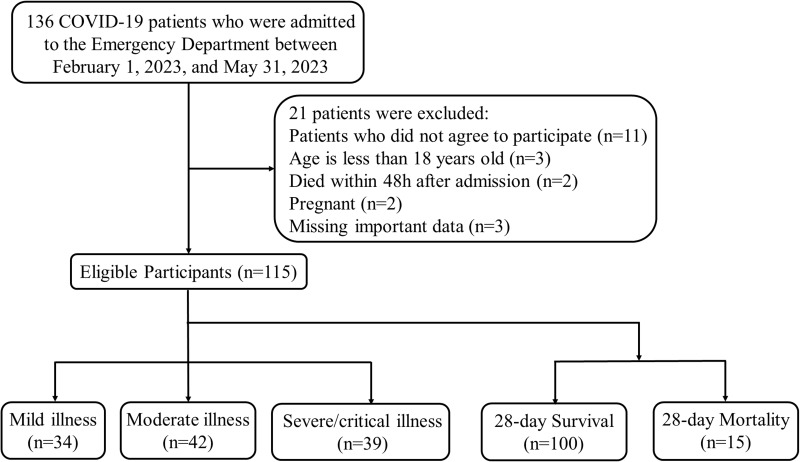
A total of 115 COVID-19 patients admitted to the emergency department of Beijing Youan Hospital from February to May 2023 were included in the study. Demographic information, laboratory measurements, and blood samples for sTREM-1 levels were collected upon admission.
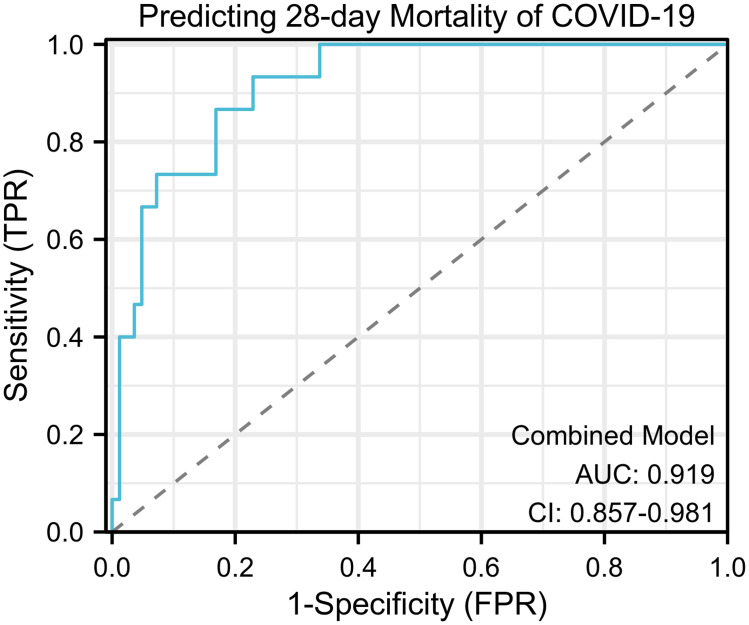
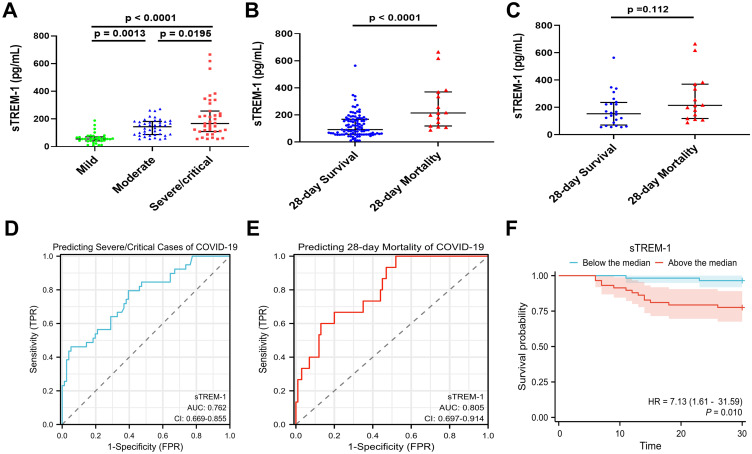
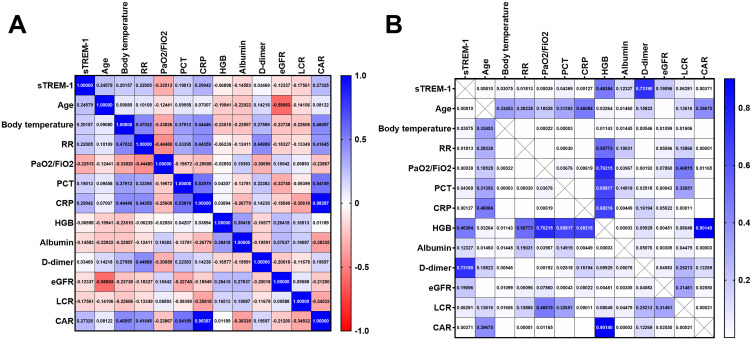
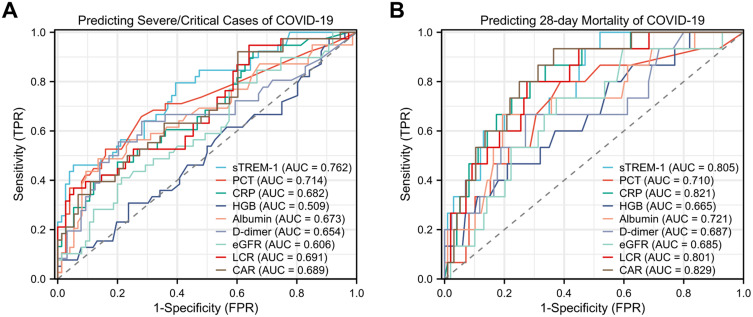
Our study found that sTREM-1 levels in the plasma of COVID-19 patients increased with the severity of the disease (moderate vs mild, p=0.0013; severe vs moderate, p=0.0195). sTREM-1 had good predictive value for disease severity and 28-day mortality (area under the ROC curve was 0.762 and 0.805, respectively). sTREM-1 also exhibited significant correlations with age, body temperature, respiratory rate, PaO/FiO, PCT, CRP, and CAR. Ultimately, through multivariate logistic regression analysis, we determined that sTREM-1 (OR 1.008, 95% CI: 1.002-1.013, p=0.005), HGB (OR 0.966, 95% CI: 0.935-0.998, p=0.036), D-dimer (OR 1.001, 95% CI: 1.000-1.001, p=0.009), and CAR (OR 1.761, 95% CI: 1.154-2.688, p=0.009) were independent predictors of 28-day mortality in COVID-19 patients. The combination of these four markers yielded a strong predictive value for 28-day mortality in COVID-19 cases with an AUC of 0.919 (95% CI: 0.857 -0.981).
sTREM-1 demonstrated good predictive value for disease severity and 28-day mortality, serving as an independent prognostic factor for adverse patient outcomes. In the future, we anticipate conducting large-scale multicenter studies to validate our research findings.
关于与新型冠状病毒肺炎(COVID-19)严重程度及不良预后相关生物标志物的研究,可能有助于改善患者预后。然而,可溶性髓系细胞触发受体-1(sTREM-1)在预测COVID-19患者严重程度和预后方面的研究较少。
本研究纳入了2023年2月至5月在北京佑安医院急诊科收治的115例COVID-19患者。入院时收集人口统计学信息、实验室检测数据以及用于检测sTREM-1水平的血样。
我们的研究发现,COVID-19患者血浆中的sTREM-1水平随疾病严重程度增加而升高(中度与轻度相比,p = 0.0013;重度与中度相比,p = 0.0195)。sTREM-1对疾病严重程度和28天死亡率具有良好的预测价值(ROC曲线下面积分别为0.762和0.805)。sTREM-1还与年龄、体温、呼吸频率、氧合指数(PaO/FiO)、降钙素原(PCT)、C反应蛋白(CRP)及淋巴细胞与单核细胞比值(CAR)显著相关。最终,通过多因素逻辑回归分析,我们确定sTREM-1(比值比[OR] 1.008,95%置信区间[CI]:1.002 - 1.013,p = 0.005)、血红蛋白(HGB,OR 0.966,95% CI:0.935 - 0.998,p = 0.036)、D-二聚体(OR 1.001,95% CI:1.000 - 1.001,p = 0.009)和CAR(OR 1.761,95% CI:1.154 - 2.688,p = 0.009)是COVID-19患者28天死亡率的独立预测因素。这四种标志物的联合对COVID-19病例28天死亡率具有很强的预测价值,AUC为0.919(95% CI:0.857 - 0.981)。
sTREM-1对疾病严重程度和28天死亡率显示出良好的预测价值,是患者不良预后的独立预测因素。未来,我们期望开展大规模多中心研究以验证我们的研究结果。