Department of Medical Oncology, Dana-Farber Cancer Institute, Boston, Massachusetts.
Center for Functional Cancer Epigenetics, Dana-Farber Cancer Institute, Boston, Massachusetts.
Clin Cancer Res. 2024 Sep 3;30(17):3798-3811. doi: 10.1158/1078-0432.CCR-24-0466.
Histologic transformation to small cell lung cancer (SCLC) is a mechanism of treatment resistance in patients with advanced oncogene-driven lung adenocarcinoma (LUAD) that currently requires histologic review for diagnosis. Herein, we sought to develop an epigenomic cell-free DNA (cfDNA)-based approach to noninvasively detect small cell transformation in patients with EGFR mutant (EGFRm) LUAD.
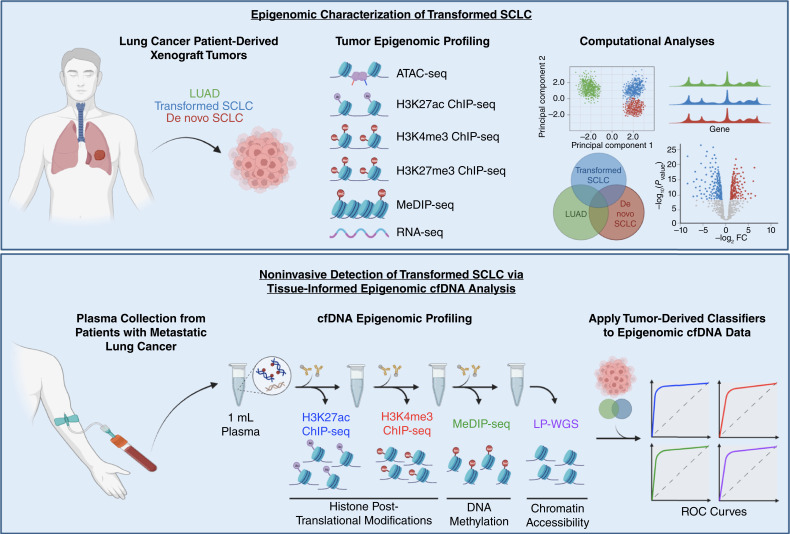
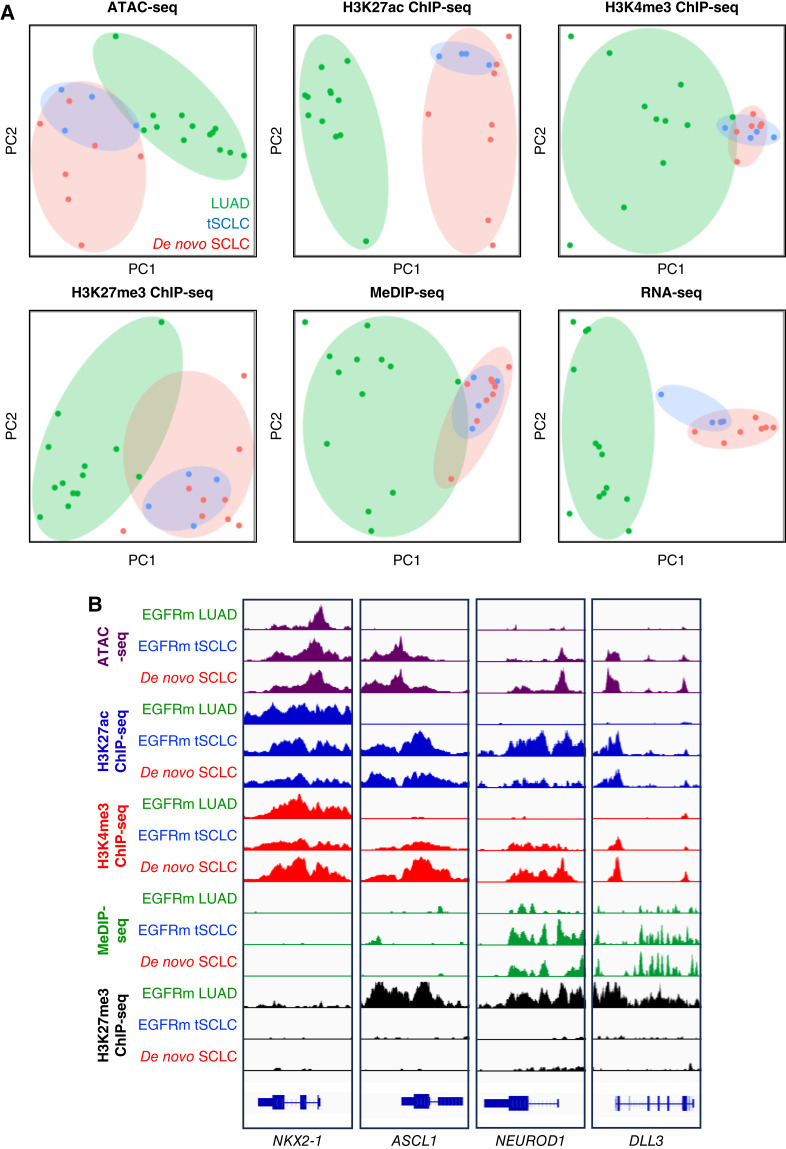
To characterize the epigenomic landscape of transformed (t)SCLC relative to LUAD and de novo SCLC, we performed chromatin immunoprecipitation sequencing (ChIP-seq) to profile the histone modifications H3K27ac, H3K4me3, and H3K27me3; methylated DNA immunoprecipitation sequencing (MeDIP-seq); assay for transposase-accessible chromatin sequencing; and RNA sequencing on 26 lung cancer patient-derived xenograft (PDX) tumors. We then generated and analyzed H3K27ac ChIP-seq, MeDIP-seq, and whole genome sequencing cfDNA data from 1 mL aliquots of plasma from patients with EGFRm LUAD with or without tSCLC.
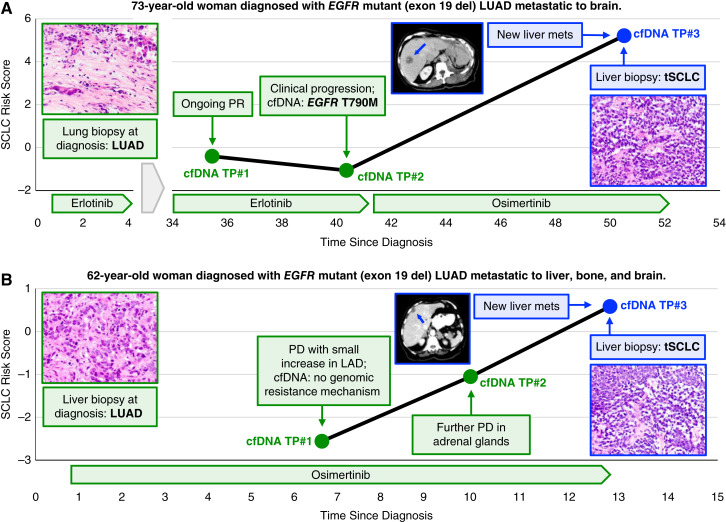
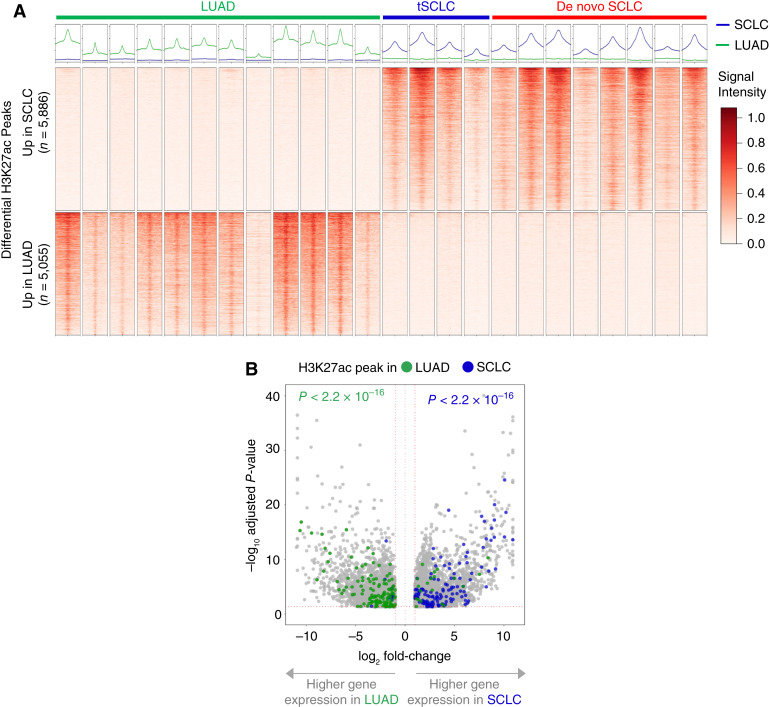
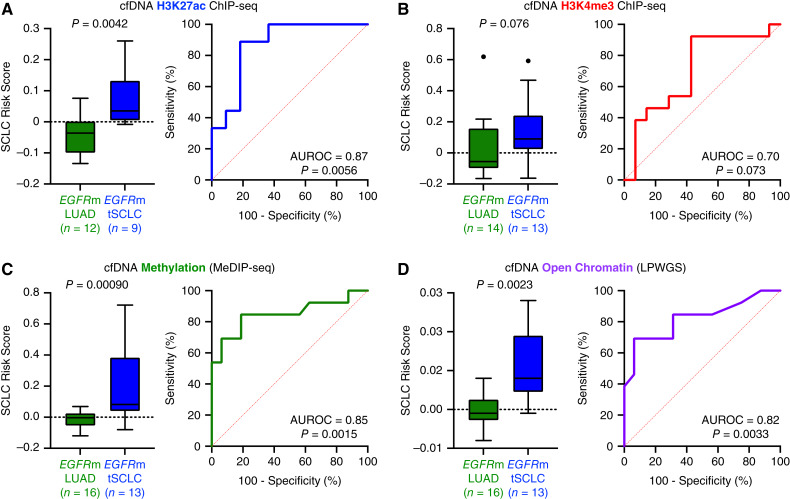
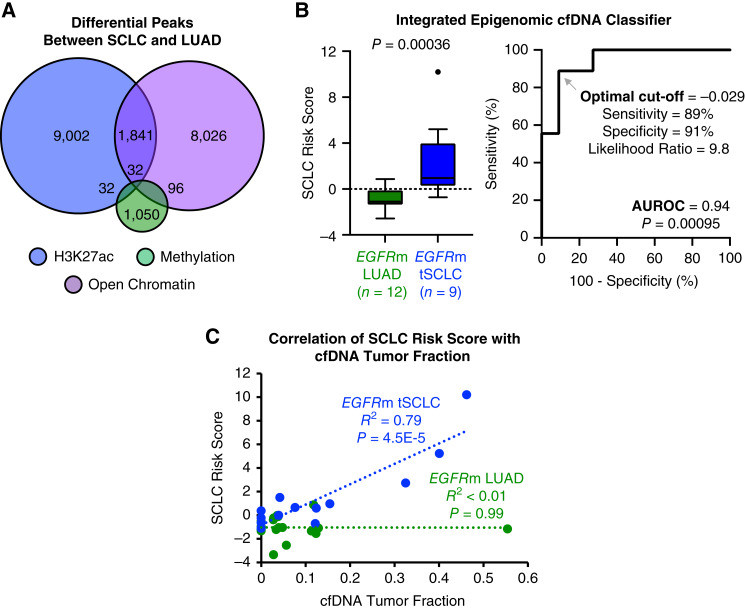
Analysis of 126 epigenomic libraries from the lung cancer PDXs revealed widespread epigenomic reprogramming between LUAD and tSCLC, with a large number of differential H3K27ac (n = 24,424), DNA methylation (n = 3,298), and chromatin accessibility (n = 16,352) sites between the two histologies. Tumor-informed analysis of each of these three epigenomic features in cfDNA resulted in accurate noninvasive discrimination between patients with EGFRm LUAD versus tSCLC [area under the receiver operating characteristic curve (AUROC) = 0.82-0.87]. A multianalyte cfDNA-based classifier integrating these three epigenomic features discriminated between EGFRm LUAD versus tSCLC with an AUROC of 0.94.
These data demonstrate the feasibility of detecting small cell transformation in patients with EGFRm LUAD through epigenomic cfDNA profiling of 1 mL of patient plasma.
小细胞肺癌(SCLC)的组织学转化是晚期致癌基因驱动型肺腺癌(LUAD)患者治疗耐药的一种机制,目前需要进行组织学检查以明确诊断。在此,我们试图开发一种基于表观基因组细胞游离 DNA(cfDNA)的方法,以非侵入性方式检测 EGFR 突变(EGFRm)LUAD 患者的小细胞转化。
为了描述转化(t)SCLC 与 LUAD 和新生 SCLC 之间的表观基因组景观,我们对 26 个肺癌患者衍生的异种移植(PDX)肿瘤进行了染色质免疫沉淀测序(ChIP-seq),以分析组蛋白修饰 H3K27ac、H3K4me3 和 H3K27me3;甲基化 DNA 免疫沉淀测序(MeDIP-seq);转座酶可及染色质测序分析;以及 RNA 测序。然后,我们从 1 毫升 EGFRm LUAD 患者的血浆中生成和分析了 H3K27ac ChIP-seq、MeDIP-seq 和全基因组测序 cfDNA 数据,这些患者或患有或未患有 tSCLC。
对 126 个来自肺癌 PDX 的表观基因组文库的分析显示,LUAD 和 tSCLC 之间存在广泛的表观基因组重编程,两种组织之间有大量差异的 H3K27ac(n=24424)、DNA 甲基化(n=3298)和染色质可及性(n=16352)位点。对这三种表观基因组特征中的每一种在 cfDNA 中的肿瘤信息分析,都能准确地将 EGFRm LUAD 患者与 tSCLC 患者区分开来[受试者工作特征曲线下的面积(AUROC)=0.82-0.87]。整合这三种表观基因组特征的多分析物 cfDNA 分类器,将 EGFRm LUAD 患者与 tSCLC 患者区分开来,AUROC 为 0.94。
这些数据表明,通过对 1 毫升患者血浆进行表观基因组 cfDNA 分析,可以检测 EGFRm LUAD 患者的小细胞转化。