Thoracic Oncology Service, Division of Solid Tumor Oncology, Department of Medicine, Memorial Sloan Kettering Cancer Center, New York, New York.
Druckenmiller Center for Lung Cancer Research, Memorial Sloan Kettering Cancer Center, New York, New York.
J Thorac Oncol. 2019 Oct;14(10):1784-1793. doi: 10.1016/j.jtho.2019.06.002. Epub 2019 Jun 19.
EGFR-mutant lung cancers are clinically and genomically heterogeneous with concurrent RB transcriptional corepressor 1 (RB1)/tumor protein p53 (TP53) alterations identifying a subset at increased risk for small cell transformation. The genomic alterations that induce lineage plasticity are unknown.
Patients with EGFR/RB1/TP53-mutant lung cancers, identified by next-generation sequencing from 2014 to 2018, were compared to patients with untreated, metastatic EGFR-mutant lung cancers without both RB1 and TP53 alterations. Time to EGFR-tyrosine kinase inhibitor discontinuation, overall survival, SCLC transformation rate, and genomic alterations were evaluated.
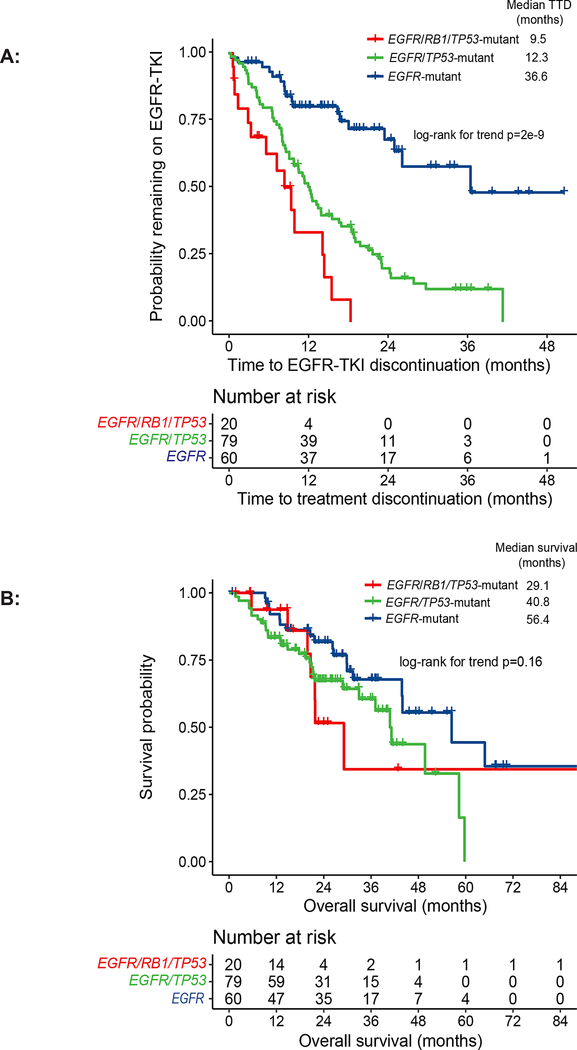
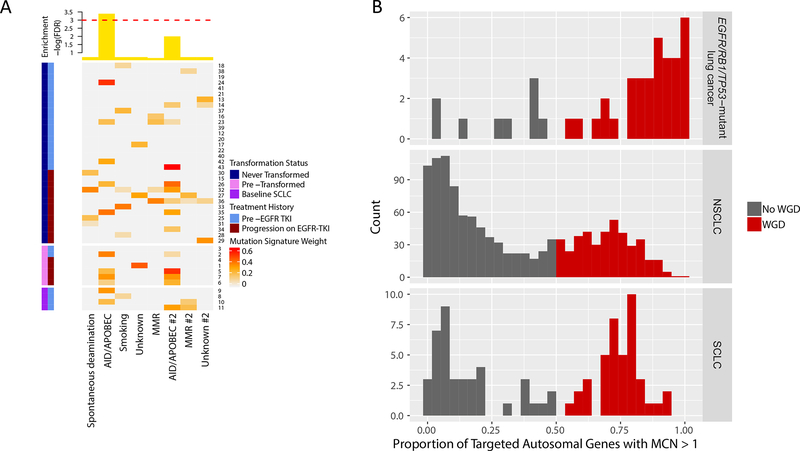
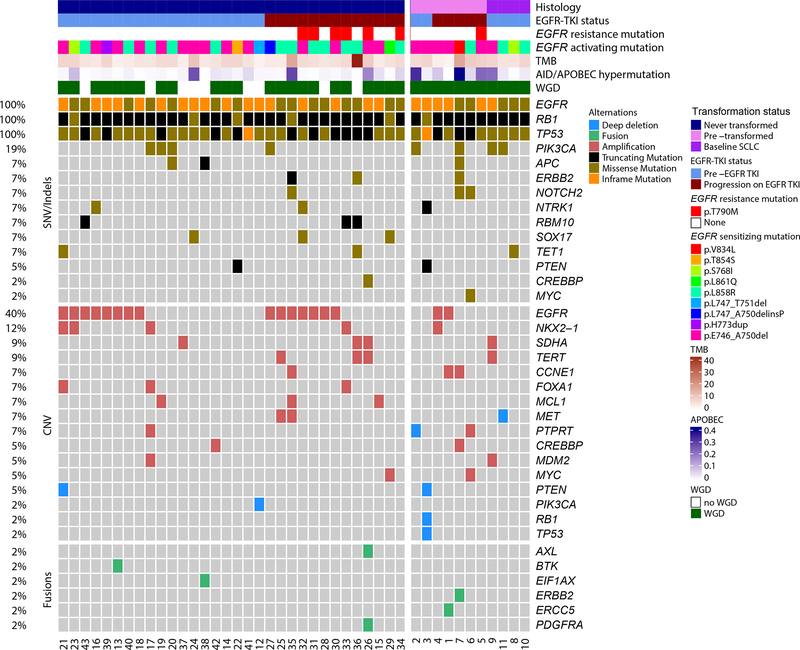
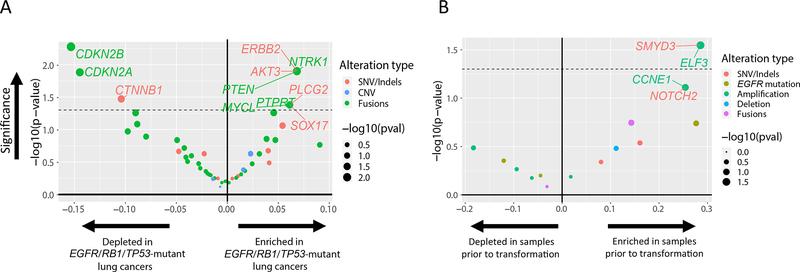
Patients with EGFR/RB1/TP53-mutant lung cancers represented 5% (43 of 863) of EGFR-mutant lung cancers but were uniquely at risk for transformation (7 of 39, 18%), with no transformations in EGFR-mutant lung cancers without baseline TP53 and RB1 alterations. Irrespective of transformation, patients with EGFR/TP53/RB1-mutant lung cancers had a shorter time to discontinuation than EGFR/TP53- and EGFR-mutant -only cancers (9.5 versus 12.3 versus 36.6 months, respectively, p = 2 × 10). The triple-mutant population had a higher incidence of whole-genome doubling compared to NSCLC and SCLC at large (80% versus 34%, p < 5 × 10 versus 51%, p < 0.002, respectively) and further enrichment in triple-mutant cancers with eventual small cell histology (seven of seven pre-transformed plus four of four baseline SCLC versus 23 of 32 never transformed, respectively, p = 0.05). Activation-induced cytidine deaminase/apolipoprotein B mRNA editing enzyme, catalytic polypeptide-like mutation signature was also enriched in triple-mutant lung cancers that transformed (false discovery rate = 0.03).
EGFR/TP53/RB1-mutant lung cancers are at unique risk of histologic transformation, with 25% presenting with de novo SCLC or eventual small cell transformation. Triple-mutant lung cancers are enriched in whole-genome doubling and Activation-induced cytidine deaminase/apolipoprotein B mRNA editing enzyme, catalytic polypeptide-like hypermutation which may represent early genomic determinants of lineage plasticity.
EGFR 突变型肺癌在临床上和基因组上具有异质性,同时存在 RB 转录核心抑制因子 1(RB1)/肿瘤蛋白 p53(TP53)改变,这一亚组患者具有发生小细胞转化的风险增加。诱导谱系可塑性的基因组改变尚不清楚。
通过下一代测序,从 2014 年到 2018 年,我们比较了 EGFR/RB1/TP53 突变型肺癌患者与未经治疗的转移性 EGFR 突变型肺癌患者(无 RB1 和 TP53 改变)。评估了 EGFR 酪氨酸激酶抑制剂停药时间、总生存期、SCLC 转化率和基因组改变。
EGFR/RB1/TP53 突变型肺癌患者占 EGFR 突变型肺癌的 5%(43/863),但具有独特的转化风险(7/39,18%),而基线无 TP53 和 RB1 改变的 EGFR 突变型肺癌中无转化。无论是否发生转化,EGFR/TP53/RB1 突变型肺癌患者的停药时间均短于 EGFR/TP53-和 EGFR 突变型肺癌患者(分别为 9.5、12.3 和 36.6 个月,p=2×10)。三重突变组与 NSCLC 和 SCLC 相比,全基因组倍增的发生率更高(80%比 34%,p<5×10 比 51%,p<0.002),并且三重突变型癌症中最终发生小细胞组织学的比例更高(七例转化前加上四例基线 SCLC 比三十二例从未转化的患者,p=0.05)。激活诱导胞嘧啶脱氨酶/载脂蛋白 B mRNA 编辑酶,催化多肽样突变特征也在三重突变型肺癌中富集,这些肺癌发生了转化(假发现率=0.03)。
EGFR/TP53/RB1 突变型肺癌具有独特的组织学转化风险,25%的患者表现为新发 SCLC 或最终发生小细胞转化。三重突变型肺癌富含全基因组倍增和激活诱导胞嘧啶脱氨酶/载脂蛋白 B mRNA 编辑酶,催化多肽样超突变,这可能代表谱系可塑性的早期基因组决定因素。