Clinical and Experimental Onco-Hematology Unit, Centro di Riferimento Oncologico di Aviano (CRO), IRCCS, Aviano, 33081, Italy.
Experimental Hematology, Institute of Oncology Research, Bellinzona, 6500, Switzerland.
Leukemia. 2024 Aug;38(8):1712-1721. doi: 10.1038/s41375-024-02301-y. Epub 2024 Jun 24.
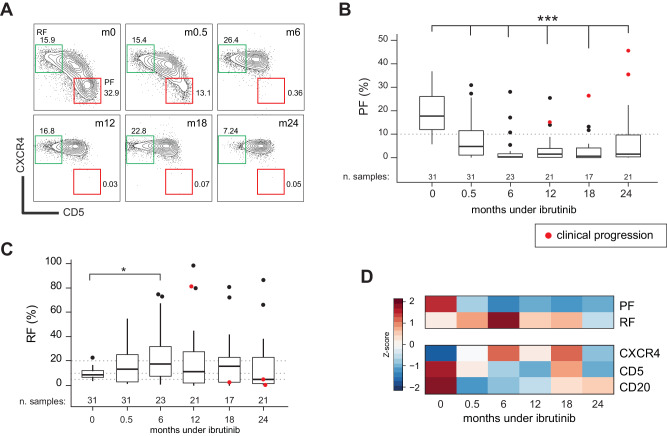
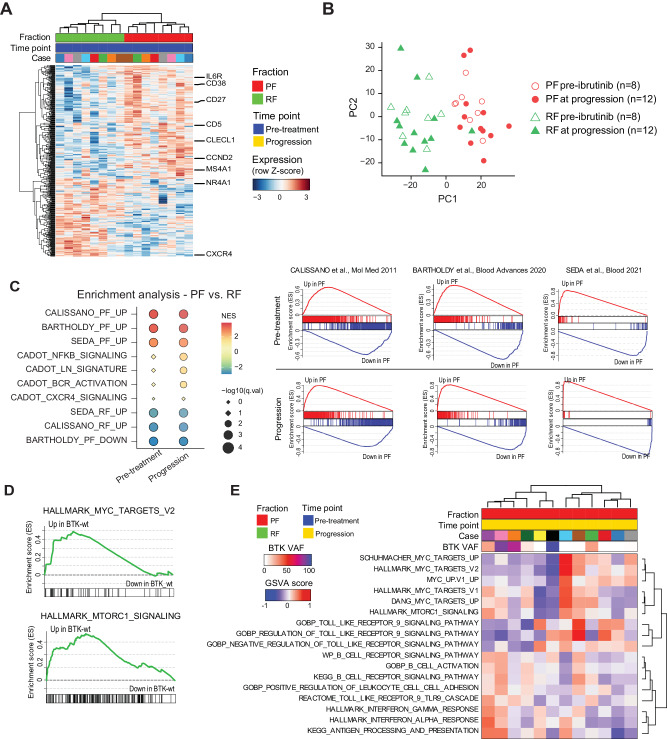
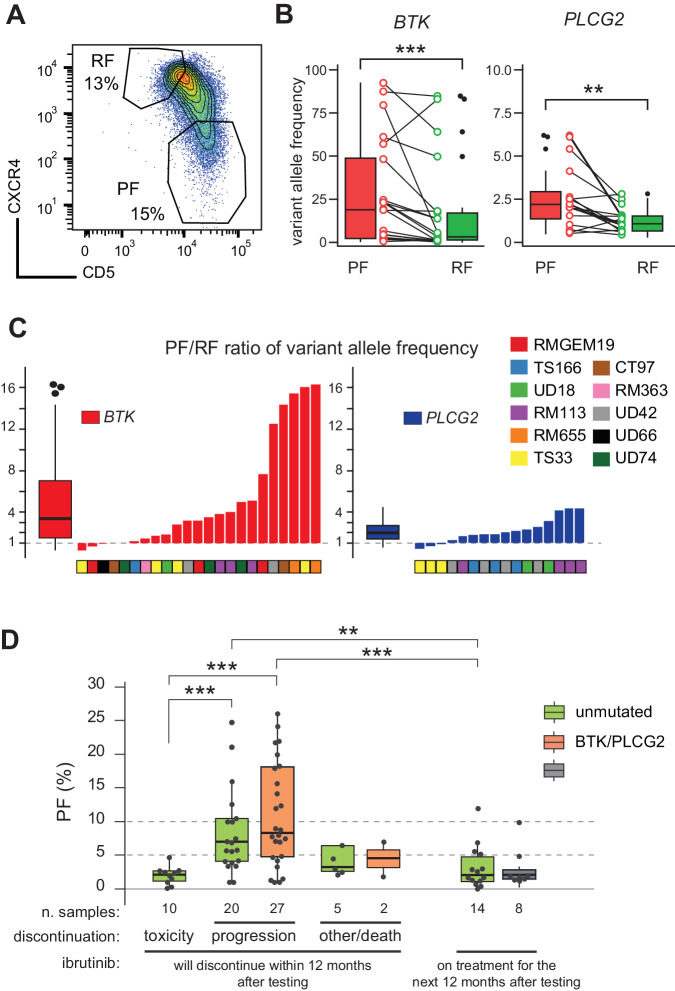
The Bruton's tyrosine kinase (BTK) inhibitor ibrutinib represents an effective strategy for treatment of chronic lymphocytic leukemia (CLL), nevertheless about 30% of patients eventually undergo disease progression. Here we investigated by flow cytometry the long-term modulation of the CLL CXCR4/CD5 proliferative fraction (PF), its correlation with therapeutic outcome and emergence of ibrutinib resistance. By longitudinal tracking, the PF, initially suppressed by ibrutinib, reappeared upon early disease progression, without association with lymphocyte count or serum beta-2-microglobulin. Somatic mutations of BTK/PLCG2, detected in 57% of progressing cases, were significantly enriched in PF with a 3-fold greater allele frequency than the non-PF fraction, suggesting a BTK/PLCG2-mutated reservoir resident within the proliferative compartments. PF increase was also present in BTK/PLCG2-unmutated cases at progression, indicating that PF evaluation could represent a marker of CLL progression under ibrutinib. Furthermore, we evidence different transcriptomic profiles of PF at progression in cases with or without BTK/PLCG2 mutations, suggestive of a reactivation of B-cell receptor signaling or the emergence of bypass signaling through MYC and/or Toll-Like-Receptor-9. Clinically, longitudinal monitoring of the CXCR4/CD5 PF by flow cytometry may provide a simple tool helping to intercept CLL progression under ibrutinib therapy.
布鲁顿酪氨酸激酶 (BTK) 抑制剂伊布替尼是治疗慢性淋巴细胞白血病 (CLL) 的有效策略,但约 30%的患者最终会出现疾病进展。在这里,我们通过流式细胞术研究了 CLL CXCR4/CD5 增殖分数 (PF) 的长期调节作用,及其与治疗结果和伊布替尼耐药性出现的相关性。通过纵向跟踪,PF 最初被伊布替尼抑制,但在早期疾病进展时再次出现,与淋巴细胞计数或血清β2-微球蛋白无关。在 57%的进展病例中检测到 BTK/PLCG2 的体细胞突变,其在 PF 中的丰度明显高于非 PF 部分,提示在增殖区室中存在 BTK/PLCG2 突变的储备细胞。在 BTK/PLCG2 未突变的病例中,PF 也在进展时增加,表明 PF 评估可能是伊布替尼下 CLL 进展的标志物。此外,我们在 BTK/PLCG2 突变或无突变的病例中发现了 PF 在进展时的不同转录组谱,提示 B 细胞受体信号的重新激活或通过 MYC 和/或 Toll 样受体 9 出现旁路信号。临床上,通过流式细胞术对 CXCR4/CD5 PF 进行纵向监测可能提供一种简单的工具,有助于在伊布替尼治疗下拦截 CLL 进展。