Student's Scientific Group, Department of Neurology, Faculty of Health Sciences, Medical University of Warsaw, Warsaw, Poland.
Department of Neurology, Faculty of Health Sciences, Medical University of Warsaw, Ludwika Kondratowicza 8, Warsaw, 03-242, Poland.
J Neural Transm (Vienna). 2024 Sep;131(9):1013-1024. doi: 10.1007/s00702-024-02800-3. Epub 2024 Jun 25.
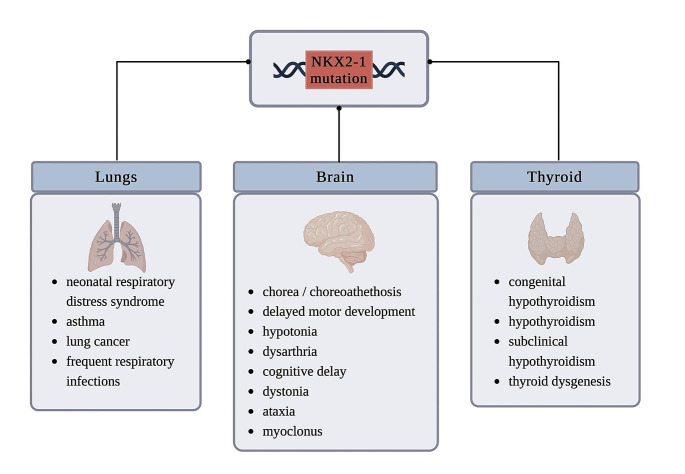
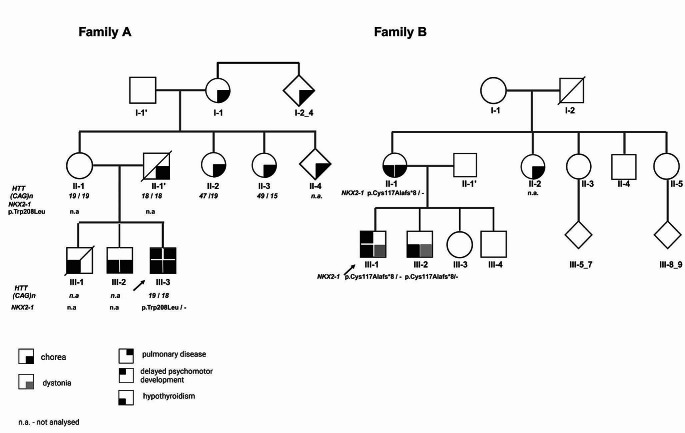
Benign hereditary chorea (BHC) is an inherited neurological disorder consisting of childhood-onset, nonprogressive chorea, generally without any other manifestations. In most reported cases, the inheritance of BHC is autosomal dominant but both incomplete penetrance and variable expressivity are observed and can be caused by NKX2-1 mutations. The spectrum contains choreoathetosis, congenital hypothyroidism, and neonatal respiratory distress syndrome. The neurological symptoms can be misdiagnosed as Huntington's disease (HD). The two Polish families were diagnosed with NKX2-1 gene mutations and a literature review concerning the NKX2-1-related disorders was conducted. All family members were examined by experienced movement disorders specialists. PubMed database was searched to obtain previously described NKX2-1 cases. Whole exome sequencing (WES) was performed in one proband (Family A) and direct NKX2-1 sequencing in the second (Family B). Two Polish families were diagnosed with NKX2-1 gene mutations (p.Trp208Leu and p.Cys117Alafs*8). In one family, the co-occurrence of HD was reported. Forty-nine publications were included in the literature review and symptoms of 195 patients with confirmed NKX2-1 mutation were analyzed. The most common symptoms were chorea and choreiform movements, and delayed motor milestones. The NKX2-1 mutation should always be considered as a potential diagnosis in families with chorea, even with a family history of HD. Lack of chorea does not exclude the NKX2-1-related disorders.
良性遗传性舞蹈病(BHC)是一种遗传性神经系统疾病,其特征为儿童期发病、进行性不加重的舞蹈病,通常无其他表现。在大多数报道的病例中,BHC 的遗传方式为常染色体显性遗传,但存在不完全外显和表现度差异,可由 NKX2-1 突变引起。其表型谱包括舞蹈手足徐动症、先天性甲状腺功能减退症和新生儿呼吸窘迫综合征。神经症状可能被误诊为亨廷顿病(HD)。两个波兰家族被诊断为 NKX2-1 基因突变,并对 NKX2-1 相关疾病进行了文献复习。所有家族成员均由经验丰富的运动障碍专家进行检查。在一个先证者(家族 A)中进行了全外显子组测序(WES),在另一个先证者(家族 B)中进行了直接 NKX2-1 测序。两个波兰家族均被诊断为 NKX2-1 基因突变(p.Trp208Leu 和 p.Cys117Alafs*8)。在一个家族中,报告了 HD 的共病现象。文献复习共纳入 49 篇出版物,分析了 195 例经证实的 NKX2-1 突变患者的症状。最常见的症状是舞蹈病和舞蹈样运动,以及运动发育迟缓。即使有 HD 家族史,对于出现舞蹈病的家族,也应始终考虑 NKX2-1 突变作为潜在的诊断。无舞蹈病并不能排除 NKX2-1 相关疾病。