Inaba Mizuki, Shimizu Yasuo, Nakamura Yusuke, Okutomi Hiroaki, Takemasa Akihiro, Niho Seiji
Department of Pulmonary Medicine and Clinical Immunology, Dokkyo Medical University, Mibu, Tochigi, Japan.
Respiratory Endoscopy Center, Dokkyo Medical University Hospital, Mibu, Japan.
Front Med (Lausanne). 2024 Jun 11;11:1381261. doi: 10.3389/fmed.2024.1381261. eCollection 2024.
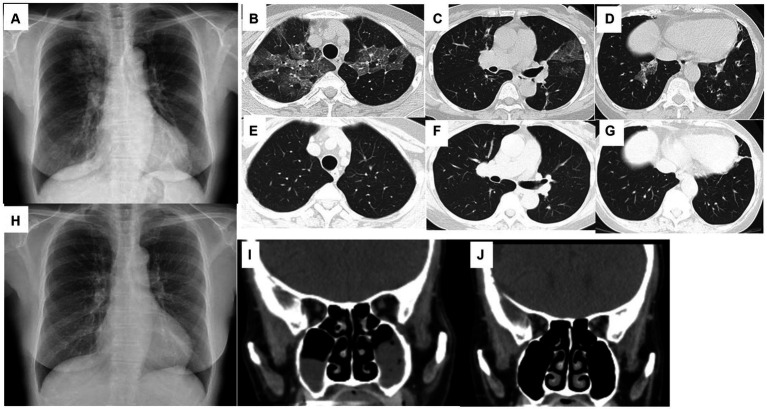
Systemic administration of corticosteroids is used in the treatment of chronic eosinophilic pneumonia (CEP). However, in patients with CEP as well as other comorbidities, the adverse effects of corticosteroids should be minimized as much as possible. A 71-year-old woman was presented with aggravating asthma with CEP and sinusitis, and she had uncompensated liver cirrhosis (LC) with a Child-Pugh score of 7. Initial treatment with a low dose of oral corticosteroids (OCSs) in combination with tezepelumab, an anti-thymic stromal lymphopoietin (TSLP) antibody, resulted in rapid improvement of asthma and CEP without deteriorating LC. Sinusitis also improved after ceasing OCS. This case suggested that tezepelumab may be useful as a treatment option for patients with CEP, especially those with liver dysfunction.
全身性给予皮质类固醇用于治疗慢性嗜酸性粒细胞性肺炎(CEP)。然而,在患有CEP以及其他合并症的患者中,应尽可能将皮质类固醇的不良反应降至最低。一名71岁女性因CEP和鼻窦炎导致哮喘加重,且患有失代偿性肝硬化(LC),Child-Pugh评分为7分。初始采用低剂量口服皮质类固醇(OCS)联合抗胸腺基质淋巴细胞生成素(TSLP)抗体tezepelumab进行治疗,结果哮喘和CEP迅速改善,且未使LC恶化。停用OCS后鼻窦炎也有所改善。该病例表明,tezepelumab可能是CEP患者,尤其是肝功能不全患者的一种有用治疗选择。