Fuentevilla-Álvarez Giovanny, Soto María Elena, Valdivia José Antonio García, Torres-Paz Yazmín Estela, Sámano Reyna, Perez-Torres Israel, Gamboa-Ávila Ricardo, Huesca-Gómez Claudia
The Department of Endocrinology, Instituto Nacional de Cardiologia Ignacio Chavez, Juan Badiano Numero 1 Col Seccion XVI, Mexico City 14080, Mexico.
Research Direction Instituto Nacional de Cardiologia Ignacio Chavez, Juan Badiano Numero 1 Col Seccion XVI, Mexico City 14080, Mexico.
Diagnostics (Basel). 2024 Jun 13;14(12):1241. doi: 10.3390/diagnostics14121241.
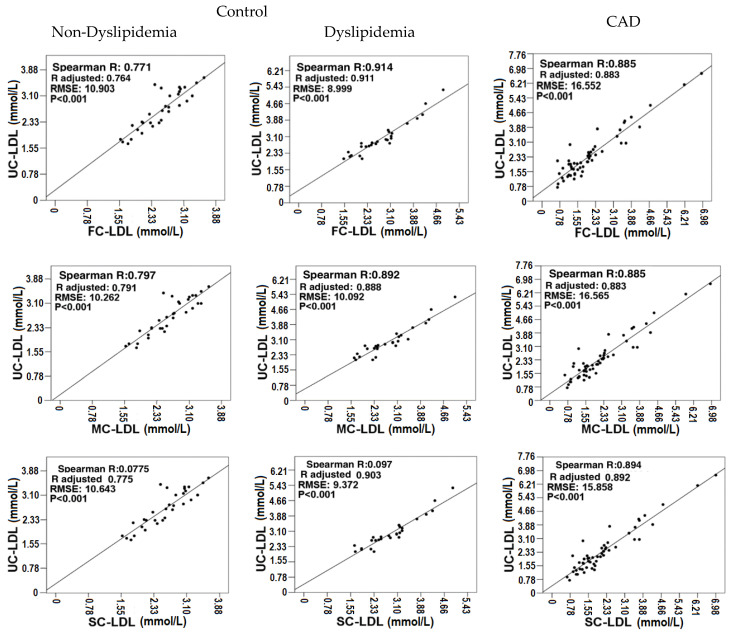
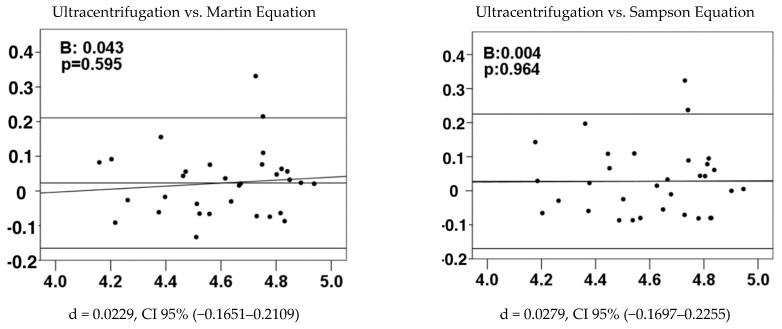
Low-density lipoprotein cholesterol (LDL-C), which makes up about 70% of the cholesterol in the blood, is critical in the formation of arteriosclerotic plaques, increasing the risk of heart disease. LDL-C levels are estimated using Friedewald, Martin and Sampson equations, though they have limitations with high triglycerides. Our aim is to compare the effectiveness of these equations versus the ultracentrifugation technique in individuals with and without dyslipidemia and identify precision. There were 113 participants, 59 healthy controls and 54 dyslipidemic patients. Samples were collected after fasting. LDL-C was estimated using the Friedewald, Martin and Sampson equations. The purified LDL-C, ultracentrifugated and dialysized control group without dyslipidemia vs. patients with coronary artery disease (CAD) showed differences in age, HDL-C, triglycerides and glucose non-HDL-C ( = 0.001 in all). There were correlations in CGWD between ultracentrifugation and Sampson R-squared (R) = 0.791. In the dyslipidemia control group, ultracentrifugation and Friedewald R = 0.911. In patients with CAD, correlation between ultracentrifugation and Sampson R = 0.892; Bland-Altman confirmed agreement in controls without dyslipidemia. The Martin and Sampson equations are interchangeable with ultracentrifugation. Conclusion: The role of LDL analysis using precise techniques is necessary to obtain better control of disease outcomes after the use of precise therapies and suggests verifying its importance through clinical trials.
低密度脂蛋白胆固醇(LDL-C)约占血液中胆固醇的70%,在动脉粥样硬化斑块形成中起关键作用,会增加心脏病风险。LDL-C水平通过Friedewald、Martin和Sampson方程估算,不过在高甘油三酯情况下这些方程存在局限性。我们的目的是比较这些方程与超速离心技术在血脂异常和非血脂异常个体中的有效性,并确定其精确性。共有113名参与者,59名健康对照者和54名血脂异常患者。空腹后采集样本。使用Friedewald、Martin和Sampson方程估算LDL-C。纯化的无血脂异常的LDL-C超速离心和透析对照组与冠心病(CAD)患者在年龄、高密度脂蛋白胆固醇(HDL-C)、甘油三酯和非高密度脂蛋白胆固醇血糖方面存在差异(均P = 0.001)。超速离心与Sampson的校正广义加权差异(CGWD)之间存在相关性,决定系数(R²)= 0.791。在血脂异常对照组中,超速离心与Friedewald的R = 0.911。在CAD患者中,超速离心与Sampson的R = 0.892;Bland-Altman分析证实无血脂异常对照组具有一致性。Martin和Sampson方程与超速离心可互换。结论:使用精确技术进行LDL分析对于在采用精确治疗后更好地控制疾病结局是必要的,并建议通过临床试验验证其重要性。