Department of Health Technology and Informatics, The Hong Kong Polytechnic University, Kowloon, Hong Kong Special Administrative Region, China.
Centre for Virology, Vaccinology and Therapeutics Limited, The University of Hong Kong, Hong Kong Special Administrative Region, China.
Viruses. 2024 Jun 18;16(6):981. doi: 10.3390/v16060981.
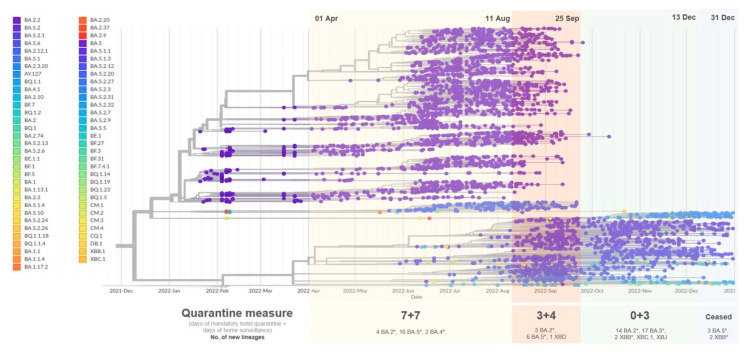
This study aimed to characterize the changing landscape of circulating SARS-CoV-2 lineages in the local community of Hong Kong throughout 2022. We examined how adjustments to quarantine arrangements influenced the transmission pattern of Omicron variants in a city with relatively rigorous social distancing measures at that time.
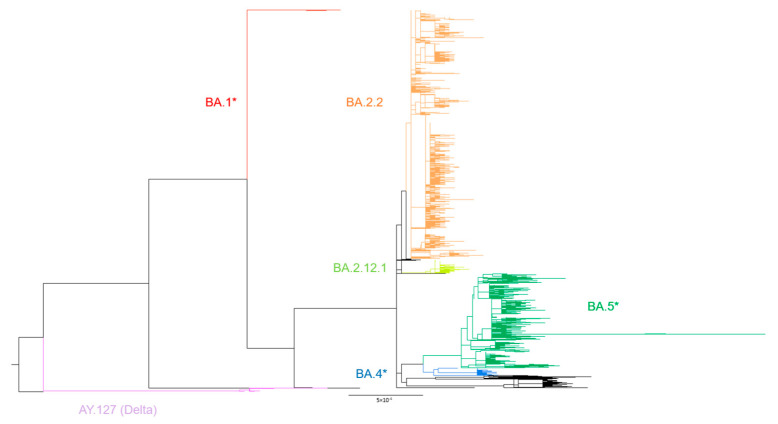
In 2022, a total of 4684 local SARS-CoV-2 genomes were sequenced using the Oxford Nanopore GridION sequencer. SARS-CoV-2 consensus genomes were generated by MAFFT, and the maximum likelihood phylogeny of these genomes was determined using IQ-TREE. The dynamic changes in lineages were depicted in a time tree created by Nextstrain. Statistical analysis was conducted to assess the correlation between changes in the number of lineages and adjustments to quarantine arrangements.
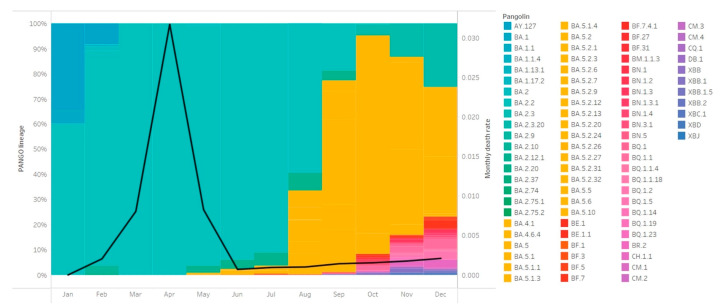
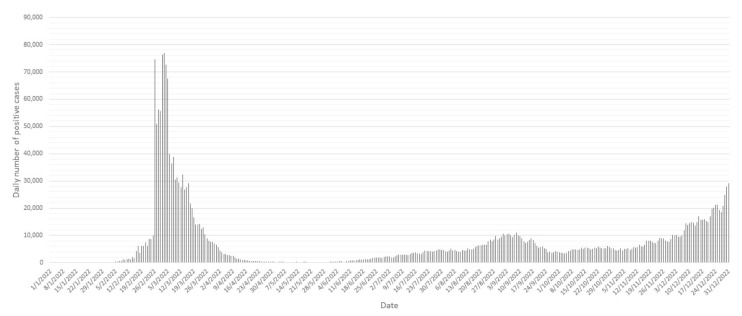
By the end of 2022, a total of 83 SARS-CoV-2 lineages were identified in the community. The increase in the number of new lineages was significantly associated with the relaxation of quarantine arrangements (One-way ANOVA, F(5, 47) = 18.233, < 0.001)). Over time, Omicron BA.5 sub-lineages replaced BA.2.2 and became the predominant Omicron variants in Hong Kong. The influx of new lineages reshaped the dynamics of Omicron variants in the community without fluctuating the death rate and hospitalization rate (One-way ANOVA, F(5, 47) = 2.037, = 0.091).
This study revealed that even with an extended mandatory quarantine period for incoming travelers, it may not be feasible to completely prevent the introduction and subsequent community spread of highly contagious Omicron variants. Ongoing molecular surveillance of COVID-19 remains essential to monitor the emergence of new recombinant variants.
本研究旨在描述 2022 年全年香港本地社区中循环的 SARS-CoV-2 谱系的变化情况。我们研究了在当时社交距离措施相对严格的城市中,隔离措施的调整如何影响奥密克戎变异株的传播模式。
2022 年,共使用 Oxford Nanopore GridION 测序仪对 4684 份本地 SARS-CoV-2 基因组进行测序。使用 MAFFT 生成 SARS-CoV-2 共识基因组,使用 IQ-TREE 确定这些基因组的最大似然系统发育。通过 Nextstrain 创建的时间树描绘谱系的动态变化。通过统计分析评估谱系数量变化与隔离措施调整之间的相关性。
截至 2022 年底,社区中共发现 83 种 SARS-CoV-2 谱系。新谱系数量的增加与隔离措施的放宽显著相关(单向方差分析,F(5, 47) = 18.233,<0.001)。随着时间的推移,奥密克戎 BA.5 亚谱系取代了 BA.2.2,成为香港主要的奥密克戎变异株。新谱系的涌入改变了社区中奥密克戎变异株的动态,而死亡率和住院率没有波动(单向方差分析,F(5, 47) = 2.037,= 0.091)。
本研究表明,即使对入境旅客实施延长的强制性隔离期,也可能无法完全阻止高传染性奥密克戎变异株的引入和随后在社区中的传播。对 COVID-19 的持续分子监测对于监测新重组变异株的出现仍然至关重要。