
一种内斯林谱系的减毒疫苗病毒可保护牛免受属于当前已确立的2.5簇的结节性皮肤病病毒的强毒重组疫苗样分离株的侵害。
An Attenuated Vaccine Virus of the Neethling Lineage Protects Cattle against the Virulent Recombinant Vaccine-like Isolate of the Lumpy Skin Disease Virus Belonging to the Currently Established Cluster 2.5.
作者信息
Shumilova Irina, Shalina Kseniya, Abed Alhussen Mohammad, Prutnikov Pavel, Krotova Alena, Byadovskaya Olga, Prokhvatilova Larisa, Chvala Ilya, Sprygin Alexander
机构信息
Federal Center for Animal Health, 600901 Vladimir, Russia.
出版信息
Vaccines (Basel). 2024 May 30;12(6):598. doi: 10.3390/vaccines12060598.
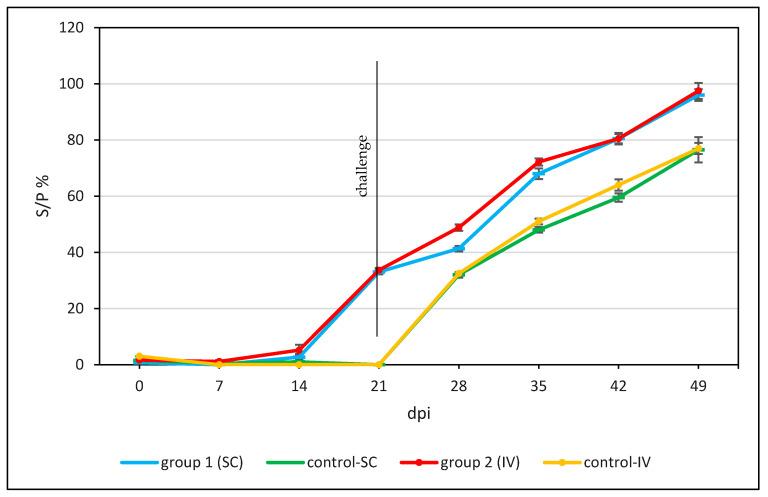
Lumpy skin disease (LSD) is an emerging transboundary and highly infectious viral disease mainly affecting cattle. The fact that it was initially confined to Africa and then spread beyond its geographical range to other regions, including the Middle East, Turkey, Europe, the Balkans, Russia and Asia, is an indication of the underestimation and neglect of this disease. Vaccination is considered the most effective way to control the spread of LSDV, when combined with other control measures. LSD is now on the rise in Southeast Asia, where the circulating virus belongs to recombinant lineage 2.5. In this study, we evaluated the efficacy of an attenuated LSDV strain belonging to the Neethling cluster 1.1 by challenge with a virulent recombinant vaccine-like LSDV isolate "Mongolia/2021" belonging to cluster 2.5. Some of the vaccinated animals showed an increase in body temperature of 1-1.5 °C above the physiological norm, without clinical signs, local reactions, vaccine-induced viremia or generalization, demonstrating the efficacy and safety of the vaccine strain against a recombinant strain. Furthermore, all the vaccinated animals showed strong immune responses, indicating a high level of immunogenicity. However, the control group challenged with "Mongolia/2021" LSD showed moderate to severe clinical signs seen in an outbreak, with high levels of virus shedding in blood samples and nasal swabs. Overall, the results of the present study demonstrate that the attenuated LSDV Neethling strain vaccine has a promising protective phenotype against the circulating strains, suggesting its potential as an effective tool for the containment and control of LSD in affected countries from Southeast Asia.
结节性皮肤病(LSD)是一种新出现的跨界且具有高度传染性的病毒性疾病,主要影响牛群。该病最初局限于非洲,随后传播到其地理范围之外的其他地区,包括中东、土耳其、欧洲、巴尔干半岛、俄罗斯和亚洲,这一事实表明对该疾病的低估和忽视。疫苗接种与其他控制措施相结合时,被认为是控制LSDV传播的最有效方法。LSD目前在东南亚呈上升趋势,该地区流行的病毒属于重组谱系2.5。在本研究中,我们通过用属于谱系2.5的强毒重组疫苗样LSDV分离株“蒙古/2021”进行攻毒,评估了属于Neethling簇1.1的减毒LSDV株的效力。一些接种疫苗的动物体温比生理正常体温升高了1-1.5℃,但没有临床症状、局部反应、疫苗诱导的病毒血症或全身性反应,证明了该疫苗株对重组株的效力和安全性。此外,所有接种疫苗的动物都表现出强烈的免疫反应,表明免疫原性水平很高。然而,用“蒙古/2021”LSD攻毒的对照组出现了疫情中所见的中度至重度临床症状,血液样本和鼻拭子中的病毒载量很高。总体而言,本研究结果表明,减毒LSDV Neethling株疫苗对流行株具有有前景的保护表型,表明其有潜力成为东南亚受影响国家控制和遏制LSD的有效工具。


 Zotero 插件