
细节决定成败:德国常用于栖息地适宜性建模的环境变量缺乏有关森林蝙蝠的信息。
The devil is in the detail: Environmental variables frequently used for habitat suitability modeling lack information for forest-dwelling bats in Germany.
作者信息
Bald Lisa, Gottwald Jannis, Hillen Jessica, Adorf Frank, Zeuss Dirk
机构信息
Department of Geography, Environmental Informatics Philipps-University Marburg Marburg Germany.
tRackIT Systems GmbH Cölbe Germany.
出版信息
Ecol Evol. 2024 Jun 26;14(6):e11571. doi: 10.1002/ece3.11571. eCollection 2024 Jun.
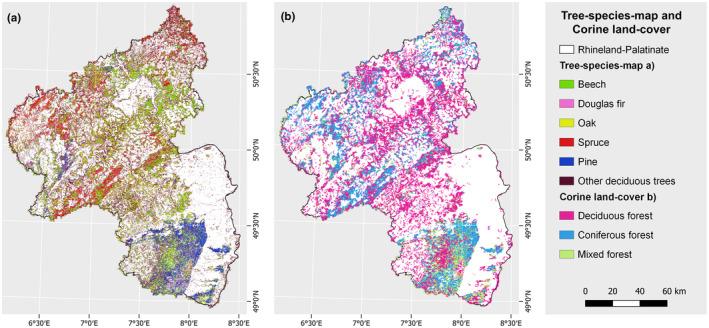
In response to the pressing challenges of the ongoing biodiversity crisis, the protection of endangered species and their habitats, as well as the monitoring of invasive species are crucial. Habitat suitability modeling (HSM) is often treated as the silver bullet to address these challenges, commonly relying on generic variables sourced from widely available datasets. However, for species with high habitat requirements, or for modeling the suitability of habitats within the geographic range of a species, variables at a coarse level of detail may fall short. Consequently, there is potential value in considering the incorporation of more targeted data, which may extend beyond readily available land cover and climate datasets. In this study, we investigate the impact of incorporating targeted land cover variables (specifically tree species composition) and vertical structure information (derived from LiDAR data) on HSM outcomes for three forest specialist bat species (, , and ) in Rhineland-Palatinate, Germany, compared to commonly utilized environmental variables, such as generic land-cover classifications (e.g., Corine Land Cover) and climate variables (e.g., Bioclim). The integration of targeted variables enhanced the performance of habitat suitability models for all three bat species. Furthermore, our results showed a high difference in the distribution maps that resulted from using different levels of detail in environmental variables. This underscores the importance of making the effort to generate the appropriate variables, rather than simply relying on commonly used ones, and the necessity of exercising caution when using habitat models as a tool to inform conservation strategies and spatial planning efforts.
为应对当前生物多样性危机带来的紧迫挑战,保护濒危物种及其栖息地以及监测入侵物种至关重要。栖息地适宜性建模(HSM)通常被视为应对这些挑战的万灵药,通常依赖于从广泛可用的数据集中获取的通用变量。然而,对于栖息地要求较高的物种,或者对于在物种地理范围内对栖息地适宜性进行建模时,细节程度粗糙的变量可能不够用。因此,考虑纳入更具针对性的数据可能具有潜在价值,这些数据可能超出了现有的土地覆盖和气候数据集。在本研究中,我们调查了纳入针对性土地覆盖变量(特别是树种组成)和垂直结构信息(源自激光雷达数据)对德国莱茵兰 - 普法尔茨州三种森林特化蝙蝠物种(、和)的栖息地适宜性建模结果的影响,并与常用的环境变量进行比较,如通用土地覆盖分类(如欧洲环境观测网络土地覆盖)和气候变量(如生物气候变量)。纳入针对性变量提高了所有三种蝙蝠物种的栖息地适宜性模型的性能。此外,我们的结果表明,使用不同细节程度的环境变量所产生的分布图存在很大差异。这凸显了努力生成适当变量而非仅仅依赖常用变量的重要性,以及在将栖息地模型用作指导保护策略和空间规划工作的工具时谨慎行事的必要性。




 Zotero 插件